

Photosynthesis, Storage, and Allocation
I en
en
E
z
,...,
I en
en
E
'-'
u
z
I+ Nitrogen
+Light
80 LL
(B\
60 _, HL
® ~ \81
40 l~ #:.LL ~. ~N
;r /'" HL ~ LN
20
LN~
o L-~ __ - L _ _ ~-J _ _ -L~
0.0 0.1 0.2 0.0 0.1 0.2 0.3
N-pool (g)
400
@
300 HL
LN
LN
200
100
0
0.0 0.5 1.0 0.0 0.5 1.0 1.5
TNC-pool (g)
143
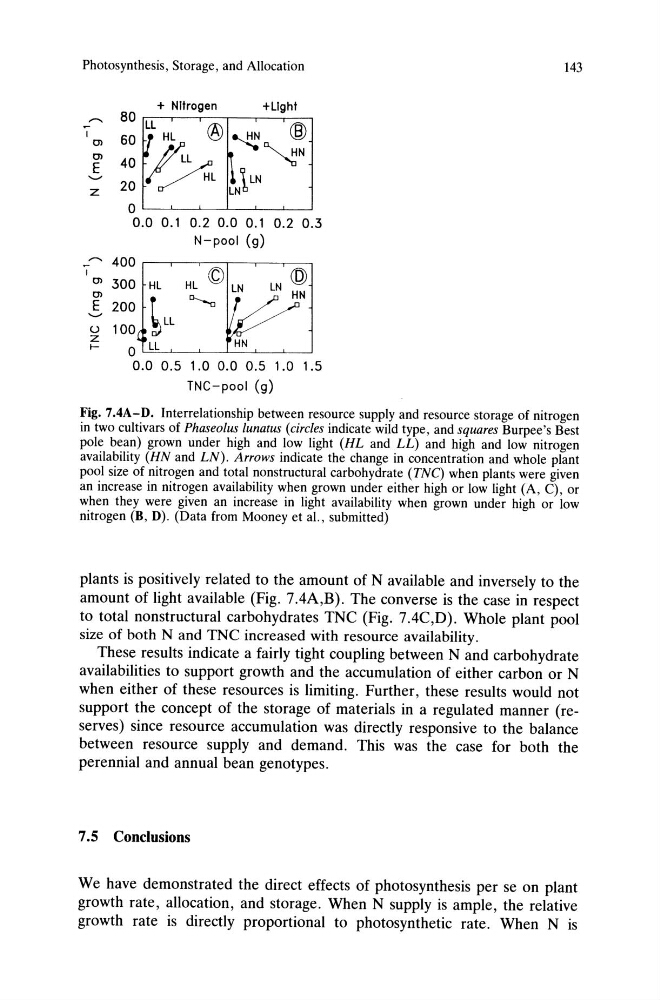
Fig.7.4A-D. Interrelationship between resource supply and resource storage of nitrogen
in two cultivars of Phaseolus lunatus (circles indicate wild type, and squares Burpee's Best
pole bean) grown under high and low light (HL and LL) and high and low nitrogen
availability (HN and LN). Arrows indicate the change in concentration and whole plant
pool size of nitrogen and total nonstructural carbohydrate (TNC) when plants were given
an increase in nitrogen availability when grown under either high or low light (A, C), or
when they were given an increase in light availability when grown under high or low
nitrogen (B, D). (Data from Mooney et aI., submitted)
plants is positively related to the amount of N available and inversely to the
amount of light available (Fig. 7.4A,B). The converse is the case in respect
to total nonstructural carbohydrates TNC (Fig. 7.4C,D). Whole plant pool
size of both Nand TNC increased with resource availability.
These results indicate a fairly tight coupling between N and carbohydrate
availabilities to support growth and the accumulation of either carbon or N
when either of these resources is limiting. Further, these results would not
support the concept of the storage of materials in a regulated manner (reserves) since resource accumulation was directly responsive to the balance
between resource supply and demand. This was the case for both the
perennial and annual bean genotypes.
7.5 Conclusions
We have demonstrated the direct effects of photosynthesis per se on plant
growth rate, allocation, and storage. When N supply is ample, the relative
growth rate is directly proportional to photosynthetic rate. When N is
I en
en
E
z
,...,
I en
en
E
'-'
u
z
I+ Nitrogen
+Light
80 LL
(B\
60 _, HL
® ~ \81
40 l~ #:.LL ~. ~N
;r /'" HL ~ LN
20
LN~
o L-~ __ - L _ _ ~-J _ _ -L~
0.0 0.1 0.2 0.0 0.1 0.2 0.3
N-pool (g)
400
@
300 HL
LN
LN
200
100
0
0.0 0.5 1.0 0.0 0.5 1.0 1.5
TNC-pool (g)
143
Fig.7.4A-D. Interrelationship between resource supply and resource storage of nitrogen
in two cultivars of Phaseolus lunatus (circles indicate wild type, and squares Burpee's Best
pole bean) grown under high and low light (HL and LL) and high and low nitrogen
availability (HN and LN). Arrows indicate the change in concentration and whole plant
pool size of nitrogen and total nonstructural carbohydrate (TNC) when plants were given
an increase in nitrogen availability when grown under either high or low light (A, C), or
when they were given an increase in light availability when grown under high or low
nitrogen (B, D). (Data from Mooney et aI., submitted)
plants is positively related to the amount of N available and inversely to the
amount of light available (Fig. 7.4A,B). The converse is the case in respect
to total nonstructural carbohydrates TNC (Fig. 7.4C,D). Whole plant pool
size of both Nand TNC increased with resource availability.
These results indicate a fairly tight coupling between N and carbohydrate
availabilities to support growth and the accumulation of either carbon or N
when either of these resources is limiting. Further, these results would not
support the concept of the storage of materials in a regulated manner (reserves) since resource accumulation was directly responsive to the balance
between resource supply and demand. This was the case for both the
perennial and annual bean genotypes.
7.5 Conclusions
We have demonstrated the direct effects of photosynthesis per se on plant
growth rate, allocation, and storage. When N supply is ample, the relative
growth rate is directly proportional to photosynthetic rate. When N is