

136
Nicotiana tabacum
500r----.----.----.----.----.--~
400
..c I
300
e C)
.E C) 200
(/) E
100
A
8
O~~~~--~~~~~~
420
c --- 400
.8 I C) 380
L.
a
u
C) 360
E 340
........
320
c
K. Fichtner et al.
100
80
60
40
20
o
60
40
20
Cl)
I
"0 C)
L.
......
C)
z E
........
c
Cl)
I
C)
C)
o
L.
...... 0>
E
z
~--~----~----~--~----~----~o
o
5
10
0
5
10
15
-2 -1
Photosynthesis (j.tmol m
s )
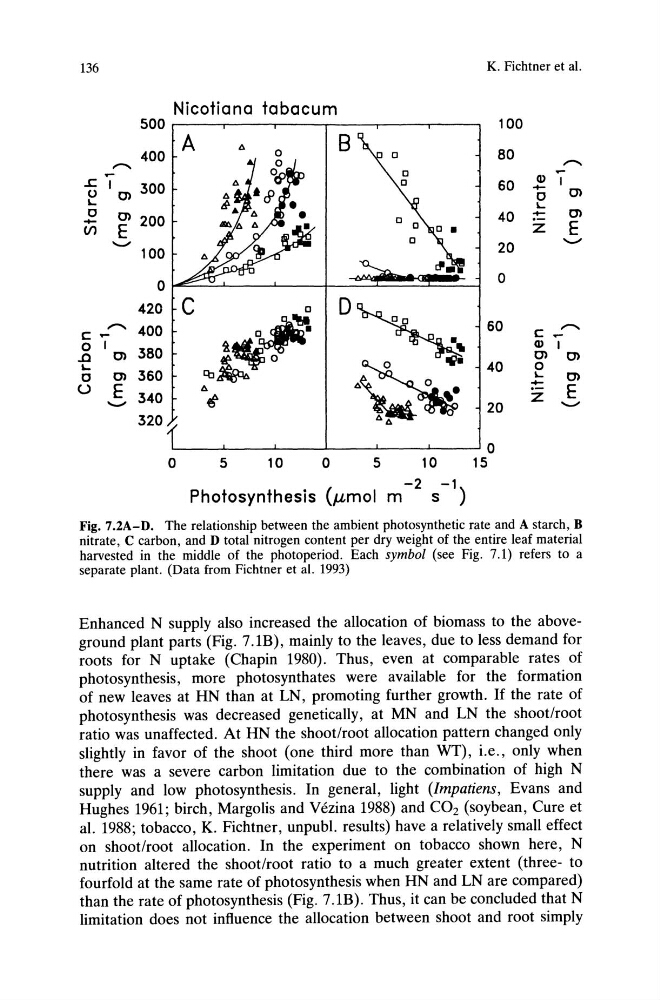
Fig. 7.2A-D. The relationship between the ambient photosynthetic rate and A starch, B
nitrate, C carbon, and D total nitrogen content per dry weight of the entire leaf material
harvested in the middle of the photoperiod. Each symbol (see Fig. 7.1) refers to a
separate plant. (Data from Fichtner et al. 1993)
Enhanced N supply also increased the allocation of biomass to the aboveground plant parts (Fig. 7.1B), mainly to the leaves, due to less demand for
roots for N uptake (Chapin 1980). Thus, even at comparable rates of
photosynthesis, more photosynthates were available for the formation
of new leaves at HN than at LN, promoting further growth. If the rate of
photosynthesis was decreased genetically, at MN and LN the shoot/root
ratio was unaffected. At HN the shoot/root allocation pattern changed only
slightly in favor of the shoot (one third more than WT), i.e., only when
there was a severe carbon limitation due to the combination of high N
supply and low photosynthesis. In general, light (Impatiens, Evans and
Hughes 1961; birch, Margolis and Vezina 1988) and CO2 (soybean, Cure et
al. 1988; tobacco, K. Fichtner, unpubl. results) have a relatively small effect
on shoot/root allocation. In the experiment on tobacco shown here, N
nutrition altered the shoot/root ratio to a much greater extent (three- to
fourfold at the same rate of photosynthesis when HN and LN are compared)
than the rate of photosynthesis (Fig. 7.1B). Thus, it can be concluded that N
limitation does not influence the allocation between shoot and root simply
Nicotiana tabacum
500r----.----.----.----.----.--~
400
..c I
300
e C)
.E C) 200
(/) E
100
A
8
O~~~~--~~~~~~
420
c --- 400
.8 I C) 380
L.
a
u
C) 360
E 340
........
320
c
K. Fichtner et al.
100
80
60
40
20
o
60
40
20
Cl)
I
"0 C)
L.
......
C)
z E
........
c
Cl)
I
C)
C)
o
L.
...... 0>
E
z
~--~----~----~--~----~----~o
o
5
10
0
5
10
15
-2 -1
Photosynthesis (j.tmol m
s )
Fig. 7.2A-D. The relationship between the ambient photosynthetic rate and A starch, B
nitrate, C carbon, and D total nitrogen content per dry weight of the entire leaf material
harvested in the middle of the photoperiod. Each symbol (see Fig. 7.1) refers to a
separate plant. (Data from Fichtner et al. 1993)
Enhanced N supply also increased the allocation of biomass to the aboveground plant parts (Fig. 7.1B), mainly to the leaves, due to less demand for
roots for N uptake (Chapin 1980). Thus, even at comparable rates of
photosynthesis, more photosynthates were available for the formation
of new leaves at HN than at LN, promoting further growth. If the rate of
photosynthesis was decreased genetically, at MN and LN the shoot/root
ratio was unaffected. At HN the shoot/root allocation pattern changed only
slightly in favor of the shoot (one third more than WT), i.e., only when
there was a severe carbon limitation due to the combination of high N
supply and low photosynthesis. In general, light (Impatiens, Evans and
Hughes 1961; birch, Margolis and Vezina 1988) and CO2 (soybean, Cure et
al. 1988; tobacco, K. Fichtner, unpubl. results) have a relatively small effect
on shoot/root allocation. In the experiment on tobacco shown here, N
nutrition altered the shoot/root ratio to a much greater extent (three- to
fourfold at the same rate of photosynthesis when HN and LN are compared)
than the rate of photosynthesis (Fig. 7.1B). Thus, it can be concluded that N
limitation does not influence the allocation between shoot and root simply