

Contents
XV
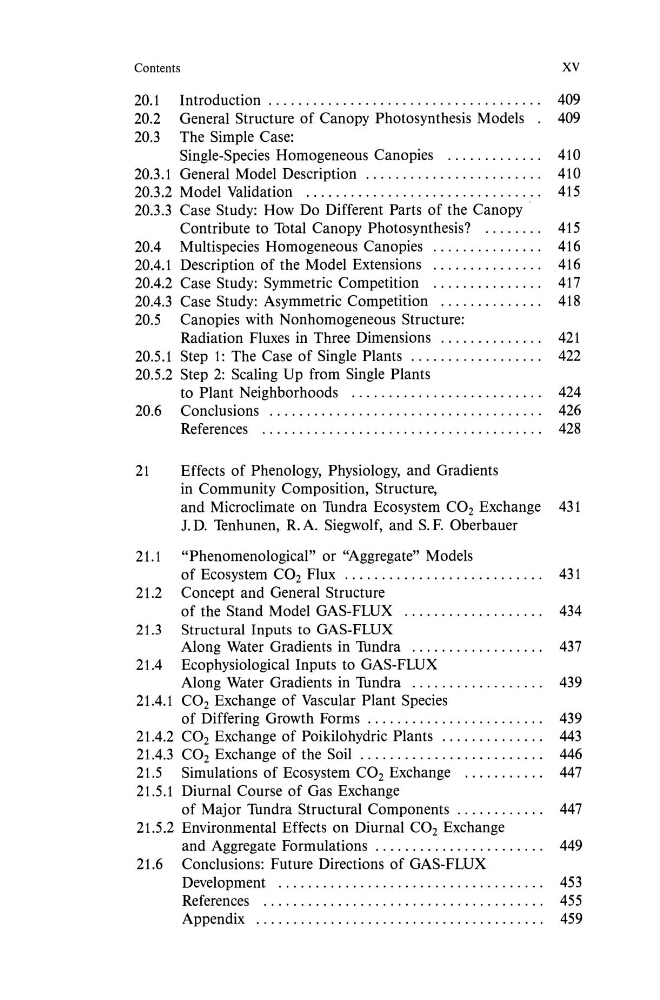
20.1 Introduction. . . . . . . . . . . . . . . . . . . . . . . . . . . . . . . . . . . .. 409
20.2 General Structure of Canopy Photosynthesis Models . 409
20.3 The Simple Case:
Single-Species Homogeneous Canopies ............. 410
20.3.1 General Model Description ........................ 410
20.3.2 Model Validation ................................ 415
20.3.3 Case Study: How Do Different Parts of the Canopy·
Contribute to Total Canopy Photosynthesis? ........ 415
20.4 Muitispecies Homogeneous Canopies ............... 416
20.4.1 Description of the Model Extensions ............... 416
20.4.2 Case Study: Symmetric Competition ............... 417
20.4.3 Case Study: Asymmetric Competition .............. 418
20.5 Canopies with Nonhomogeneous Structure:
Radiation Fluxes in Three Dimensions .............. 421
20.5.1 Step 1: The Case of Single Plants .................. 422
20.5.2 Step 2: Scaling Up from Single Plants
to Plant Neighborhoods .......................... 424
20.6 Conclusions....... . . . . . . . . . . . . . . . . . . . . . . . . . . . . .. 426
References ...................................... 428
21
Effects of Phenology, Physiology, and Gradients
in Community Composition, Structure,
and Microclimate on Tundra Ecosystem CO 2 Exchange 431
J. D. Tenhunen, R. A. Siegwolf, and S. F. Oberbauer
21.1 "Phenomenological" or "Aggregate" Models
of Ecosystem CO 2 Flux ........................... 431
21.2 Concept and General Structure
of the Stand Model GAS-FLUX ................... 434
21.3 Structural Inputs to GAS-FLUX
Along Water Gradients in Tundra .................. 437
21.4 Ecophysiological Inputs to GAS-FLUX
Along Water Gradients in Tundra .................. 439
21.4.1 CO 2 Exchange of Vascular Plant Species
of Differing Growth Forms ........................ 439
21.4.2 CO 2 Exchange of Poikilohydric Plants .............. 443
21.4.3 CO 2 Exchange of the Soil ......................... 446
21.5 Simulations of Ecosystem CO 2 Exchange ........... 447
21.5.1 Diurnal Course of Gas Exchange
of Major Tundra Structural Components. . . . . . . . . . .. 447
21.5.2 Environmental Effects on Diurnal CO 2 Exchange
and Aggregate Formulations ....................... 449
21.6 Conclusions: Future Directions of GAS-FLUX
Development .................................... 453
References ...................................... 455
Appendix ....................................... 459
XV
20.1 Introduction. . . . . . . . . . . . . . . . . . . . . . . . . . . . . . . . . . . .. 409
20.2 General Structure of Canopy Photosynthesis Models . 409
20.3 The Simple Case:
Single-Species Homogeneous Canopies ............. 410
20.3.1 General Model Description ........................ 410
20.3.2 Model Validation ................................ 415
20.3.3 Case Study: How Do Different Parts of the Canopy·
Contribute to Total Canopy Photosynthesis? ........ 415
20.4 Muitispecies Homogeneous Canopies ............... 416
20.4.1 Description of the Model Extensions ............... 416
20.4.2 Case Study: Symmetric Competition ............... 417
20.4.3 Case Study: Asymmetric Competition .............. 418
20.5 Canopies with Nonhomogeneous Structure:
Radiation Fluxes in Three Dimensions .............. 421
20.5.1 Step 1: The Case of Single Plants .................. 422
20.5.2 Step 2: Scaling Up from Single Plants
to Plant Neighborhoods .......................... 424
20.6 Conclusions....... . . . . . . . . . . . . . . . . . . . . . . . . . . . . .. 426
References ...................................... 428
21
Effects of Phenology, Physiology, and Gradients
in Community Composition, Structure,
and Microclimate on Tundra Ecosystem CO 2 Exchange 431
J. D. Tenhunen, R. A. Siegwolf, and S. F. Oberbauer
21.1 "Phenomenological" or "Aggregate" Models
of Ecosystem CO 2 Flux ........................... 431
21.2 Concept and General Structure
of the Stand Model GAS-FLUX ................... 434
21.3 Structural Inputs to GAS-FLUX
Along Water Gradients in Tundra .................. 437
21.4 Ecophysiological Inputs to GAS-FLUX
Along Water Gradients in Tundra .................. 439
21.4.1 CO 2 Exchange of Vascular Plant Species
of Differing Growth Forms ........................ 439
21.4.2 CO 2 Exchange of Poikilohydric Plants .............. 443
21.4.3 CO 2 Exchange of the Soil ......................... 446
21.5 Simulations of Ecosystem CO 2 Exchange ........... 447
21.5.1 Diurnal Course of Gas Exchange
of Major Tundra Structural Components. . . . . . . . . . .. 447
21.5.2 Environmental Effects on Diurnal CO 2 Exchange
and Aggregate Formulations ....................... 449
21.6 Conclusions: Future Directions of GAS-FLUX
Development .................................... 453
References ...................................... 455
Appendix ....................................... 459