

124
W. Schulze and E.-D. Schulze
6.2 The Metabolic Pathway of Assimilatory Starch Formation
and the Use of Mutants to Circumvent Chloroplast Starch Formation
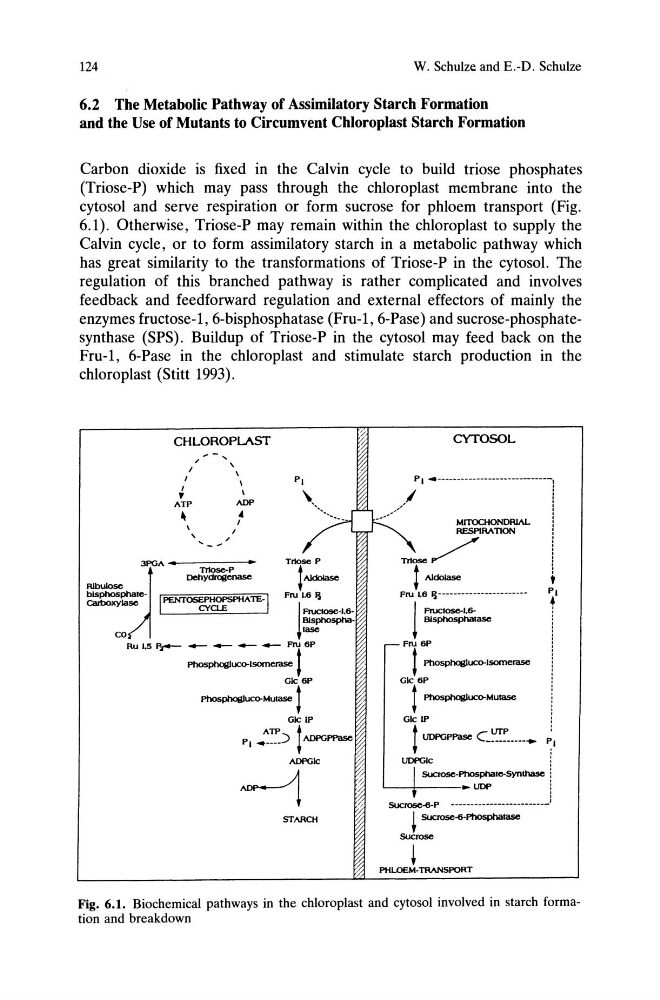
Carbon dioxide is fixed in the Calvin cycle to build triose phosphates
(Triose-P) which may pass through the chloroplast membrane into the
cytosol and serve respiration or form sucrose for phloem transport (Fig.
6.1). Otherwise, Triose-P may remain within the chloroplast to supply the
Calvin cycle, or to form assimilatory starch in a metabolic pathway which
has great similarity to the transformations of Triose-P in the cytosol. The
regulation of this branched pathway is rather complicated and involves
feedback and feedforward regulation and external effectors of mainly the
enzymes fructose-I, 6-bisphosphatase (Fru-l, 6-Pase) and sucrose-phosphatesynthase (SPS). Buildup of Triose-P in the cytosol may feed back on the
Fru-l, 6-Pase in the chloroplast and stimulate starch production in the
chloroplast (Stitt 1993).
C~~~~~~LAST
~
CYTOSOL
+,,_,J ·~~r<'·---=---l
3PGA ..
~ Triose P ~ TrIose /
I
=\!"'~~ I""::::rel J:- - ,rult7-~----------------- ~ . . . I
CYCU::
BlsphosphaBlsphosphalase
co
lase
Ru 1.5 P.,.- _ _ _ _ Flu 6P
r - Fru 6P
PhosphoSluco-lsomerase l
l PIlosphoglUCO-lsomerase
Glc 6P
Glc 6P
PhosphoSluCO-Mulase 1
! PhosphoSlUCO-MUIaSe
Glc IP
Glc 1P
PI .~~~ ! ADPGPI'aSe
t UOPGPPase c~~ _____ ... PI
ADPGlc
f{
UDPGlc
I
~ ~ ~l:~:~~::~=:J
STARCH
/
+ ~rose-6-Phosphalase
SUcrose
Fig. 6.1. Biochemical pathways in the chloroplast and cytosol involved in starch formation and breakdown
W. Schulze and E.-D. Schulze
6.2 The Metabolic Pathway of Assimilatory Starch Formation
and the Use of Mutants to Circumvent Chloroplast Starch Formation
Carbon dioxide is fixed in the Calvin cycle to build triose phosphates
(Triose-P) which may pass through the chloroplast membrane into the
cytosol and serve respiration or form sucrose for phloem transport (Fig.
6.1). Otherwise, Triose-P may remain within the chloroplast to supply the
Calvin cycle, or to form assimilatory starch in a metabolic pathway which
has great similarity to the transformations of Triose-P in the cytosol. The
regulation of this branched pathway is rather complicated and involves
feedback and feedforward regulation and external effectors of mainly the
enzymes fructose-I, 6-bisphosphatase (Fru-l, 6-Pase) and sucrose-phosphatesynthase (SPS). Buildup of Triose-P in the cytosol may feed back on the
Fru-l, 6-Pase in the chloroplast and stimulate starch production in the
chloroplast (Stitt 1993).
C~~~~~~LAST
~
CYTOSOL
+,,_,J ·~~r<'·---=---l
3PGA ..
~ Triose P ~ TrIose /
I
=\!"'~~ I""::::rel J:- - ,rult7-~----------------- ~ . . . I
CYCU::
BlsphosphaBlsphosphalase
co
lase
Ru 1.5 P.,.- _ _ _ _ Flu 6P
r - Fru 6P
PhosphoSluco-lsomerase l
l PIlosphoglUCO-lsomerase
Glc 6P
Glc 6P
PhosphoSluCO-Mulase 1
! PhosphoSlUCO-MUIaSe
Glc IP
Glc 1P
PI .~~~ ! ADPGPI'aSe
t UOPGPPase c~~ _____ ... PI
ADPGlc
f{
UDPGlc
I
~ ~ ~l:~:~~::~=:J
STARCH
/
+ ~rose-6-Phosphalase
SUcrose
Fig. 6.1. Biochemical pathways in the chloroplast and cytosol involved in starch formation and breakdown