

Apoplastic & Symplastic Proton Concentrations & Their Significance for Metabolism 117
40
:r
Buxus
:2
U 30
Cl
E
-
S
'l5 20
E
.3.
II>
·iii
~
E 10
>.
:3
"5
.r:.
co
0
1
2
3
4
5
6
7
8
9 10
Na2S03 added to the solution
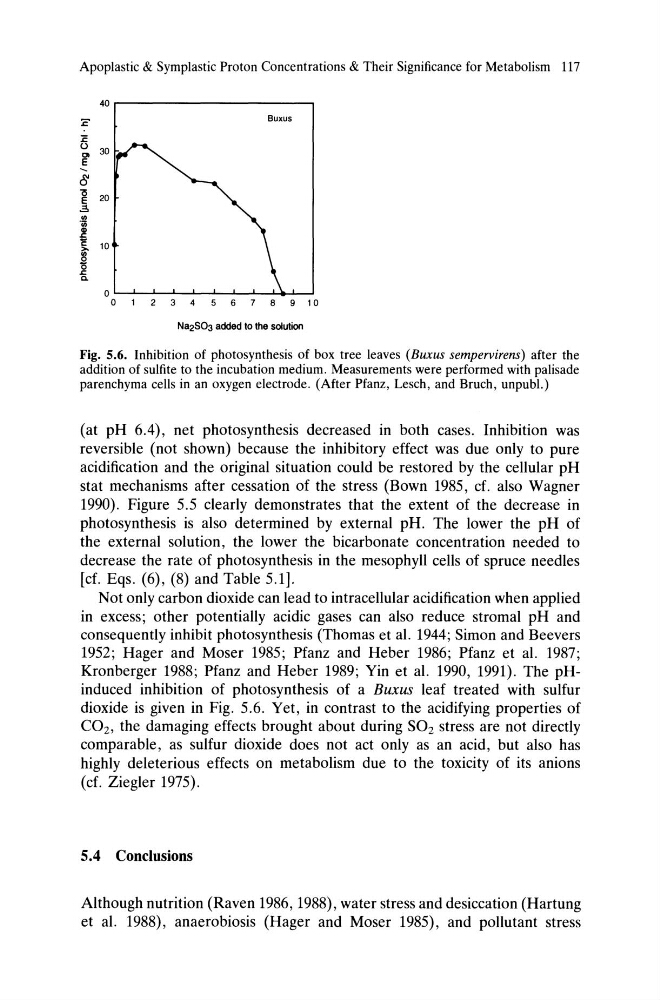
Fig. 5.6. Inhibition of photosynthesis of box tree leaves (Buxus sempervirens) after the
addition of sulfite to the incubation medium. Measurements were performed with palisade
parenchyma cells in an oxygen electrode. (After Pfanz, Lesch, and Bruch, unpubl.)
(at pH 6.4), net photosynthesis decreased in both cases. Inhibition was
reversible (not shown) because the inhibitory effect was due only to pure
acidification and the original situation could be restored by the cellular pH
stat mechanisms after cessation of the stress (Bown 1985, cf. also Wagner
1990). Figure 5.5 clearly demonstrates that the extent of the decrease in
photosynthesis is also determined by external pH. The lower the pH of
the external solution, the lower the bicarbonate concentration needed to
decrease the rate of photosynthesis in the mesophyll cells of spruce needles
[cf. Eqs. (6), (8) and Table 5.1].
Not only carbon dioxide can lead to intracellular acidification when applied
in excess; other potentially acidic gases can also reduce stromal pH and
consequently inhibit photosynthesis (Thomas et al. 1944; Simon and Beevers
1952; Hager and Moser 1985; Pfanz and Heber 1986; Pfanz et al. 1987;
Kronberger 1988; Pfanz and Heber 1989; Yin et al. 1990, 1991). The pHinduced inhibition of photosynthesis of a Buxus leaf treated with sulfur
dioxide is given in Fig. 5.6. Yet, in contrast to the acidifying properties of
COz, the damaging effects brought about during SOz stress are not directly
comparable, as sulfur dioxide does not act only as an acid, but also has
highly deleterious effects on metabolism due to the toxicity of its anions
(cf. Ziegler 1975).
5.4 Conclusions
Although nutrition (Raven 1986, 1988), water stress and desiccation (Hartung
et al. 1988), anaerobiosis (Hager and Moser 1985), and pollutant stress
40
:r
Buxus
:2
U 30
Cl
E
-
S
'l5 20
E
.3.
II>
·iii
~
E 10
>.
:3
"5
.r:.
co
0
1
2
3
4
5
6
7
8
9 10
Na2S03 added to the solution
Fig. 5.6. Inhibition of photosynthesis of box tree leaves (Buxus sempervirens) after the
addition of sulfite to the incubation medium. Measurements were performed with palisade
parenchyma cells in an oxygen electrode. (After Pfanz, Lesch, and Bruch, unpubl.)
(at pH 6.4), net photosynthesis decreased in both cases. Inhibition was
reversible (not shown) because the inhibitory effect was due only to pure
acidification and the original situation could be restored by the cellular pH
stat mechanisms after cessation of the stress (Bown 1985, cf. also Wagner
1990). Figure 5.5 clearly demonstrates that the extent of the decrease in
photosynthesis is also determined by external pH. The lower the pH of
the external solution, the lower the bicarbonate concentration needed to
decrease the rate of photosynthesis in the mesophyll cells of spruce needles
[cf. Eqs. (6), (8) and Table 5.1].
Not only carbon dioxide can lead to intracellular acidification when applied
in excess; other potentially acidic gases can also reduce stromal pH and
consequently inhibit photosynthesis (Thomas et al. 1944; Simon and Beevers
1952; Hager and Moser 1985; Pfanz and Heber 1986; Pfanz et al. 1987;
Kronberger 1988; Pfanz and Heber 1989; Yin et al. 1990, 1991). The pHinduced inhibition of photosynthesis of a Buxus leaf treated with sulfur
dioxide is given in Fig. 5.6. Yet, in contrast to the acidifying properties of
COz, the damaging effects brought about during SOz stress are not directly
comparable, as sulfur dioxide does not act only as an acid, but also has
highly deleterious effects on metabolism due to the toxicity of its anions
(cf. Ziegler 1975).
5.4 Conclusions
Although nutrition (Raven 1986, 1988), water stress and desiccation (Hartung
et al. 1988), anaerobiosis (Hager and Moser 1985), and pollutant stress