

82
J.S. Amthor
2 Glycine
cytosOl
mitochondrion
2 Glycine
Malate
:tNAO+-j
NH3
CO 2
NAOH
OAA
Serine
t
OAA
HYdrOXy~Uva~:OH -..... t
t-- NAO+ ~
Glycerate
Malate
peroxisome
Glycerate
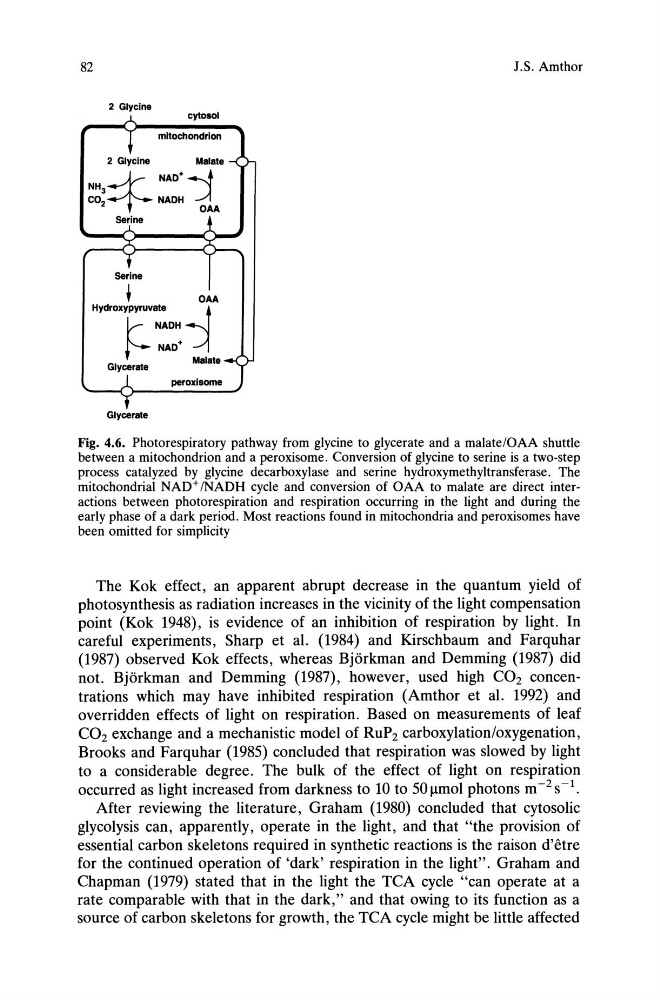
Fig. 4.6. Photorespiratory pathway from glycine to glycerate and a malate/OAA shuttle
between a mitochondrion and a peroxisome. Conversion of glycine to serine is a two·step
process catalyzed by glycine decarboxylase and serine hydroxymethyitransferase. The
mitochondrial NAD+ INADH cycle and conversion of OAA to malate are direct interactions between photorespiration and respiration occurring in the light and during the
early phase of a dark period. Most reactions found in mitochondria and peroxisomes have
been omitted for simplicity
The Kok effect, an apparent abrupt decrease in the quantum yield of
photosynthesis as radiation increases in the vicinity of the light compensation
point (Kok 1948), is evidence of an inhibition of respiration by light. In
careful experiments, Sharp et al. (1984) and Kirschbaum and Farquhar
(1987) observed Kok effects, whereas Bjorkman and Demming (1987) did
not. Bjorkman and Demming (1987), however, used high CO2 concentrations which may have inhibited respiration (Amthor et al. 1992) and
overridden effects of light on respiration. Based on measurements of leaf
CO 2 exchange and a mechanistic model of RUP2 carboxylation/oxygenation,
Brooks and Farquhar (1985) concluded that respiration was slowed by light
to a considerable degree. The bulk of the effect of light on respiration
occurred as light increased from darkness to 10 to 50 Ilmol photons m -2 s -1.
After reviewing the literature, Graham (1980) concluded that cytosolic
glycolysis can, apparently, operate in the light, and that "the provision of
essential carbon skeletons required in synthetic reactions is the raison d'etre
for the continued operation of 'dark' respiration in the light". Graham and
Chapman (1979) stated that in the light the TCA cycle "can operate at a
rate comparable with that in the dark," and that owing to its function as a
source of carbon skeletons for growth, the TCA cycle might be little affected
J.S. Amthor
2 Glycine
cytosOl
mitochondrion
2 Glycine
Malate
:tNAO+-j
NH3
CO 2
NAOH
OAA
Serine
t
OAA
HYdrOXy~Uva~:OH -..... t
t-- NAO+ ~
Glycerate
Malate
peroxisome
Glycerate
Fig. 4.6. Photorespiratory pathway from glycine to glycerate and a malate/OAA shuttle
between a mitochondrion and a peroxisome. Conversion of glycine to serine is a two·step
process catalyzed by glycine decarboxylase and serine hydroxymethyitransferase. The
mitochondrial NAD+ INADH cycle and conversion of OAA to malate are direct interactions between photorespiration and respiration occurring in the light and during the
early phase of a dark period. Most reactions found in mitochondria and peroxisomes have
been omitted for simplicity
The Kok effect, an apparent abrupt decrease in the quantum yield of
photosynthesis as radiation increases in the vicinity of the light compensation
point (Kok 1948), is evidence of an inhibition of respiration by light. In
careful experiments, Sharp et al. (1984) and Kirschbaum and Farquhar
(1987) observed Kok effects, whereas Bjorkman and Demming (1987) did
not. Bjorkman and Demming (1987), however, used high CO2 concentrations which may have inhibited respiration (Amthor et al. 1992) and
overridden effects of light on respiration. Based on measurements of leaf
CO 2 exchange and a mechanistic model of RUP2 carboxylation/oxygenation,
Brooks and Farquhar (1985) concluded that respiration was slowed by light
to a considerable degree. The bulk of the effect of light on respiration
occurred as light increased from darkness to 10 to 50 Ilmol photons m -2 s -1.
After reviewing the literature, Graham (1980) concluded that cytosolic
glycolysis can, apparently, operate in the light, and that "the provision of
essential carbon skeletons required in synthetic reactions is the raison d'etre
for the continued operation of 'dark' respiration in the light". Graham and
Chapman (1979) stated that in the light the TCA cycle "can operate at a
rate comparable with that in the dark," and that owing to its function as a
source of carbon skeletons for growth, the TCA cycle might be little affected