

80
J.S. Amthor
4.3 Respiration in Photosynthesizing Leaves
Respiration, photosynthesis, and photorespiration occur simultaneously in
photosynthesizing cells. The most immediate spatial and temporal interactions between respiration and photosynthesis therefore occur in photosynthesizing cells where respiration and photo respiration are concurrently
releasing CO2 in mitochondria; chloroplast metabolism as well as respiration
can be contributing A TP and reductant to the cytosol; and carbon skeletons
are produced in respiration, photosynthesis, and photorespiration.
In leaves subject to moderate to high light and normal temperature and
CO2 concentration, photosynthetic CO2 assimilation may proceed 10 to
20 times faster than CO2 release in respiration in the dark at the same
temperature. Nonetheless, the extent of respiration in leaves during the day
has been of considerable interest from the earliest studies of plant respiration
and photosynthesis, and opinions concerning the effects of light or photosynthesis on respiration have varied extensively, even up to the present.
Because a principal function of respiration is to supply reductant and usable
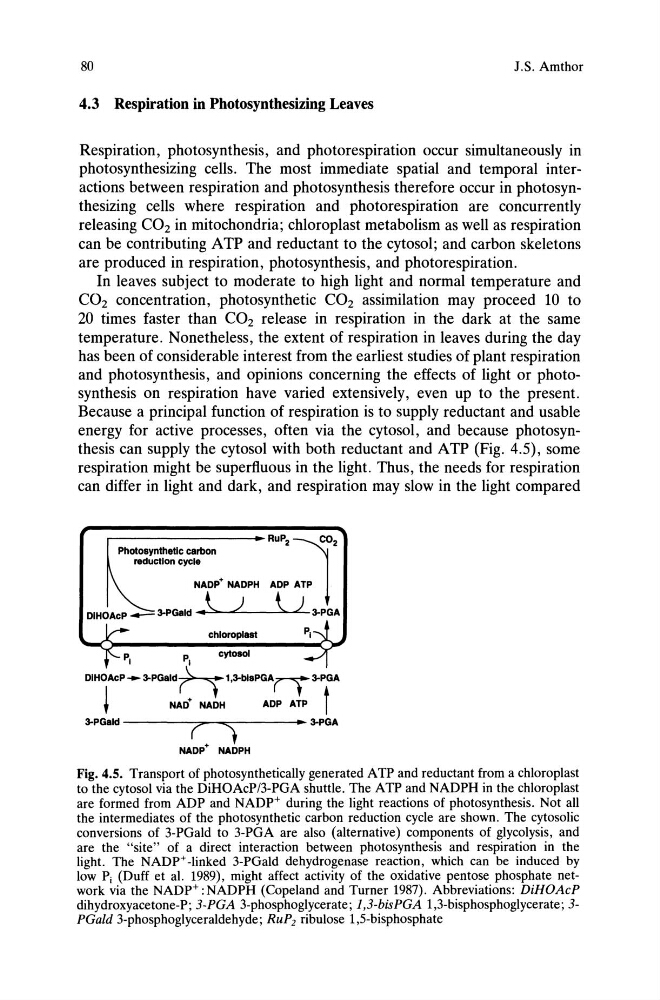
energy for active processes, often via the cytosol, and because photosynthesis can supply the cytosol with both reductant and ATP (Fig. 4.5), some
respiration might be superfluous in the light. Thus, the needs for respiration
can differ in light and dark, and respiration may slow in the light compared
Photosynthetic cerbon
reduction cycle
NADP+ NADPH
DiHOAcP _
3-PGeld
i)
chloroplast
PI
PI
cytosol
RUP2102
ADP A;P ~
\. ) 3-PGA
DIHOAcP -- 3-PGaldH 1,3-blSPGArT 3-PGA
! NAD+ NADH ADP AlP t
3-PGald
(
' )
.. 3-PGA
NADP+ NADPH
Fig. 4.5. Transport of photosynthetically generated A TP and reductant from a chloroplast
to the cytosol via the DiHOAcP/3-PGA shuttle. The ATP and NADPH in the chloroplast
are formed from ADP and NADP+ during the light reactions of photosynthesis. Not all
the intermediates of the photosynthetic carbon reduction cycle are shown. The cytosolic
conversions of 3-PGald to 3-PGA are also (alternative) components of glycolysis, and
are the "site" of a direct interaction between photosynthesis and respiration in the
light. The NADP+ -linked 3-PGald dehydrogenase reaction, which can be induced by
low Pi (Duff et al. 1989), might affect activity of the oxidative pentose phosphate network via the NADP+: NADPH (Copeland and Turner 1987). Abbreviations: DiHOAcP
dihydroxyacetone-P; 3-PGA 3-phosphoglycerate; 1,3-bisPGA 1,3-bisphosphoglycerate; 3PGaid 3-phosphoglyceraldehyde; RuP2 ribulose 1,5-bisphosphate
J.S. Amthor
4.3 Respiration in Photosynthesizing Leaves
Respiration, photosynthesis, and photorespiration occur simultaneously in
photosynthesizing cells. The most immediate spatial and temporal interactions between respiration and photosynthesis therefore occur in photosynthesizing cells where respiration and photo respiration are concurrently
releasing CO2 in mitochondria; chloroplast metabolism as well as respiration
can be contributing A TP and reductant to the cytosol; and carbon skeletons
are produced in respiration, photosynthesis, and photorespiration.
In leaves subject to moderate to high light and normal temperature and
CO2 concentration, photosynthetic CO2 assimilation may proceed 10 to
20 times faster than CO2 release in respiration in the dark at the same
temperature. Nonetheless, the extent of respiration in leaves during the day
has been of considerable interest from the earliest studies of plant respiration
and photosynthesis, and opinions concerning the effects of light or photosynthesis on respiration have varied extensively, even up to the present.
Because a principal function of respiration is to supply reductant and usable
energy for active processes, often via the cytosol, and because photosynthesis can supply the cytosol with both reductant and ATP (Fig. 4.5), some
respiration might be superfluous in the light. Thus, the needs for respiration
can differ in light and dark, and respiration may slow in the light compared
Photosynthetic cerbon
reduction cycle
NADP+ NADPH
DiHOAcP _
3-PGeld
i)
chloroplast
PI
PI
cytosol
RUP2102
ADP A;P ~
\. ) 3-PGA
DIHOAcP -- 3-PGaldH 1,3-blSPGArT 3-PGA
! NAD+ NADH ADP AlP t
3-PGald
(
' )
.. 3-PGA
NADP+ NADPH
Fig. 4.5. Transport of photosynthetically generated A TP and reductant from a chloroplast
to the cytosol via the DiHOAcP/3-PGA shuttle. The ATP and NADPH in the chloroplast
are formed from ADP and NADP+ during the light reactions of photosynthesis. Not all
the intermediates of the photosynthetic carbon reduction cycle are shown. The cytosolic
conversions of 3-PGald to 3-PGA are also (alternative) components of glycolysis, and
are the "site" of a direct interaction between photosynthesis and respiration in the
light. The NADP+ -linked 3-PGald dehydrogenase reaction, which can be induced by
low Pi (Duff et al. 1989), might affect activity of the oxidative pentose phosphate network via the NADP+: NADPH (Copeland and Turner 1987). Abbreviations: DiHOAcP
dihydroxyacetone-P; 3-PGA 3-phosphoglycerate; 1,3-bisPGA 1,3-bisphosphoglycerate; 3PGaid 3-phosphoglyceraldehyde; RuP2 ribulose 1,5-bisphosphate