

60
P.A. Whigham . G.ß. Fogel
4.4.4
Rule Discovery
Expressing knowledge or models in the form of rules became popular during the
1970's with the advent of expert systems (Buchanan and Shortliffe 1984). There
has been a long history of rule discovery using evolutionary techniques (Wilson
1987; De Jong 1988; Grefenstette 1988; Robertson and Riolo 1988; De Jong and
Spears 1991; Frey and Slate 1991; Lees and Ritman 1991; Corcoran and Sen
1994; Sipper 1994). The attraction with rules is that they can be easily interpreted
by auser, and can be treated independently of the system in which they were
created. Arecent approach to rule discovery using evolution has been described
by Bobbin and Recknagel (Bobbin and Recknagel 2001), where a set of rules for
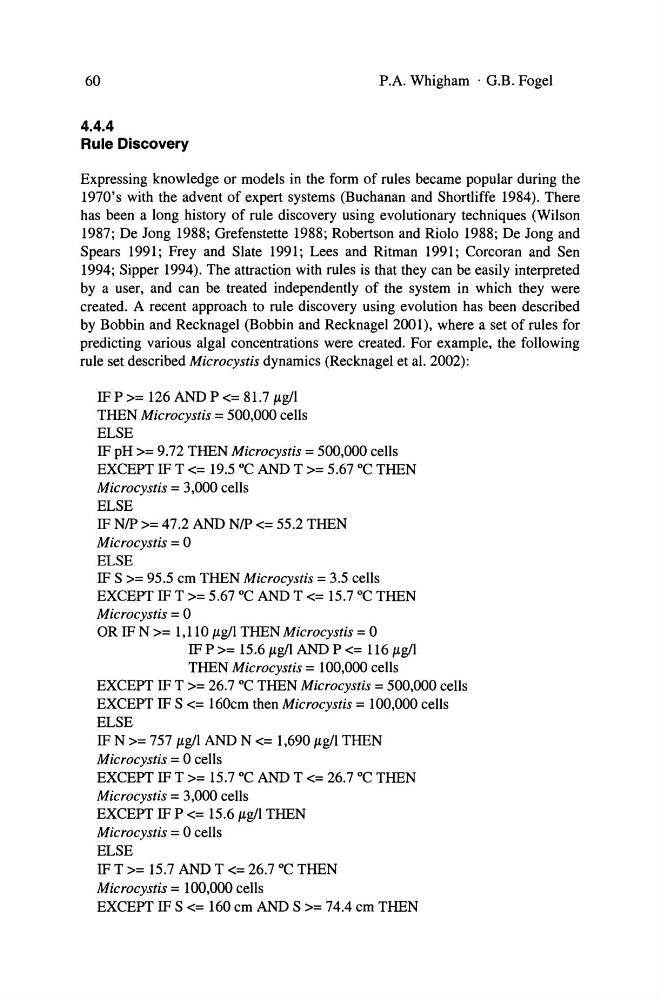
predicting various algal concentrations were created. For example, the following
rule set described Microcystis dynamics (Recknagel et al. 2002):
IF P >= 126 AND P <= 81.7 J.Lgll
THEN Microcystis = 500,000 cells
ELSE
IF pR >= 9.72 THEN Microcystis = 500,000 cells
EXCEPT IF T <= 19.5 °C AND T >= 5.67 °C THEN
Microcystis = 3,000 cells
ELSE
IF NIP >= 47.2 AND NIP <= 55.2 THEN
Microcystis = 0
ELSE
IF S >= 95.5 cm THEN Microcystis = 3.5 cells
EXCEPT IF T >= 5.67 °C AND T <= 15.7 °C THEN
Microcystis = 0
OR IF N >= 1,110 J.Lgll THEN Microcystis = 0
IF P >= 15.6 J.Lgll AND P <= 116 J.Lgll
THEN Microcystis = 100,000 cells
EXCEPT IF T >= 26.7 °C THEN Microcystis = 500,000 cells
EXCEPT IF S <= 160cm then Microcystis = 100,000 cells
ELSE
IF N >= 757 J.Lgll AND N <= 1,690 J.Lg/1 THEN
Microcystis = 0 cells
EXCEPT IF T >= 15.7 °C AND T <= 26.7 °C THEN
Microcystis = 3,000 cells
EXCEPT IF P <= 15.6 J.Lgll THEN
Microcystis = 0 cells
ELSE
IF T >= 15.7 AND T <= 26.7 °C THEN
Microcystis = 100,000 cells
EXCEPT IF S <= 160 cm AND S >= 74.4 cm THEN
P.A. Whigham . G.ß. Fogel
4.4.4
Rule Discovery
Expressing knowledge or models in the form of rules became popular during the
1970's with the advent of expert systems (Buchanan and Shortliffe 1984). There
has been a long history of rule discovery using evolutionary techniques (Wilson
1987; De Jong 1988; Grefenstette 1988; Robertson and Riolo 1988; De Jong and
Spears 1991; Frey and Slate 1991; Lees and Ritman 1991; Corcoran and Sen
1994; Sipper 1994). The attraction with rules is that they can be easily interpreted
by auser, and can be treated independently of the system in which they were
created. Arecent approach to rule discovery using evolution has been described
by Bobbin and Recknagel (Bobbin and Recknagel 2001), where a set of rules for
predicting various algal concentrations were created. For example, the following
rule set described Microcystis dynamics (Recknagel et al. 2002):
IF P >= 126 AND P <= 81.7 J.Lgll
THEN Microcystis = 500,000 cells
ELSE
IF pR >= 9.72 THEN Microcystis = 500,000 cells
EXCEPT IF T <= 19.5 °C AND T >= 5.67 °C THEN
Microcystis = 3,000 cells
ELSE
IF NIP >= 47.2 AND NIP <= 55.2 THEN
Microcystis = 0
ELSE
IF S >= 95.5 cm THEN Microcystis = 3.5 cells
EXCEPT IF T >= 5.67 °C AND T <= 15.7 °C THEN
Microcystis = 0
OR IF N >= 1,110 J.Lgll THEN Microcystis = 0
IF P >= 15.6 J.Lgll AND P <= 116 J.Lgll
THEN Microcystis = 100,000 cells
EXCEPT IF T >= 26.7 °C THEN Microcystis = 500,000 cells
EXCEPT IF S <= 160cm then Microcystis = 100,000 cells
ELSE
IF N >= 757 J.Lgll AND N <= 1,690 J.Lg/1 THEN
Microcystis = 0 cells
EXCEPT IF T >= 15.7 °C AND T <= 26.7 °C THEN
Microcystis = 3,000 cells
EXCEPT IF P <= 15.6 J.Lgll THEN
Microcystis = 0 cells
ELSE
IF T >= 15.7 AND T <= 26.7 °C THEN
Microcystis = 100,000 cells
EXCEPT IF S <= 160 cm AND S >= 74.4 cm THEN