

Chapter 4 . Applications of Evolutionary Computation
55
Parent 1
Parent 2
Child 1
Child 2
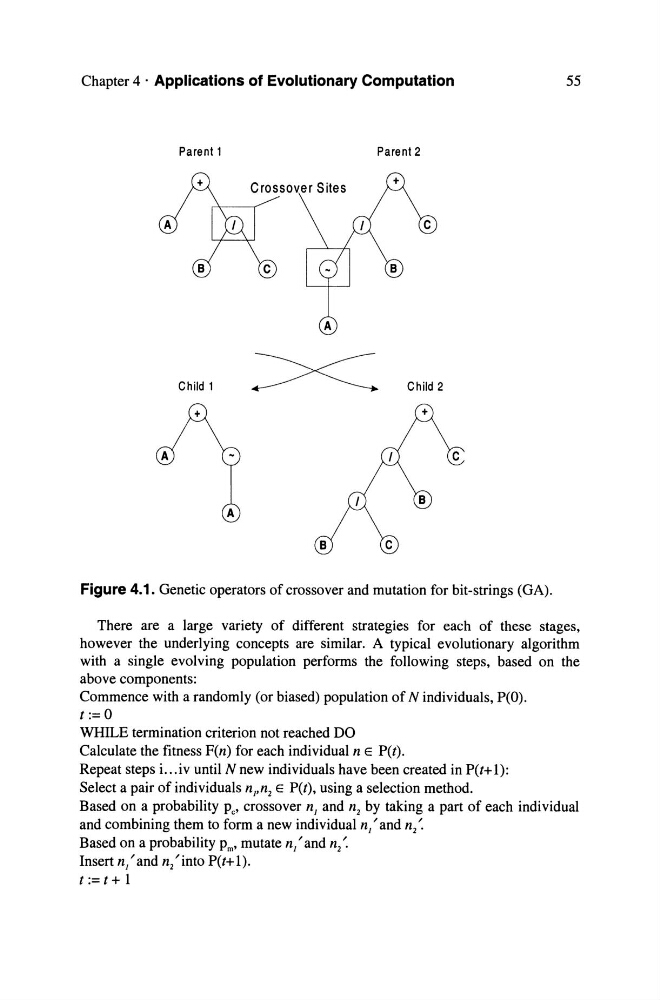
Figure 4.1. Genetic operators of crossover and mutation for bit-strings (GA).
There are a large variety of different strategies for each of these stages,
however the underlying concepts are similar. A typical evolutionary algorithm
with a single evolving population performs the following steps, based on the
above components:
Commence with a randomly (or biased) population of N individuals, P(O).
t :=0
WHILE termination criterion not reached DO
Calculate the fitness F(n) for each individual n E pet).
Repeat steps i .. .iv until N new individuals have been created in P(t+ 1):
Select a pair of individuals n1,n Z E pet), using a selection method.
Based on a probability Pe' crossover n 1 and n z by taking apart of each individual
and combining them to form a new individual n/ and nz~
Based on a probability Pm' mutate n l' and n Z ~
Insert n / and n/ into P( t+ 1).
t:= t + 1
55
Parent 1
Parent 2
Child 1
Child 2
Figure 4.1. Genetic operators of crossover and mutation for bit-strings (GA).
There are a large variety of different strategies for each of these stages,
however the underlying concepts are similar. A typical evolutionary algorithm
with a single evolving population performs the following steps, based on the
above components:
Commence with a randomly (or biased) population of N individuals, P(O).
t :=0
WHILE termination criterion not reached DO
Calculate the fitness F(n) for each individual n E pet).
Repeat steps i .. .iv until N new individuals have been created in P(t+ 1):
Select a pair of individuals n1,n Z E pet), using a selection method.
Based on a probability Pe' crossover n 1 and n z by taking apart of each individual
and combining them to form a new individual n/ and nz~
Based on a probability Pm' mutate n l' and n Z ~
Insert n / and n/ into P( t+ 1).
t:= t + 1