

Preface
In the 50s and 60s cross-sectional data of lake surveys were utilized for steady
state assessments of the eutrophication status of lakes by univariate nonlinear
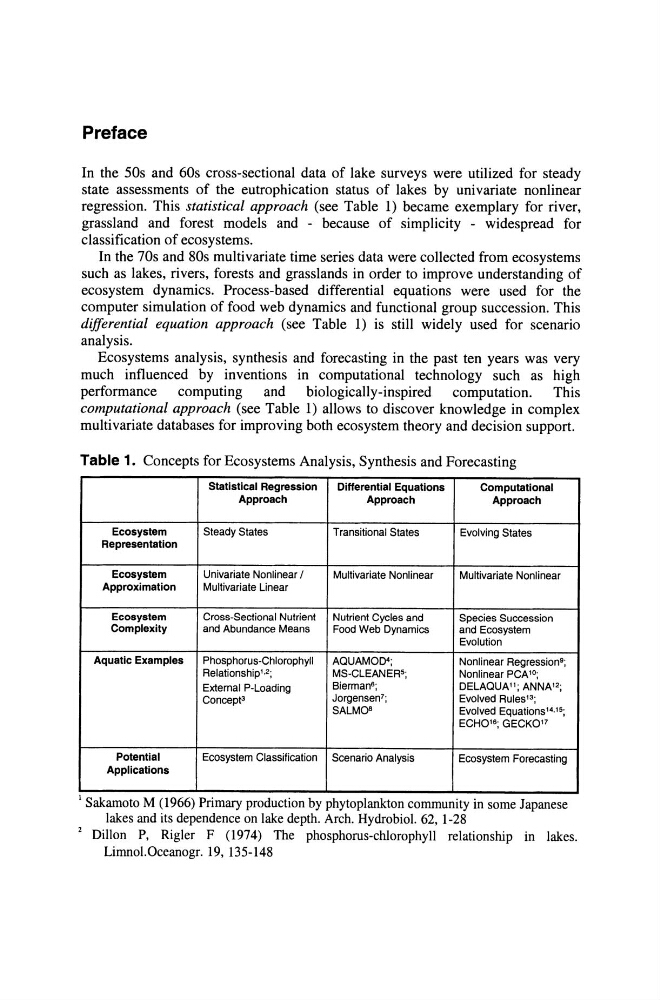
regression. This statistical approach (see Table 1) became exemplary for river,
grassland and forest models and - because of simplicity - widespread for
classification of ecosystems.
In the 70s and 80s multivariate time series data were collected from ecosystems
such as lakes, rivers, forests and grasslands in order to improve understanding of
ecosystem dynamics. Process-based differential equations were used for the
computer simulation of food web dynamics and functional group succession. This
differential equation approach (see Table 1) is still widely used for scenario
analysis.
Ecosystems analysis, synthesis and forecasting in the past ten years was very
much influenced by inventions in computational technology such as high
performance computing and biologically-inspired computation. This
computational approach (see Table 1) allows to discover knowledge in complex
multivariate databases for improving both ecosystem theory and decision support.
Table 1. Concepts for Ecosystems Analysis, Synthesis and Forecasting
Statistlcal Regression
Differential Equatlons
Computational
Approach
Approach
Approach
Ecosystem
Steady States
Transitional States
Evolving States
Representatlon
Ecosystem
Univariate Nonlinear I
Multivariate Nonlinear
Multivariate Nonlinear
Approximation
Multivariate Linear
Ecosystem
Cross-Sectional Nutrient
Nutrient Cycles and
Species Succession
Complexity
and Abundance Means
Food Web Dynamics
and Ecosystem
Evolution
Aquatlc Examples
Phosphorus-Chlorophyll
AQUAMO[)4;
Nonlinear Regression";
Relationship',2;
MS-CLEANER5;
Nonlinear PCA'o;
External P-Loading
Bierman 6 ;
DELAQUA"; ANNA12;
Concept3
Jorgensen7 ;
Evolved Rules'3;
SALMO"
Evolved Equations14,'5;
ECHO'6; GECKO"
Potential
Ecosystem Classification Scenario Analysis
Ecosystem Forecasting
Applications
1 Sakamoto M (1966) Primary production by phytoplankton community in some Japanese
lakes and its dependence on lake depth. Arch. Hydrobiol. 62, 1-28
2 Dillon P, Rigler F (1974) The phosphorus-chlorophyll relationship in lakes.
Limnol.Oceanogr. 19, 135-148
In the 50s and 60s cross-sectional data of lake surveys were utilized for steady
state assessments of the eutrophication status of lakes by univariate nonlinear
regression. This statistical approach (see Table 1) became exemplary for river,
grassland and forest models and - because of simplicity - widespread for
classification of ecosystems.
In the 70s and 80s multivariate time series data were collected from ecosystems
such as lakes, rivers, forests and grasslands in order to improve understanding of
ecosystem dynamics. Process-based differential equations were used for the
computer simulation of food web dynamics and functional group succession. This
differential equation approach (see Table 1) is still widely used for scenario
analysis.
Ecosystems analysis, synthesis and forecasting in the past ten years was very
much influenced by inventions in computational technology such as high
performance computing and biologically-inspired computation. This
computational approach (see Table 1) allows to discover knowledge in complex
multivariate databases for improving both ecosystem theory and decision support.
Table 1. Concepts for Ecosystems Analysis, Synthesis and Forecasting
Statistlcal Regression
Differential Equatlons
Computational
Approach
Approach
Approach
Ecosystem
Steady States
Transitional States
Evolving States
Representatlon
Ecosystem
Univariate Nonlinear I
Multivariate Nonlinear
Multivariate Nonlinear
Approximation
Multivariate Linear
Ecosystem
Cross-Sectional Nutrient
Nutrient Cycles and
Species Succession
Complexity
and Abundance Means
Food Web Dynamics
and Ecosystem
Evolution
Aquatlc Examples
Phosphorus-Chlorophyll
AQUAMO[)4;
Nonlinear Regression";
Relationship',2;
MS-CLEANER5;
Nonlinear PCA'o;
External P-Loading
Bierman 6 ;
DELAQUA"; ANNA12;
Concept3
Jorgensen7 ;
Evolved Rules'3;
SALMO"
Evolved Equations14,'5;
ECHO'6; GECKO"
Potential
Ecosystem Classification Scenario Analysis
Ecosystem Forecasting
Applications
1 Sakamoto M (1966) Primary production by phytoplankton community in some Japanese
lakes and its dependence on lake depth. Arch. Hydrobiol. 62, 1-28
2 Dillon P, Rigler F (1974) The phosphorus-chlorophyll relationship in lakes.
Limnol.Oceanogr. 19, 135-148