

8
A. Salski
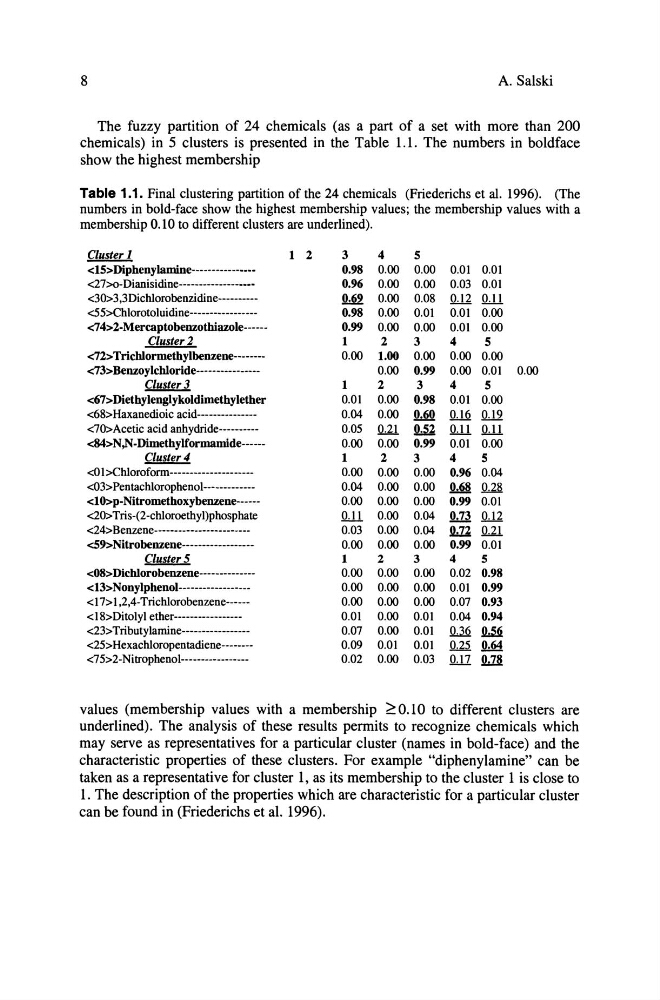
The fuzzy partition of 24 chemicals (as a part of a set with more than 200
chemicals) in 5 clusters is presented in the Table 1.1. The numbers in boldface
show the highest membership
Table 1.1. Final clustering partition of the 24 chemicals (Friederichs et al. 1996). (The
numbers in bold-face show the highest membership values; the membership values with a
membership 0.10 to different clusters are underlined).
Cluster 1
1 2
3
4
5
<15>Diphenylamine---------------0.98 0.00 0.00 0.01 0.01
<27>0-Dianisidine------------------0.96 0.00 0.00 0.03 0.01
<30>3,3Dichlorobenzidine---------!!&2 0.00 0.08 0.12 Qll
<55>Chlorotoluidine----------------0.98 0.00 0.01 0.01 0.00
<74>2-Mercaptobenzothiazole-----0.99 0.00 0.00 0.01 0.00
Cluster 2
1
2
3
4
5
<72> Trichlormethylbenzene-------0.00 1.00 0.00 0.00 0.00
<73>Benzoylchloride---------------0.00 0.99 0.00 0.01 0.00
Cluster 3
1
2
3
4
5
<67>Diethylenglykoldimethylether
0.01 0.00 0.98 0.01 0.00
<68>Haxanedioic acid--------------0.04 0.00 0.60 0.\6 0.\9
<70>Acetic acid anhydride---------0.05 0.21 ~ Qll Qll
<84>N,N-Dimethylformamide-----0.00 0.00 0.99 0.01 0.00
Cluster 4
1
2
3
4
5
<01 >Chloroform--------------------0.00 0.00 0.00 0.96 0.04
<03>Pentachlorophenol------------0.04 0.00 0.00 y
0.28
p-Nitromethoxybenzene-----0.00 0.00 0.00 0.99 0.01
<20> Tris-(2-chloroethyl)phosphate
Qll 0.00 0.04 ~ 0.\2
<24>Benzene-----------------------0.03 0.00 0.04 !bll 0.21
<59>Nitrobenzene-----------------0.00 0.00 0.00 0.99 0.01
ClusterS
1
2
3
4
5
<08>Dichlorobenzene-------------0.00 0.00 0.00 0.02 0.98
<13>Nonylphenol-----------------0.00 0.00 0.00 0.01 0.99
<17> 1,2,4-Trichlorobenzene-----0.00 0.00 0.00 0.07 0.93
<18>Ditolyl ether----------------0.01 0.00 0.01 0.04 0.94
<23> Tributylamine----------------0.07 0.00 0.01 QJQ ~
<25>Hexachloropentadiene-------0.09 0.01 0.01 0.25 0.64
<75>2-Nitrophenol----------------0.02 0.00 0.03 0.17 !ill
values (membership values with a membership ~ 0.10 to different clusters are
underlined). The analysis of these results permits to recognize chemicals which
may serve as representatives for a particular cluster (names in bold-face) and the
characteristic properties of these clusters. For example "diphenylamine" can be
taken as a representative for cluster 1, as its membership to the cluster 1 is close to
1. The description of the properties wh ich are characteristic for a particular cluster
can be found in (Friederichs et al. 1996).
A. Salski
The fuzzy partition of 24 chemicals (as a part of a set with more than 200
chemicals) in 5 clusters is presented in the Table 1.1. The numbers in boldface
show the highest membership
Table 1.1. Final clustering partition of the 24 chemicals (Friederichs et al. 1996). (The
numbers in bold-face show the highest membership values; the membership values with a
membership 0.10 to different clusters are underlined).
Cluster 1
1 2
3
4
5
<15>Diphenylamine---------------0.98 0.00 0.00 0.01 0.01
<27>0-Dianisidine------------------0.96 0.00 0.00 0.03 0.01
<30>3,3Dichlorobenzidine---------!!&2 0.00 0.08 0.12 Qll
<55>Chlorotoluidine----------------0.98 0.00 0.01 0.01 0.00
<74>2-Mercaptobenzothiazole-----0.99 0.00 0.00 0.01 0.00
Cluster 2
1
2
3
4
5
<72> Trichlormethylbenzene-------0.00 1.00 0.00 0.00 0.00
<73>Benzoylchloride---------------0.00 0.99 0.00 0.01 0.00
Cluster 3
1
2
3
4
5
<67>Diethylenglykoldimethylether
0.01 0.00 0.98 0.01 0.00
<68>Haxanedioic acid--------------0.04 0.00 0.60 0.\6 0.\9
<70>Acetic acid anhydride---------0.05 0.21 ~ Qll Qll
<84>N,N-Dimethylformamide-----0.00 0.00 0.99 0.01 0.00
Cluster 4
1
2
3
4
5
<01 >Chloroform--------------------0.00 0.00 0.00 0.96 0.04
<03>Pentachlorophenol------------0.04 0.00 0.00 y
0.28
<20> Tris-(2-chloroethyl)phosphate
Qll 0.00 0.04 ~ 0.\2
<24>Benzene-----------------------0.03 0.00 0.04 !bll 0.21
<59>Nitrobenzene-----------------0.00 0.00 0.00 0.99 0.01
ClusterS
1
2
3
4
5
<08>Dichlorobenzene-------------0.00 0.00 0.00 0.02 0.98
<13>Nonylphenol-----------------0.00 0.00 0.00 0.01 0.99
<17> 1,2,4-Trichlorobenzene-----0.00 0.00 0.00 0.07 0.93
<18>Ditolyl ether----------------0.01 0.00 0.01 0.04 0.94
<23> Tributylamine----------------0.07 0.00 0.01 QJQ ~
<25>Hexachloropentadiene-------0.09 0.01 0.01 0.25 0.64
<75>2-Nitrophenol----------------0.02 0.00 0.03 0.17 !ill
values (membership values with a membership ~ 0.10 to different clusters are
underlined). The analysis of these results permits to recognize chemicals which
may serve as representatives for a particular cluster (names in bold-face) and the
characteristic properties of these clusters. For example "diphenylamine" can be
taken as a representative for cluster 1, as its membership to the cluster 1 is close to
1. The description of the properties wh ich are characteristic for a particular cluster
can be found in (Friederichs et al. 1996).