

Chapter 14 . Time-Series Prediction of Chlorophyll a in Lakes
285
predictive characteristics of models with and without hidden nodes were general
for all remaining models apart from those discussed above.
Kasumigaura - same day model 0 hidden nades
o
1983 1984
1985
1986
1987
1988
1989
1990
1991
1992
1993
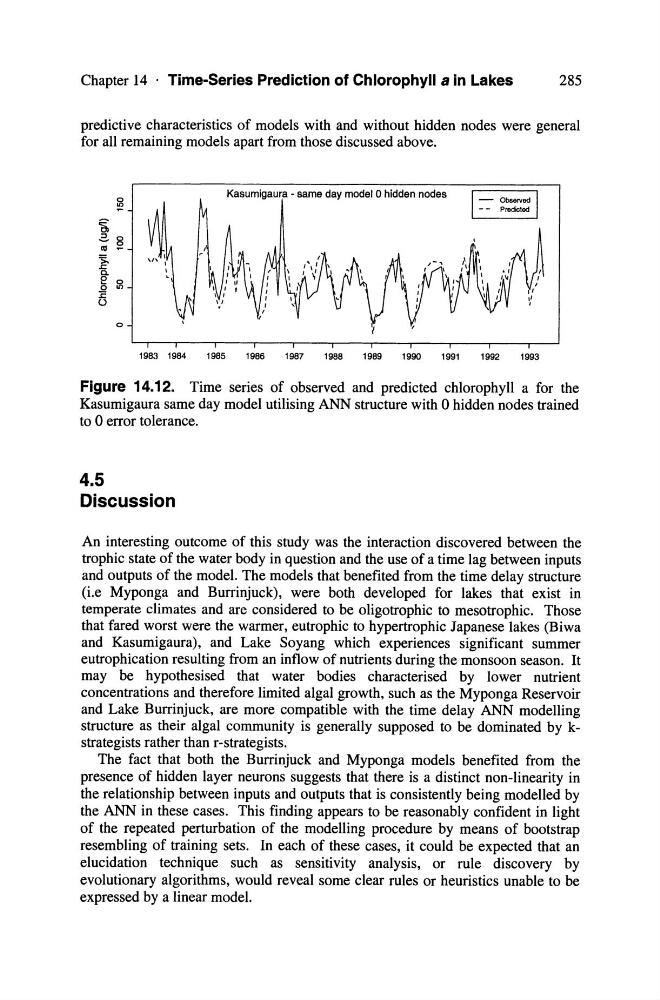
Figure 14.12. Time series of observed and predicted chlorophyll a for the
Kasumigaura same day model utilising ANN structure with 0 hidden nodes trained
to 0 error tolerance.
4.5
Discussion
An interesting outcome of this study was the interaction discovered between the
trophic state of the water body in question and the use of a time lag between inputs
and outputs of the model. The models that benefited from the time delay structure
(i.e Myponga and Burrinjuck), were both developed for lakes that exist in
temperate climates and are considered to be oligotrophie to mesotrophic. Those
that fared worst were the warmer, eutrophic to hypertrophic Japanese lakes (Biwa
and Kasumigaura), and Lake Soyang which experiences significant summer
eutrophication resulting from an inflow of nutrients during the monsoon season. It
may be hypothesised that water bodies characterised by lower nutrient
concentrations and therefore limited algal growth, such as the Myponga Reservoir
and Lake Burrinjuck, are more compatible with the time delay ANN modelling
structure as their algal community is generally supposed to be dominated by kstrategists rather than r-strategists.
The fact that both the Burrinjuck and Myponga models benefited from the
presence of hidden layer neurons suggests that there is a distinct non-linearity in
the relationship between inputs and outputs that is consistently being modelIed by
the ANN in these cases. This finding appears to be reasonably confident in light
of the repeated perturbation of the modelling procedure by means of bootstrap
resembling of training sets. In each of these cases, it could be expected that an
elucidation technique such as sensitivity analysis, or rule discovery by
evolutionary algorithms, would reveal some clear rules or heuristics unable to be
expressed by a linear model.
285
predictive characteristics of models with and without hidden nodes were general
for all remaining models apart from those discussed above.
Kasumigaura - same day model 0 hidden nades
o
1983 1984
1985
1986
1987
1988
1989
1990
1991
1992
1993
Figure 14.12. Time series of observed and predicted chlorophyll a for the
Kasumigaura same day model utilising ANN structure with 0 hidden nodes trained
to 0 error tolerance.
4.5
Discussion
An interesting outcome of this study was the interaction discovered between the
trophic state of the water body in question and the use of a time lag between inputs
and outputs of the model. The models that benefited from the time delay structure
(i.e Myponga and Burrinjuck), were both developed for lakes that exist in
temperate climates and are considered to be oligotrophie to mesotrophic. Those
that fared worst were the warmer, eutrophic to hypertrophic Japanese lakes (Biwa
and Kasumigaura), and Lake Soyang which experiences significant summer
eutrophication resulting from an inflow of nutrients during the monsoon season. It
may be hypothesised that water bodies characterised by lower nutrient
concentrations and therefore limited algal growth, such as the Myponga Reservoir
and Lake Burrinjuck, are more compatible with the time delay ANN modelling
structure as their algal community is generally supposed to be dominated by kstrategists rather than r-strategists.
The fact that both the Burrinjuck and Myponga models benefited from the
presence of hidden layer neurons suggests that there is a distinct non-linearity in
the relationship between inputs and outputs that is consistently being modelIed by
the ANN in these cases. This finding appears to be reasonably confident in light
of the repeated perturbation of the modelling procedure by means of bootstrap
resembling of training sets. In each of these cases, it could be expected that an
elucidation technique such as sensitivity analysis, or rule discovery by
evolutionary algorithms, would reveal some clear rules or heuristics unable to be
expressed by a linear model.