

204
0:1':Cl~
.~ .. E
i! [
~ .. o
~E
::z
~.:"J
~ .. E
~E
c.;~
160
140
A
120
100
80
60
40
20
.J ~
0
160
140
B
120
100
80
60
40
20
0
Jan
Feb
Ma,
Ap'
May
c
4
Jun
K.-S. Jeong . F. Recknagel . G.-J. Joo
Jul
Aug Sep
1994
-
Obaerved
- - - Predlcted
~
~
Oct
Nov
Dec
_
M. turuginoSQ
S. hantuchü
Jan
Irr. Prep. Eva. Dis. Sec Turb. WT pH DO Cond. Alk. N03 NH4 P04 Si02 Ro. CIs. Co.
Input variables
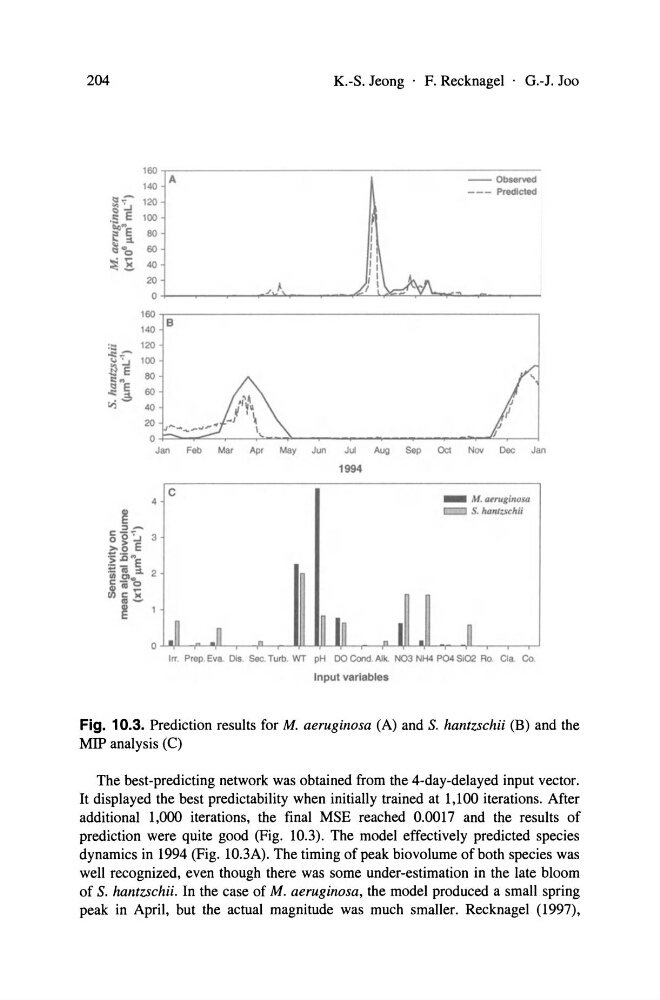
Fig. 10.3. Prediction results for M. aeruginosa (A) and S. hantzschii (B) and the
MIP analysis (C)
The best-predicting network was obtained from the 4-day-delayed input vector.
It displayed the best predictability when initially trained at 1,100 iterations. After
additional 1,000 iterations, the final MSE reached 0.0017 and the results of
prediction were quite good (Fig. 10.3). The model effectively predicted species
dynamics in 1994 (Fig. 1O.3A). The timing of peak biovolume of both species was
weIl recognized, even though there was some under-estimation in the late bloom
of S. hantzschii. In the case of M. aeruginosa, the model produced a small spring
peak in April, but the actual magnitude was much smaIler. Recknagel (1997),
0:1':Cl~
.~ .. E
i! [
~ .. o
~E
::z
~.:"J
~ .. E
~E
c.;~
160
140
A
120
100
80
60
40
20
.J ~
0
160
140
B
120
100
80
60
40
20
0
Jan
Feb
Ma,
Ap'
May
c
4
Jun
K.-S. Jeong . F. Recknagel . G.-J. Joo
Jul
Aug Sep
1994
-
Obaerved
- - - Predlcted
~
~
Oct
Nov
Dec
_
M. turuginoSQ
S. hantuchü
Jan
Irr. Prep. Eva. Dis. Sec Turb. WT pH DO Cond. Alk. N03 NH4 P04 Si02 Ro. CIs. Co.
Input variables
Fig. 10.3. Prediction results for M. aeruginosa (A) and S. hantzschii (B) and the
MIP analysis (C)
The best-predicting network was obtained from the 4-day-delayed input vector.
It displayed the best predictability when initially trained at 1,100 iterations. After
additional 1,000 iterations, the final MSE reached 0.0017 and the results of
prediction were quite good (Fig. 10.3). The model effectively predicted species
dynamics in 1994 (Fig. 1O.3A). The timing of peak biovolume of both species was
weIl recognized, even though there was some under-estimation in the late bloom
of S. hantzschii. In the case of M. aeruginosa, the model produced a small spring
peak in April, but the actual magnitude was much smaIler. Recknagel (1997),