

Chapter 8· Analysis of Stream Macroinvertebrate Communities
167
network. Consequently this was comparable with the actual field data at
Genus/Species level, X'''' (Fig. 8.2lt). Similar to the case of X', the overall
conformational characteristics in densities were generally in accordance with the
field data for Genus/Species. In comparing X" (Fig. 8.2le) and X"" (Fig. 8.2lt),
the "averaging effect" was also observed: groups rarely occurring tended to
disappear while the dominant groups appeared more consistently. Patteming by
the counterpropagation network is further described in Park et al. (200la).
The results demonstrate the counterpropagation network could extract
information on relationships among hierarchical levels in communities.
Information regarding associations or relationships in communities would be
valuable for verifying ecosystem functioning, and would ass ist greatly to interpret
ecological status of the stream ecosystem. This type of patteming would
especially useful for revealing inter-relationship among more than two groups at
the same time. The patteming of multi-relational functioning in communities of
benthic macroinvertebrates will be discussed in the future.
8.4.2
PaHerning of Exergy
While community organization could be revealed through information of
relationships among groups, another major aspect of ecological informatics on the
other side is to develop an integrative expression of communities.
The integrative expression of ecological status of community, however, is
difficult since community consists of many variables varying in a complex manner
as mentioned previously. Although community develops progressively in one
direction in general, it is difficult to simply represent the status of the community
in one parameter; whether it is matured, disturbed or recovering for instance.
However integrative diagnostics on community is essential for establishing
sustainable management strategies in stream ecosystems.
In this regard, exergy could be a useful parameter to represent the overall status
of community. Exergy is defined as the amount of work a system can perform
when it is brought to thermodynamic equilibrium with its environment. Exergy
could express the organization of the ecosystem by the living components, and
represents the biomass of the system and the information that this biomass is
carrying (J~rgensen 1992, 1994, 1995, 1997; J~rgensen et al. 1995).
It is possible, according to J~rgensen (1992, 1995), to calculate a relative
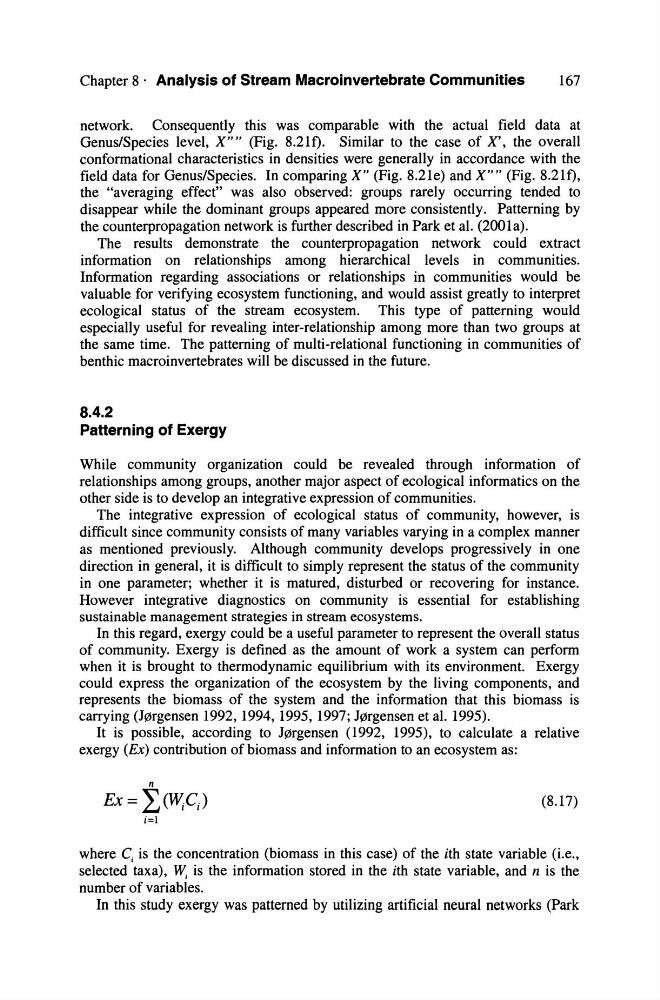
exergy (Ex) contribution of biomass and information to an ecosystem as:
n
Ex= L(W;C)
(8.17)
i=1
where Cj is the concentration (biom ass in this case) of the ith state variable (i.e.,
selected taxa), W, is the information stored in the ith state variable, and n is the
number of variables.
In this study exergy was pattemed by utilizing artificial neural networks (Park
167
network. Consequently this was comparable with the actual field data at
Genus/Species level, X'''' (Fig. 8.2lt). Similar to the case of X', the overall
conformational characteristics in densities were generally in accordance with the
field data for Genus/Species. In comparing X" (Fig. 8.2le) and X"" (Fig. 8.2lt),
the "averaging effect" was also observed: groups rarely occurring tended to
disappear while the dominant groups appeared more consistently. Patteming by
the counterpropagation network is further described in Park et al. (200la).
The results demonstrate the counterpropagation network could extract
information on relationships among hierarchical levels in communities.
Information regarding associations or relationships in communities would be
valuable for verifying ecosystem functioning, and would ass ist greatly to interpret
ecological status of the stream ecosystem. This type of patteming would
especially useful for revealing inter-relationship among more than two groups at
the same time. The patteming of multi-relational functioning in communities of
benthic macroinvertebrates will be discussed in the future.
8.4.2
PaHerning of Exergy
While community organization could be revealed through information of
relationships among groups, another major aspect of ecological informatics on the
other side is to develop an integrative expression of communities.
The integrative expression of ecological status of community, however, is
difficult since community consists of many variables varying in a complex manner
as mentioned previously. Although community develops progressively in one
direction in general, it is difficult to simply represent the status of the community
in one parameter; whether it is matured, disturbed or recovering for instance.
However integrative diagnostics on community is essential for establishing
sustainable management strategies in stream ecosystems.
In this regard, exergy could be a useful parameter to represent the overall status
of community. Exergy is defined as the amount of work a system can perform
when it is brought to thermodynamic equilibrium with its environment. Exergy
could express the organization of the ecosystem by the living components, and
represents the biomass of the system and the information that this biomass is
carrying (J~rgensen 1992, 1994, 1995, 1997; J~rgensen et al. 1995).
It is possible, according to J~rgensen (1992, 1995), to calculate a relative
exergy (Ex) contribution of biomass and information to an ecosystem as:
n
Ex= L(W;C)
(8.17)
i=1
where Cj is the concentration (biom ass in this case) of the ith state variable (i.e.,
selected taxa), W, is the information stored in the ith state variable, and n is the
number of variables.
In this study exergy was pattemed by utilizing artificial neural networks (Park