

152
T.-S. Chon . Y.S. Park· I.-S. Kwak . E.Y. Cha
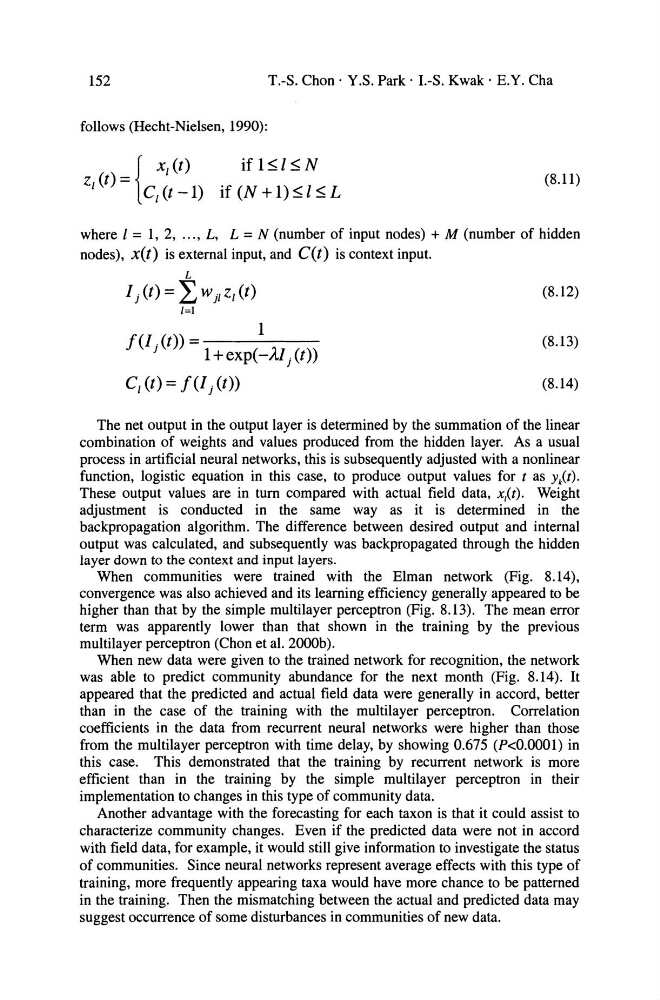
follows (Hecht-Nielsen, 1990):
if 1 ::; 1 ::; N
if (N + 1)::; 1::; L
(8.11)
where I = 1, 2, ... , L, L = N (number of input nodes) + M (number of hidden
nodes), x(t) is extern al input, and C(t) is context input.
L
I j (t) = L WjlZI (t)
(8.12)
1=1
1
f(lj(t)) = 1
('1 ( ))
+exp -/I" j t
(8.13)
CI (t) = f(l j (t))
(8.14)
The net output in the output layer is determined by the summation of the linear
combination of weights and values produced from the hidden layer. As a usual
process in artificial neural networks, this is subsequently adjusted with a nonlinear
function, logistic equation in this case, to produce output values for t as Yk(t).
These output values are in turn compared with actual field data, x/(t). Weight
adjustment is conducted in the same way as it is determined in the
backpropagation algorithm. The difference between desired output and internal
output was calculated, and subsequently was backpropagated through the hidden
layer down to the context and input layers.
When communities were trained with the Elman network (Fig. 8.14),
convergence was also achieved and its leaming efficiency generally appeared to be
higher than that by the simple multilayer perceptron (Fig. 8.13). The mean error
term was apparently lower than that shown in the training by the previous
multilayer perceptron (Chon et al. 2000b).
When new data were given to the trained network for recognition, the network
was able to predict community abundance for the next month (Fig. 8.14). It
appeared that the predicted and actual field data were generally in accord, better
than in the case of the training with the multilayer perceptron. Correlation
coefficients in the data from recurrent neural networks were higher than those
from the multilayer perceptron with time delay, by showing 0.675 (P
efficient than in the training by the simple multilayer perceptron in their
implementation to changes in this type of community data.
Another advantage with the forecasting for each taxon is that it could assist to
characterize community changes. Even if the predicted data were not in accord
with field data, for example, it would still give information to investigate the status
of communities. Since neural networks represent average effects with this type of
training, more frequently appearing taxa would have more chance to be patterned
in the training. Then the mismatching between the actual and predicted data may
suggest occurrence of some disturbances in communities of new data.
T.-S. Chon . Y.S. Park· I.-S. Kwak . E.Y. Cha
follows (Hecht-Nielsen, 1990):
if 1 ::; 1 ::; N
if (N + 1)::; 1::; L
(8.11)
where I = 1, 2, ... , L, L = N (number of input nodes) + M (number of hidden
nodes), x(t) is extern al input, and C(t) is context input.
L
I j (t) = L WjlZI (t)
(8.12)
1=1
1
f(lj(t)) = 1
('1 ( ))
+exp -/I" j t
(8.13)
CI (t) = f(l j (t))
(8.14)
The net output in the output layer is determined by the summation of the linear
combination of weights and values produced from the hidden layer. As a usual
process in artificial neural networks, this is subsequently adjusted with a nonlinear
function, logistic equation in this case, to produce output values for t as Yk(t).
These output values are in turn compared with actual field data, x/(t). Weight
adjustment is conducted in the same way as it is determined in the
backpropagation algorithm. The difference between desired output and internal
output was calculated, and subsequently was backpropagated through the hidden
layer down to the context and input layers.
When communities were trained with the Elman network (Fig. 8.14),
convergence was also achieved and its leaming efficiency generally appeared to be
higher than that by the simple multilayer perceptron (Fig. 8.13). The mean error
term was apparently lower than that shown in the training by the previous
multilayer perceptron (Chon et al. 2000b).
When new data were given to the trained network for recognition, the network
was able to predict community abundance for the next month (Fig. 8.14). It
appeared that the predicted and actual field data were generally in accord, better
than in the case of the training with the multilayer perceptron. Correlation
coefficients in the data from recurrent neural networks were higher than those
from the multilayer perceptron with time delay, by showing 0.675 (P
efficient than in the training by the simple multilayer perceptron in their
implementation to changes in this type of community data.
Another advantage with the forecasting for each taxon is that it could assist to
characterize community changes. Even if the predicted data were not in accord
with field data, for example, it would still give information to investigate the status
of communities. Since neural networks represent average effects with this type of
training, more frequently appearing taxa would have more chance to be patterned
in the training. Then the mismatching between the actual and predicted data may
suggest occurrence of some disturbances in communities of new data.