

102
P. Goethals . A. Dedecker . W. Gabriels . N. De Pauw
To get insight in the inference system of the ANN models, all input variables
except the one of interest are kept constant (at the average value of the database).
In this way, one is able to determine the impact of the variable on the presence or
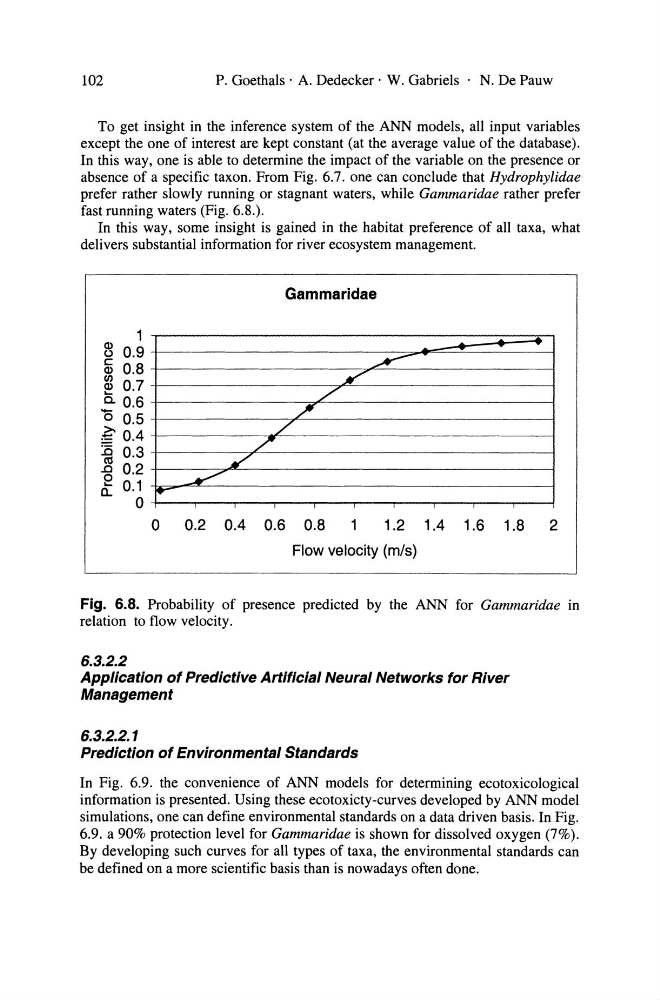
absence of a specific taxon. From Fig. 6.7. one can conclude that Hydrophylidae
prefer rather slowly running or stagnant waters, while Gammaridae rather prefer
fast running waters (Fig. 6.8.).
In this way, some insight is gained in the habitat preference of all taxa, what
deli vers substantial information for river ecosystem management.
1
~ 0.9
a5 0.8
CI)
~ 0.7
a. 0.6
Ö 0.5
>::;: 0.4
~ 0.3
.g 0.2
a: 0.1
o
...
o
Gammaridae
~
/
. /
./
./
. /
/
~
0.2 0.4 0.6 0.8
1.2 1.4 1.6 1.8
2
Flow velocity (m/s)
Fig. 6.8. Prob ability of presence predicted by the ANN for Gammaridae in
relation to flow velocity .
6.3.2.2
Application of Predictive Artificial Neural Networks for River
Management
6.3.2.2.1
Prediction 0' Environmental Standards
In Fig. 6.9. the convenience of ANN models for determining ecotoxicological
information is presented. Using these ecotoxicty-curves developed by ANN model
simulations, one can define environmental standards on a data driven basis. In Fig.
6.9. a 90% protection level for Gammaridae is shown for dissolved oxygen (7%).
By developing such curves for all types of taxa, the environmental standards can
be defined on a more scientific basis than is nowadays often done.
P. Goethals . A. Dedecker . W. Gabriels . N. De Pauw
To get insight in the inference system of the ANN models, all input variables
except the one of interest are kept constant (at the average value of the database).
In this way, one is able to determine the impact of the variable on the presence or
absence of a specific taxon. From Fig. 6.7. one can conclude that Hydrophylidae
prefer rather slowly running or stagnant waters, while Gammaridae rather prefer
fast running waters (Fig. 6.8.).
In this way, some insight is gained in the habitat preference of all taxa, what
deli vers substantial information for river ecosystem management.
1
~ 0.9
a5 0.8
CI)
~ 0.7
a. 0.6
Ö 0.5
>::;: 0.4
~ 0.3
.g 0.2
a: 0.1
o
...
o
Gammaridae
~
/
. /
./
./
. /
/
~
0.2 0.4 0.6 0.8
1.2 1.4 1.6 1.8
2
Flow velocity (m/s)
Fig. 6.8. Prob ability of presence predicted by the ANN for Gammaridae in
relation to flow velocity .
6.3.2.2
Application of Predictive Artificial Neural Networks for River
Management
6.3.2.2.1
Prediction 0' Environmental Standards
In Fig. 6.9. the convenience of ANN models for determining ecotoxicological
information is presented. Using these ecotoxicty-curves developed by ANN model
simulations, one can define environmental standards on a data driven basis. In Fig.
6.9. a 90% protection level for Gammaridae is shown for dissolved oxygen (7%).
By developing such curves for all types of taxa, the environmental standards can
be defined on a more scientific basis than is nowadays often done.