

Chapter 6 . Stream Assessment
6.3
Results
6.3.1
Classification Trees
6.3.1.1
Model Deve/opment and Validation
97
Classification trees were constructed for all 52 taxa collected during the 60
samplings in the headwaters of the Zwalm river basin. The reliability of the
predictions differs dramatically between the macroinvertebrate taxa. The
frequency of occurrence of the taxa in the different sites is one of the major
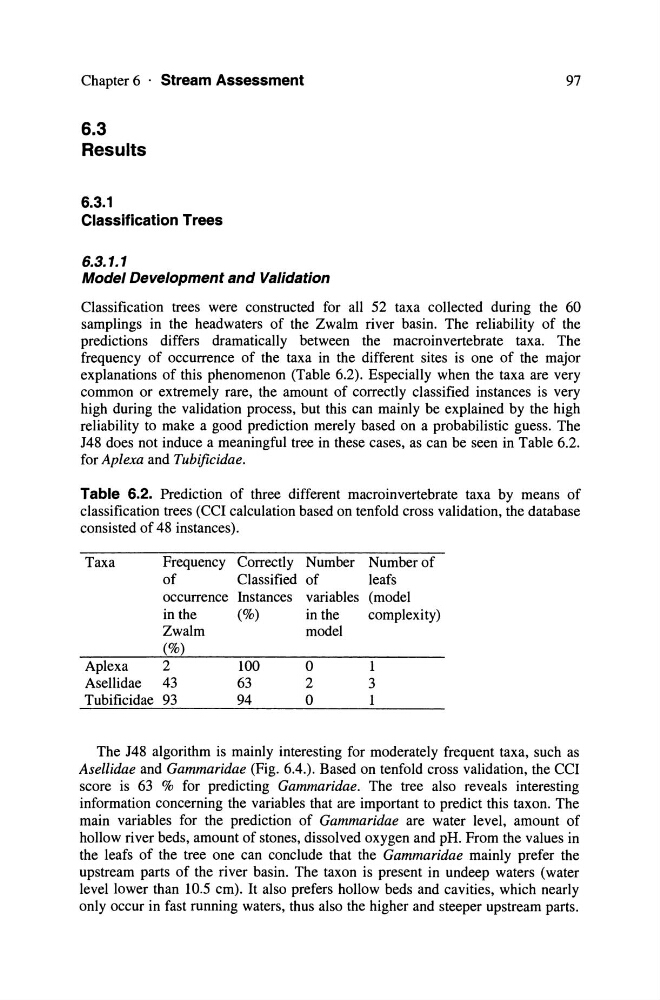
explanations of this phenomenon (Table 6.2). Especially when the taxa are very
common or extremely rare, the amount of correctly classified instances is very
high during the validation process, but this can mainly be explained by the high
reliability to make a good prediction merely based on a probabilistic guess. The
J48 does not induce a meaningful tree in these cases, as can be seen in Table 6.2.
for Aplexa and Tubificidae.
Table 6.2. Prediction of three different macroinvertebrate taxa by means of
classification trees (CCI calculation based on tenfold cross validation, the database
consisted of 48 instances).
Taxa
Frequency Correctly Number Numberof
of
Classified of
leafs
occurrence Instances variables (model
in the
(%)
in the
complexity)
Zwalm
model
(%)
Aplexa
2
100
0
1
Asellidae 43
63
2
3
Tubificidae 93
94
0
1
The J48 algorithm is mainly interesting for moderately frequent taxa, such as
Asellidae and Gammaridae (Fig. 6.4.). Based on tenfold cross validation, the CCI
score is 63 % for predicting Gammaridae. The tree also reveals interesting
information concerning the variables that are important to predict this taxon. The
main variables for the prediction of Gammaridae are water level, amount of
hollow river beds, amount of stones, dissolved oxygen and pH. From the va lues in
the leafs of the tree one can conclude that the Gammaridae mainly prefer the
upstream parts of the river basin. The taxon is present in undeep waters (water
level lower than 10.5 cm). It also prefers hollow beds and cavities, which nearly
only occur in fast running waters, thus also the higher and steeper upstream parts.
6.3
Results
6.3.1
Classification Trees
6.3.1.1
Model Deve/opment and Validation
97
Classification trees were constructed for all 52 taxa collected during the 60
samplings in the headwaters of the Zwalm river basin. The reliability of the
predictions differs dramatically between the macroinvertebrate taxa. The
frequency of occurrence of the taxa in the different sites is one of the major
explanations of this phenomenon (Table 6.2). Especially when the taxa are very
common or extremely rare, the amount of correctly classified instances is very
high during the validation process, but this can mainly be explained by the high
reliability to make a good prediction merely based on a probabilistic guess. The
J48 does not induce a meaningful tree in these cases, as can be seen in Table 6.2.
for Aplexa and Tubificidae.
Table 6.2. Prediction of three different macroinvertebrate taxa by means of
classification trees (CCI calculation based on tenfold cross validation, the database
consisted of 48 instances).
Taxa
Frequency Correctly Number Numberof
of
Classified of
leafs
occurrence Instances variables (model
in the
(%)
in the
complexity)
Zwalm
model
(%)
Aplexa
2
100
0
1
Asellidae 43
63
2
3
Tubificidae 93
94
0
1
The J48 algorithm is mainly interesting for moderately frequent taxa, such as
Asellidae and Gammaridae (Fig. 6.4.). Based on tenfold cross validation, the CCI
score is 63 % for predicting Gammaridae. The tree also reveals interesting
information concerning the variables that are important to predict this taxon. The
main variables for the prediction of Gammaridae are water level, amount of
hollow river beds, amount of stones, dissolved oxygen and pH. From the va lues in
the leafs of the tree one can conclude that the Gammaridae mainly prefer the
upstream parts of the river basin. The taxon is present in undeep waters (water
level lower than 10.5 cm). It also prefers hollow beds and cavities, which nearly
only occur in fast running waters, thus also the higher and steeper upstream parts.