

498
Washington
Oregon
The SIT consisted of landscape ecology, terrestrial resources, aquatic resources, economics, and
social sciences teams. Support for the teams included a geographic information system (GIS) team
and administrative and public information staffs.
An important component of the assessment was a
liaison for Native American tribes.
Because the assessment would provide information for federal agency decision making, all project
members were required to be federal employees according to the Federal Advisory Committee Act (all
committees advising government agencies must be
officially sanctioned or be federal employees).
Therefore, federal employees were assembled from
the USDA Forest Service, USDI Bureau of Land
Management, US Bureau of Mines, USDI National
Biological Service, and the US Geological Survey.
In addition to the personnel in Walla Walla, Washington, detached units were located in Missoula,
Montana, Boise, Idaho, Wenatchee, Washington,
Seattle, Washington, and Portland, Oregon to name
a few. In addition to the teams themselves, the project relied heavily on contractors to supply information about many ecosystem components.
Based on the issues facing land managers
throughout the basin, a variety of policy questions
Interior Columbia Basin Ecosystem Management Project
Montana
Wyoming
Colorado
New Mexico
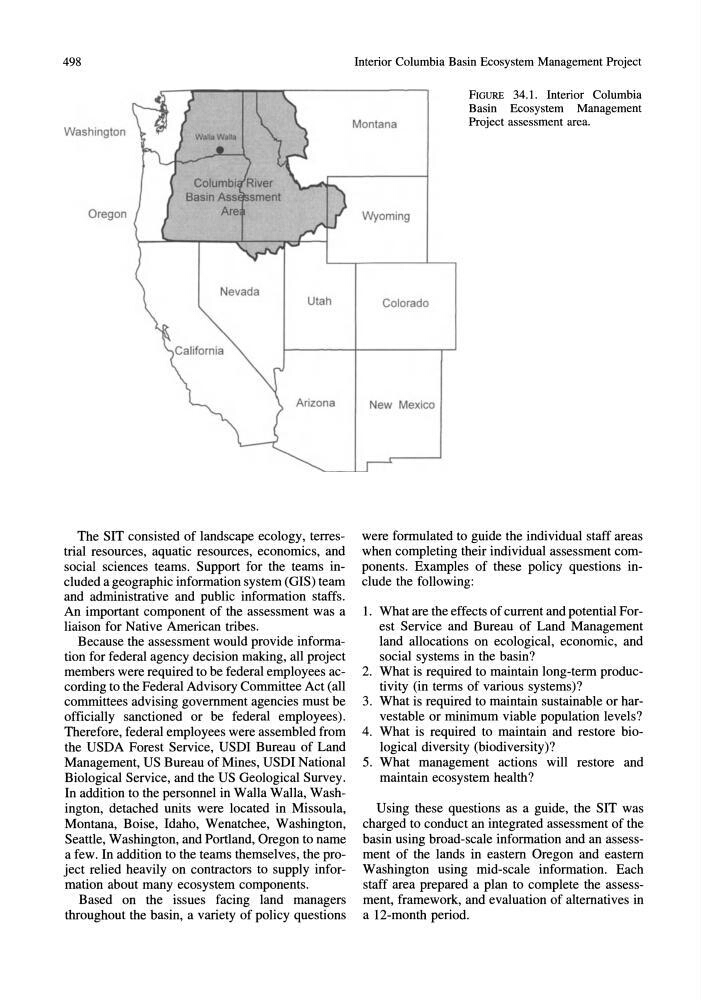
FiGURE 34.1. Interior Columbia
Basin Ecosystem Management
Project assessment area.
were formulated to guide the individual staff areas
when completing their individual assessment components. Examples of these policy questions include the following:
1. What are the effects of current and potential Forest Service and Bureau of Land Management
land allocations on ecological, economic, and
social systems in the basin?
2. What is required to maintain long-term productivity (in terms of various systems)?
3. What is required to maintain sustainable or harvestable or minimum viable population levels?
4. What is required to maintain and restore biological diversity (biodiversity)?
5. What management actions will restore and
maintain ecosystem health?
Using these questions as a guide, the SIT was
charged to conduct an integrated assessment of the
basin using broad-scale information and an assessment of the lands in eastern Oregon and eastern
Washington using mid-scale information. Each
staff area prepared a plan to complete the assessment, framework, and evaluation of alternatives in
a 12-month period.
Washington
Oregon
The SIT consisted of landscape ecology, terrestrial resources, aquatic resources, economics, and
social sciences teams. Support for the teams included a geographic information system (GIS) team
and administrative and public information staffs.
An important component of the assessment was a
liaison for Native American tribes.
Because the assessment would provide information for federal agency decision making, all project
members were required to be federal employees according to the Federal Advisory Committee Act (all
committees advising government agencies must be
officially sanctioned or be federal employees).
Therefore, federal employees were assembled from
the USDA Forest Service, USDI Bureau of Land
Management, US Bureau of Mines, USDI National
Biological Service, and the US Geological Survey.
In addition to the personnel in Walla Walla, Washington, detached units were located in Missoula,
Montana, Boise, Idaho, Wenatchee, Washington,
Seattle, Washington, and Portland, Oregon to name
a few. In addition to the teams themselves, the project relied heavily on contractors to supply information about many ecosystem components.
Based on the issues facing land managers
throughout the basin, a variety of policy questions
Interior Columbia Basin Ecosystem Management Project
Montana
Wyoming
Colorado
New Mexico
FiGURE 34.1. Interior Columbia
Basin Ecosystem Management
Project assessment area.
were formulated to guide the individual staff areas
when completing their individual assessment components. Examples of these policy questions include the following:
1. What are the effects of current and potential Forest Service and Bureau of Land Management
land allocations on ecological, economic, and
social systems in the basin?
2. What is required to maintain long-term productivity (in terms of various systems)?
3. What is required to maintain sustainable or harvestable or minimum viable population levels?
4. What is required to maintain and restore biological diversity (biodiversity)?
5. What management actions will restore and
maintain ecosystem health?
Using these questions as a guide, the SIT was
charged to conduct an integrated assessment of the
basin using broad-scale information and an assessment of the lands in eastern Oregon and eastern
Washington using mid-scale information. Each
staff area prepared a plan to complete the assessment, framework, and evaluation of alternatives in
a 12-month period.