

Appendix 31 .1: Additional Reports Related to UMR AEA Phase I
471
ties. Alternative ways of solving the river puzzle
are examined. Participants will identify policy and
management options that achieve social, economic,
and ecological goals. In the end, no single solution
will emerge. Instead, several composite solutions
drawn from a variety of ideas are recognized, but
the real product consists of shared insights and understanding.
The phase II workshops will help build relationships and dialogue that span methods, disciplines, and institutions. Scenario development is a
tool for helping the river community to take the
long view in a world of considerable uncertainty,
building deep and realistic confidence based on insight into possible outcomes of our choices. Key
steps in phase II will include the following:
1. Identification of central economic, ecological,
and social issues or decisions we face in the
foreseeable future on the UMR
2. Identification of key regional factors influencing the success or failure of these decisions or
issu,es
3. Identification of national and international driving trends that could influence key regional
factors
4. Ranking key factors and driving trends on degree of importance and uncertainty
5. Selecting sound reasons for how key economic,
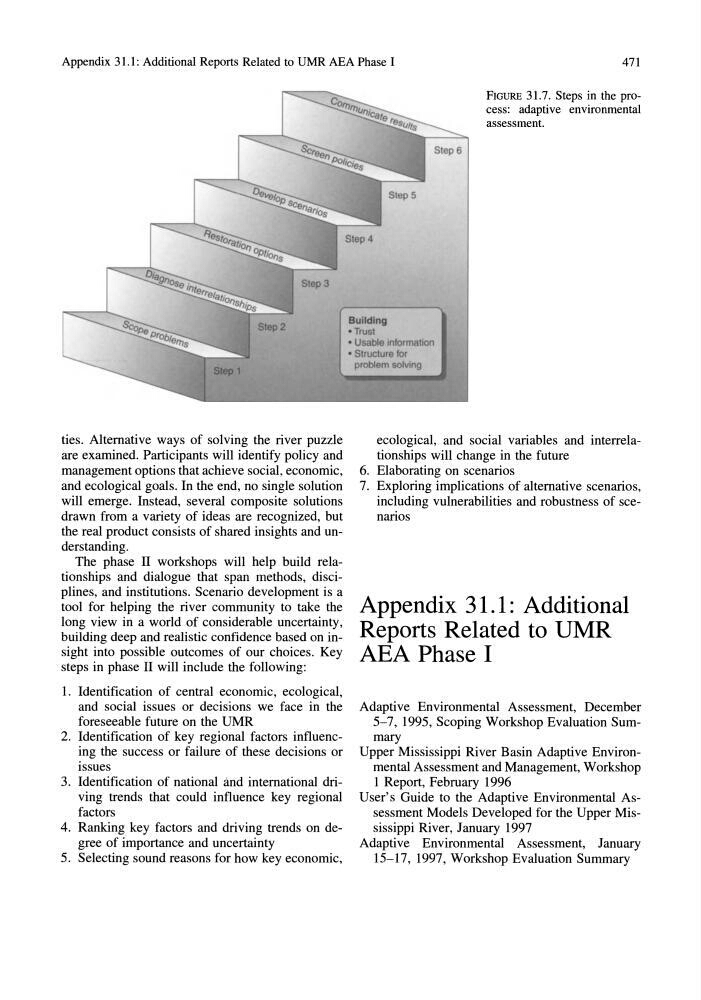
Building
• Trust
• Usable Information
• Structure for
FIGURE 31.7. Steps in the process: adaptive environmental
assessment.
ecological, and social variables and interrelationships will change in the future
6. Elaborating on scenarios
7. Exploring implications of alternative scenarios,
including vulnerabilities and robustness of scenarios
Appendix 31.1: Additional
Reports Related to UMR
AEA Phase I
Adaptive Environmental Assessment, December
5-7, 1995, Scoping Workshop Evaluation Summary
Upper Mississippi River Basin Adaptive Environmental Assessment and Management, Workshop
1 Report, February 1996
User's Guide to the Adaptive Environmental Assessment Models Developed for the Upper Mississippi River, January 1997
Adaptive Environmental Assessment, January
15-17, 1997, Workshop Evaluation Summary
471
ties. Alternative ways of solving the river puzzle
are examined. Participants will identify policy and
management options that achieve social, economic,
and ecological goals. In the end, no single solution
will emerge. Instead, several composite solutions
drawn from a variety of ideas are recognized, but
the real product consists of shared insights and understanding.
The phase II workshops will help build relationships and dialogue that span methods, disciplines, and institutions. Scenario development is a
tool for helping the river community to take the
long view in a world of considerable uncertainty,
building deep and realistic confidence based on insight into possible outcomes of our choices. Key
steps in phase II will include the following:
1. Identification of central economic, ecological,
and social issues or decisions we face in the
foreseeable future on the UMR
2. Identification of key regional factors influencing the success or failure of these decisions or
issu,es
3. Identification of national and international driving trends that could influence key regional
factors
4. Ranking key factors and driving trends on degree of importance and uncertainty
5. Selecting sound reasons for how key economic,
Building
• Trust
• Usable Information
• Structure for
FIGURE 31.7. Steps in the process: adaptive environmental
assessment.
ecological, and social variables and interrelationships will change in the future
6. Elaborating on scenarios
7. Exploring implications of alternative scenarios,
including vulnerabilities and robustness of scenarios
Appendix 31.1: Additional
Reports Related to UMR
AEA Phase I
Adaptive Environmental Assessment, December
5-7, 1995, Scoping Workshop Evaluation Summary
Upper Mississippi River Basin Adaptive Environmental Assessment and Management, Workshop
1 Report, February 1996
User's Guide to the Adaptive Environmental Assessment Models Developed for the Upper Mississippi River, January 1997
Adaptive Environmental Assessment, January
15-17, 1997, Workshop Evaluation Summary