

430
Assessing Human Processes in Society-Environment Interactions
Social!
Cultural
I
I
/
/
<: -----Environmental
,
\
Political
,
\
\
\;..'/ /
-- \
\
\
\
\
\
I
I
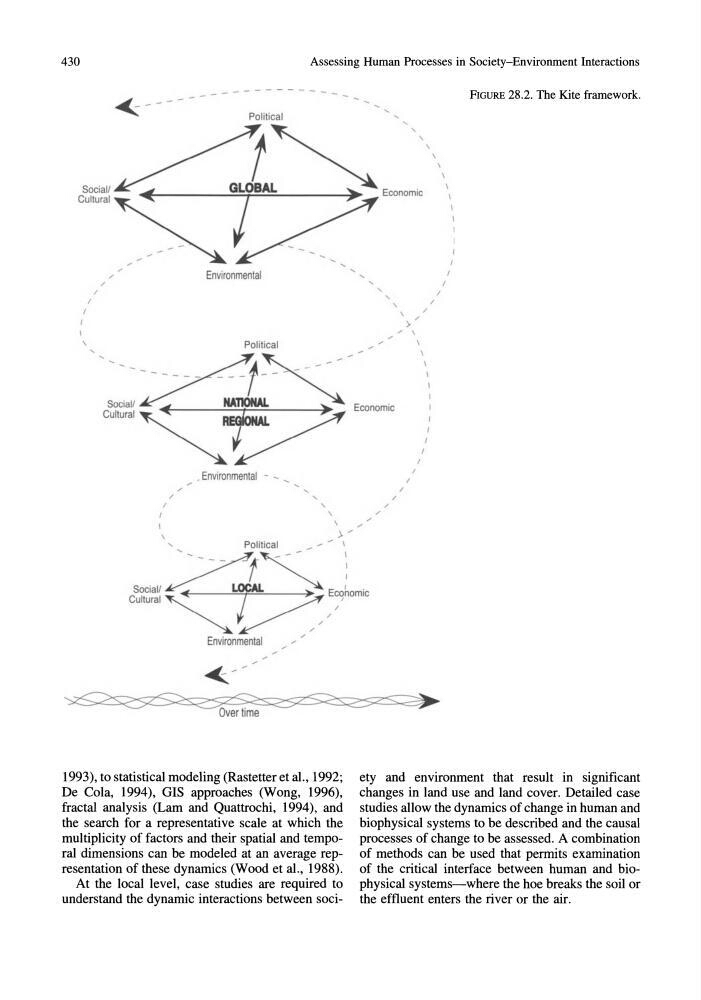
FIGURE 28.2. The Kite framework.
\
"--- ;A~-= ~ V ',,",m' ,
I
I
. Environmental -
" \
\
\
J. '
"
Political
~
\
/
"
I
I
~,~ '
Social!
0(
r > Ecohomic
CUltural~ ~ //I
Environmental
Overtime
1993), to statistical modeling (Rastetter et al., 1992;
De Cola, 1994), GIS approaches (Wong, 1996),
fractal analysis (Lam and Quattrochi, 1994), and
the search for a representative scale at which the
multiplicity of factors and their spatial and temporal dimensions can be modeled at an average representation of these dynamics (Wood et aI., 1988).
At the local level, case studies are required to
understand the dynamic interactions between society and environment that result in significant
changes in land use and land cover. Detailed case
studies allow the dynamics of change in human and
biophysical systems to be described and the causal
processes of change to be assessed. A combination
of methods can be used that permits examination
of the critical interface between human and biophysical systems-where the hoe breaks the soil or
the effluent enters the river or the air.
Assessing Human Processes in Society-Environment Interactions
Social!
Cultural
I
I
/
/
<: -----Environmental
,
\
Political
,
\
\
\;..'/ /
-- \
\
\
\
\
\
I
I
FIGURE 28.2. The Kite framework.
\
"--- ;A~-= ~ V ',,",m' ,
I
I
. Environmental -
" \
\
\
J. '
"
Political
~
\
/
"
I
I
~,~ '
Social!
0(
r > Ecohomic
CUltural~ ~ //I
Environmental
Overtime
1993), to statistical modeling (Rastetter et al., 1992;
De Cola, 1994), GIS approaches (Wong, 1996),
fractal analysis (Lam and Quattrochi, 1994), and
the search for a representative scale at which the
multiplicity of factors and their spatial and temporal dimensions can be modeled at an average representation of these dynamics (Wood et aI., 1988).
At the local level, case studies are required to
understand the dynamic interactions between society and environment that result in significant
changes in land use and land cover. Detailed case
studies allow the dynamics of change in human and
biophysical systems to be described and the causal
processes of change to be assessed. A combination
of methods can be used that permits examination
of the critical interface between human and biophysical systems-where the hoe breaks the soil or
the effluent enters the river or the air.