

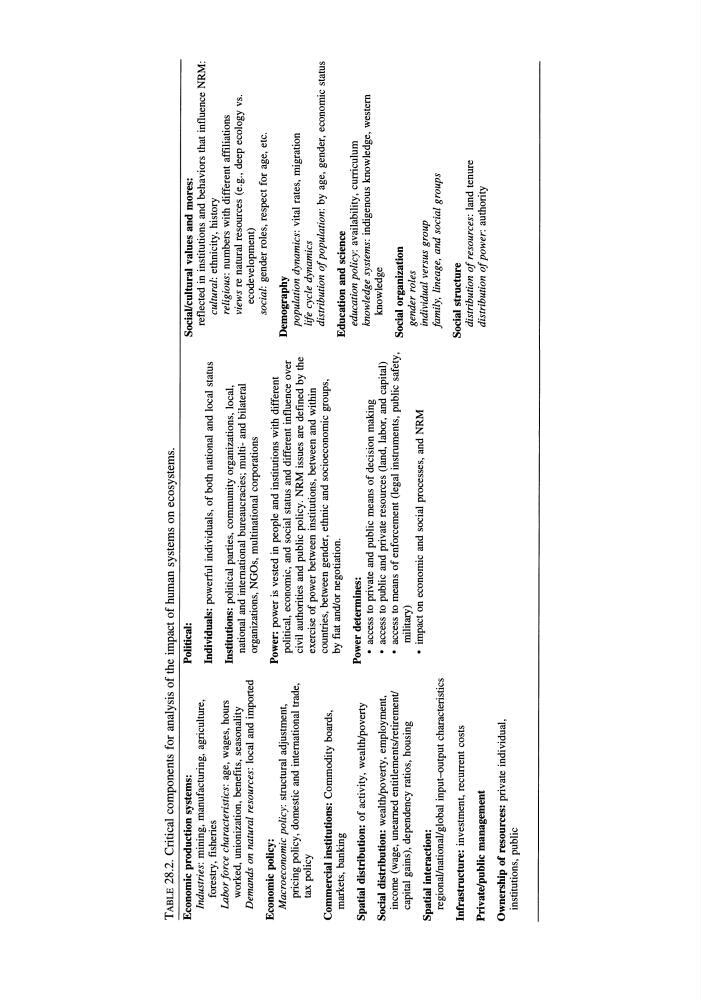
TABLE
28.2. Critical components for analysis of the impact of human systems on ecosystems.
Economic production systems:
Industries: mining, manufacturing, agriculture,
forestry, fisheries
Labor force characteristics: age, wages, hours
worked, unionization, benefits, seasonality
Demands on natural resources: local and imported
Economic policy:
Macroeconomic policy: structural adjustment,
pricing policy, domestic and international trade,
tax policy
Commercial institutions: Commodity boards,
markets, banking
Spatial distribution:
of activity, wealth/poverty
Social distribution: wealth/poverty, employment,
income (wage, unearned entitlements/retirement!
capital gains), dependency ratios, housing
Spatial interaction:
regional/national/global input-output characteristics
Infrastructure: investment, recurrent costs
Private/public management
Ownership of resources: private individual,
institutions, public
Political:
Individuals: powerful individuals, of both national and local status
Institutions: political parties, community organizations, local,
national and international bureaucracies; multi- and bilateral
organizations, NOOs, multinational corporations
Power: power is vested in people and institutions with different
political, economic, and social status and different influence over
civil authorities and public policy. NRM issues are defined by the
exercise of power between institutions, between and within
countries, between gender, ethnic and socioeconomic groups,
by fiat and/or negotiation.
Power determines:
• access
to private and public means of decision making
• access
to public and private resources (land, labor, and capital)
• access to
means of enforcement (legal instruments, public safety,
military)
• impact on economic and social processes, and NRM
Social/cultural values and mores:
reflected in institutions and behaviors that influence NRM:
cultural: ethnicity, history
religious: numbers with different affiliations
views re natural resources (e.g., deep ecology vs.
ecodevelopment)
social: gender roles, respect for age, etc.
Demography
population dynamics: vital rates, migration
life cycle dynamics
distribution of population: by age, gender, economic status
Education
and science
education policy: availability, curriculum
knowledge systems: indigenous knowledge, western
knowledge
Social organization
gender roles
individual versus group
family, lineage, and social groups
Social structure
distribution of resources: land tenure
distribution of power: authority
28.2. Critical components for analysis of the impact of human systems on ecosystems.
Economic production systems:
Industries: mining, manufacturing, agriculture,
forestry, fisheries
Labor force characteristics: age, wages, hours
worked, unionization, benefits, seasonality
Demands on natural resources: local and imported
Economic policy:
Macroeconomic policy: structural adjustment,
pricing policy, domestic and international trade,
tax policy
Commercial institutions: Commodity boards,
markets, banking
Spatial distribution:
of activity, wealth/poverty
Social distribution: wealth/poverty, employment,
income (wage, unearned entitlements/retirement!
capital gains), dependency ratios, housing
Spatial interaction:
regional/national/global input-output characteristics
Infrastructure: investment, recurrent costs
Private/public management
Ownership of resources: private individual,
institutions, public
Political:
Individuals: powerful individuals, of both national and local status
Institutions: political parties, community organizations, local,
national and international bureaucracies; multi- and bilateral
organizations, NOOs, multinational corporations
Power: power is vested in people and institutions with different
political, economic, and social status and different influence over
civil authorities and public policy. NRM issues are defined by the
exercise of power between institutions, between and within
countries, between gender, ethnic and socioeconomic groups,
by fiat and/or negotiation.
Power determines:
• access
to private and public means of decision making
• access
to public and private resources (land, labor, and capital)
• access to
means of enforcement (legal instruments, public safety,
military)
• impact on economic and social processes, and NRM
Social/cultural values and mores:
reflected in institutions and behaviors that influence NRM:
cultural: ethnicity, history
religious: numbers with different affiliations
views re natural resources (e.g., deep ecology vs.
ecodevelopment)
social: gender roles, respect for age, etc.
Demography
population dynamics: vital rates, migration
life cycle dynamics
distribution of population: by age, gender, economic status
Education
and science
education policy: availability, curriculum
knowledge systems: indigenous knowledge, western
knowledge
Social organization
gender roles
individual versus group
family, lineage, and social groups
Social structure
distribution of resources: land tenure
distribution of power: authority