

26.4 Assessing Conservation Status of Freshwater Biota
with formerly extensive distribution across the region are already extinct or declining across vast
portions of their native range. By conveying endangerment and extinction data in a spatially explicit way and by placing simple lists of populations and streams into a landscape context, the
mapping approach better reveals the expansive nature of biotic loss in aquatic ecosystems. Recent
federal government decisions to confer regional
protection for certain threatened salmon species under the Endangered Species Act have considered
regional patterns of endangerment, even where
stream-specific population data are lacking. Allendorf et al. (1997) recommend that priorities for
salmon protection include such large-scale spatial
considerations as the regional extinction patterns
among co-occurring fishes and other biota and the
possible regional ecological and genetic consequences of local population extinction.
Fragmentation of species ranges at the regional
scale is one consequence of local extinction and decline that is widely evident in species status maps
such as those in Frissell (1993). As individual populations decline, potential metapopulation functions that provide demographic and genetic support
to nearby populations are also compromised. At the
smaller scale of popUlations and metapopulations
within watersheds and river reaches, fragmentation
is an even more widespread and imminent threat to
biotic diversity. Physical barriers (e.g., dams, dewatered or polluted reaches) not only isolate populations and accelerate local extinction by preventing dispersal (Sheldon, 1988; Zwick, 1992;
Dynesius and Nilsson, 1994; Rieman and McIntyre, 1995; Pringle, 1997), but they also disrupt the
continuity of flow of water, sediment, nutrients, and
heat loads, thus altering many ecosystem processes
and favoring introduced over native species (Stanford et al., 1996; Poff et al., 1997; Ward, 1997).
Assessments of an aquatic population's robustness or probability of persistence should consider
the actual and potential spatial distribution of both
the population and its habitat within a catchment
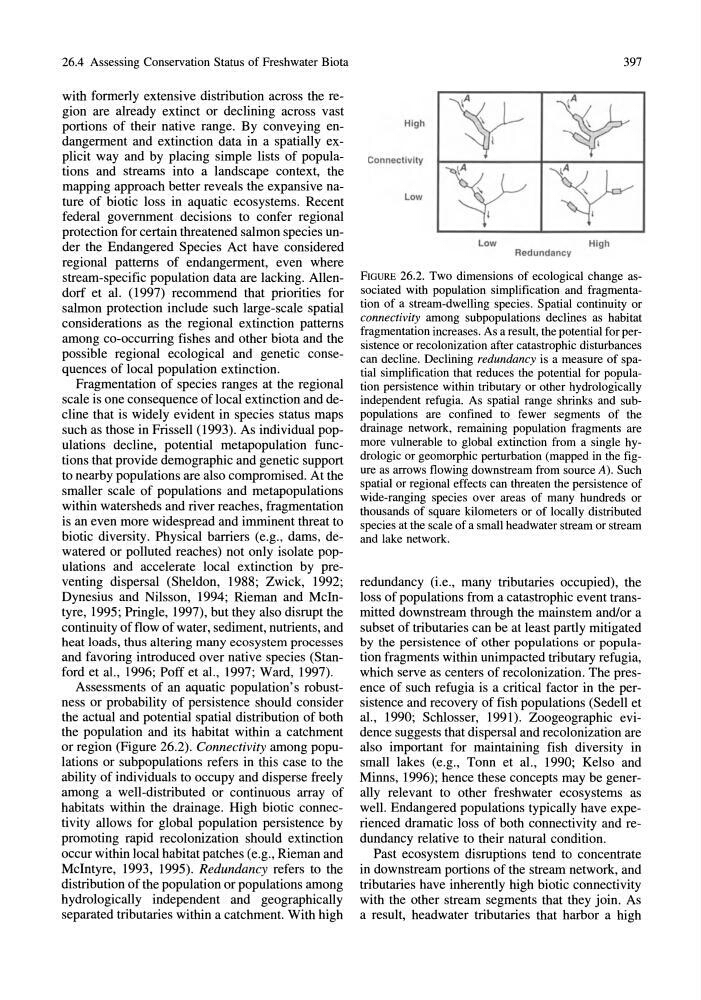
or region (Figure 26.2). Connectivity among populations or sUbpopulations refers in this case to the
ability of individuals to occupy and disperse freely
among a well-distributed or continuous array of
habitats within the drainage. High biotic connectivity allows for global population persistence by
promoting rapid recolonization should extinction
occur within local habitat patches (e.g., Rieman and
McIntyre, 1993, 1995). Redundancy refers to the
distribution of the population or populations among
hydrologically independent and geographically
separated tributaries within a catchment. With high
397
High
Connectivity
Low
Low
Redundancv
High
FIGURE 26.2. Two dimensions of ecological change associated with population simplification and fragmentation of a stream-dwelling species. Spatial continuity or
connectivity among subpopulations declines as habitat
fragmentation increases. As a result, the potential for persistence or recolonization after catastrophic disturbances
can decline. Declining redundancy is a measure of spatial simplification that reduces the potential for population persistence within tributary or other hydrologically
independent refugia. As spatial range shrinks and subpopUlations are confined to fewer segments of the
drainage network, remaining population fragments are
more vulnerable to global extinction from a single hydrologic or geomorphic perturbation (mapped in the figure as arrows flowing downstream from source A). Such
spatial or regional effects can threaten the persistence of
wide-ranging species over areas of many hundreds or
thousands of square kilometers or of locally distributed
species at the scale of a small headwater stream or stream
and lake network.
redundancy (i.e., many tributaries occupied), the
loss of populations from a catastrophic event transmitted downstream through the mainstem andlor a
subset of tributaries can be at least partly mitigated
by the persistence of other populations or population fragments within unimpacted tributary refugia,
which serve as centers of recolonization. The presence of such refugia is a critical factor in the persistence and recovery of fish populations (Sedell et
al., 1990; Schlosser, 1991). Zoogeographic evidence suggests that dispersal and recolonization are
also important for maintaining fish diversity in
small lakes (e.g., Tonn et aI., 1990; Kelso and
Minns, 1996); hence these concepts may be generally relevant to other freshwater ecosystems as
well. Endangered populations typically have experienced dramatic loss of both connectivity and redundancy relative to their natural condition.
Past ecosystem disruptions tend to concentrate
in downstream portions of the stream network, and
tributaries have inherently high biotic connectivity
with the other stream segments that they join. As
a result, headwater tributaries that harbor a high
with formerly extensive distribution across the region are already extinct or declining across vast
portions of their native range. By conveying endangerment and extinction data in a spatially explicit way and by placing simple lists of populations and streams into a landscape context, the
mapping approach better reveals the expansive nature of biotic loss in aquatic ecosystems. Recent
federal government decisions to confer regional
protection for certain threatened salmon species under the Endangered Species Act have considered
regional patterns of endangerment, even where
stream-specific population data are lacking. Allendorf et al. (1997) recommend that priorities for
salmon protection include such large-scale spatial
considerations as the regional extinction patterns
among co-occurring fishes and other biota and the
possible regional ecological and genetic consequences of local population extinction.
Fragmentation of species ranges at the regional
scale is one consequence of local extinction and decline that is widely evident in species status maps
such as those in Frissell (1993). As individual populations decline, potential metapopulation functions that provide demographic and genetic support
to nearby populations are also compromised. At the
smaller scale of popUlations and metapopulations
within watersheds and river reaches, fragmentation
is an even more widespread and imminent threat to
biotic diversity. Physical barriers (e.g., dams, dewatered or polluted reaches) not only isolate populations and accelerate local extinction by preventing dispersal (Sheldon, 1988; Zwick, 1992;
Dynesius and Nilsson, 1994; Rieman and McIntyre, 1995; Pringle, 1997), but they also disrupt the
continuity of flow of water, sediment, nutrients, and
heat loads, thus altering many ecosystem processes
and favoring introduced over native species (Stanford et al., 1996; Poff et al., 1997; Ward, 1997).
Assessments of an aquatic population's robustness or probability of persistence should consider
the actual and potential spatial distribution of both
the population and its habitat within a catchment
or region (Figure 26.2). Connectivity among populations or sUbpopulations refers in this case to the
ability of individuals to occupy and disperse freely
among a well-distributed or continuous array of
habitats within the drainage. High biotic connectivity allows for global population persistence by
promoting rapid recolonization should extinction
occur within local habitat patches (e.g., Rieman and
McIntyre, 1993, 1995). Redundancy refers to the
distribution of the population or populations among
hydrologically independent and geographically
separated tributaries within a catchment. With high
397
High
Connectivity
Low
Low
Redundancv
High
FIGURE 26.2. Two dimensions of ecological change associated with population simplification and fragmentation of a stream-dwelling species. Spatial continuity or
connectivity among subpopulations declines as habitat
fragmentation increases. As a result, the potential for persistence or recolonization after catastrophic disturbances
can decline. Declining redundancy is a measure of spatial simplification that reduces the potential for population persistence within tributary or other hydrologically
independent refugia. As spatial range shrinks and subpopUlations are confined to fewer segments of the
drainage network, remaining population fragments are
more vulnerable to global extinction from a single hydrologic or geomorphic perturbation (mapped in the figure as arrows flowing downstream from source A). Such
spatial or regional effects can threaten the persistence of
wide-ranging species over areas of many hundreds or
thousands of square kilometers or of locally distributed
species at the scale of a small headwater stream or stream
and lake network.
redundancy (i.e., many tributaries occupied), the
loss of populations from a catastrophic event transmitted downstream through the mainstem andlor a
subset of tributaries can be at least partly mitigated
by the persistence of other populations or population fragments within unimpacted tributary refugia,
which serve as centers of recolonization. The presence of such refugia is a critical factor in the persistence and recovery of fish populations (Sedell et
al., 1990; Schlosser, 1991). Zoogeographic evidence suggests that dispersal and recolonization are
also important for maintaining fish diversity in
small lakes (e.g., Tonn et aI., 1990; Kelso and
Minns, 1996); hence these concepts may be generally relevant to other freshwater ecosystems as
well. Endangered populations typically have experienced dramatic loss of both connectivity and redundancy relative to their natural condition.
Past ecosystem disruptions tend to concentrate
in downstream portions of the stream network, and
tributaries have inherently high biotic connectivity
with the other stream segments that they join. As
a result, headwater tributaries that harbor a high