

332
Elements of Ecological Land Classifications for Ecological Assessments
water-based recreation in the United States. The
value of outdoor activities was modeled in ten
coarse-level ecoregions with an individual travel
cost model, a widely used nonmarket valuation
technique (Bowker et a!., 1996). Bhat et a!. (1998)
concluded that outdoor recreation values exhibit
spatial differences across ecoregions in the United
States. In another example, an ELC was incorporated into an impact assessment for the rapid (TGV)
rail link between Rotterdam and Amsterdam in the
Netherlands (Canters et a!., 1991).
Although ELCs receive frequent use, their performance is often not validated, even for the purpose for which they were designed. Notable exceptions include the performance evaluation of the
ecoregional framework used by the US EPA for establishing recovery criteria in aquatic ecosystems
(Hughes et a!., 1990); testing the correspondence
between existing vegetation cover and the ELUs
of an ELC developed with abiotic data in northwestern Wisconsin, USA (Host et a!., 1996) and in
the Pacific Northwest (Wright et aI., 1998); evaluation of the use of an ELC at a fine scale for forest management with a forest succession model
(LINKAGES; Pastor and Post, 1986) in northern
Minnesota, USA (Host and Pastor, 1998); and evaluation of the impact of changing landscape pattern
and land cover variability on ecoregion discrimination in Minnesota (Mladenoff et a!., 1997) and
the ICRB (Bourgeron et a!., 1999).
ELCs are often used for purposes for which they
were not initially designed. For example, terrestrial
ELCs designed for the management of vegetation
are often used for conservation, although biodiversity maintenance generally was not an initial concern in their development. Two existing ELCs (the
US-EPA ELC: Omernik, 1995; the USFS ELC:
ECOMAP, 1993; Bailey, 1995) and two de novo
ELCs (Bourgeron et a!., unpublished) were compared to determine their ability to recover patterns
not used in their construction in the ICRB (Bourgeron et aI., unpublished). The two de novo ELCs
were constructed using direct and indirect variables
(see Section 22.2), respectively. ELCs were evaluated under the hypothesis that, to be useful for a
specific objective, the ELUs of an ELC at a given
scale should differ in the composition of the patterns of interest (Host et a!., 1996). Three levels
were addressed: provinces, sections (ECOMAP,
1993; Bailey, 1995), and subsection groups. The
latter groupings of subsections (ECOMAP, 1993;
Bailey, 1995) were performed for analyses in the
ICBEMP (Jensen et a!., 1997). The US-EPA ELC
was tested solely at the province level, because it
was the only level available for this system that
covered the entire ICRB. An electivity index (Jacobs, 1974; Jenkins, 1979; Pastor and Broschart,
1990) indicated a positive or negative association
of selected patterns with ELUs.
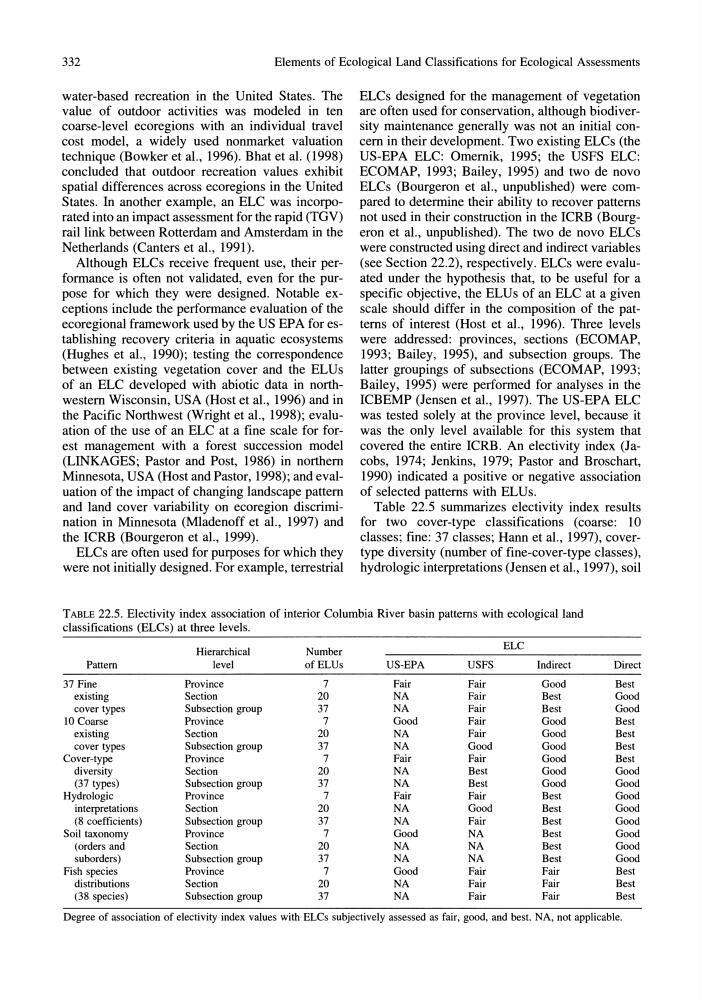
Table 22.5 summarizes electivity index results
for two cover-type classifications (coarse: 10
classes; fine: 37 classes; Hann et a!., 1997), covertype diversity (number of fine-cover-type classes),
hydrologic interpretations (Jensen et a!., 1997), soil
TABLE 22.5. Electivity index association of interior Columbia River basin patterns with ecological land
classifications (ELCs) at three levels.
Hierarchical
Number
ELC
Pattern
level
ofELUs
US-EPA
USFS
Indirect
Direct
37 Fine
Province
7
Fair
Fair
Good
Best
existing
Section
20
NA
Fair
Best
Good
cover types
Subsection group
37
NA
Fair
Best
Good
10 Coarse
Province
7
Good
Fair
Good
Best
existing
Section
20
NA
Fair
Good
Best
cover types
Subsection group
37
NA
Good
Good
Best
Cover-type
Province
7
Fair
Fair
Good
Best
diversity
Section
20
NA
Best
Good
Good
(37 types)
Subsection group
37
NA
Best
Good
Good
Hydrologic
Province
7
Fair
Fair
Best
Good
interpretations
Section
20
NA
Good
Best
Good
(8 coefficients)
Subsection group
37
NA
Fair
Best
Good
Soil taxonomy
Province
7
Good
NA
Best
Good
(orders and
Section
20
NA
NA
Best
Good
suborders)
Subsection group
37
NA
NA
Best
Good
Fish species
Province
7
Good
Fair
Fair
Best
distributions
Section
20
NA
Fair
Fair
Best
(38 species)
Subsection group
37
NA
Fair
Fair
Best
Degree of association of electivity index values with ELCs subjectively assessed as fair, good, and best. NA, not applicable.
Elements of Ecological Land Classifications for Ecological Assessments
water-based recreation in the United States. The
value of outdoor activities was modeled in ten
coarse-level ecoregions with an individual travel
cost model, a widely used nonmarket valuation
technique (Bowker et a!., 1996). Bhat et a!. (1998)
concluded that outdoor recreation values exhibit
spatial differences across ecoregions in the United
States. In another example, an ELC was incorporated into an impact assessment for the rapid (TGV)
rail link between Rotterdam and Amsterdam in the
Netherlands (Canters et a!., 1991).
Although ELCs receive frequent use, their performance is often not validated, even for the purpose for which they were designed. Notable exceptions include the performance evaluation of the
ecoregional framework used by the US EPA for establishing recovery criteria in aquatic ecosystems
(Hughes et a!., 1990); testing the correspondence
between existing vegetation cover and the ELUs
of an ELC developed with abiotic data in northwestern Wisconsin, USA (Host et a!., 1996) and in
the Pacific Northwest (Wright et aI., 1998); evaluation of the use of an ELC at a fine scale for forest management with a forest succession model
(LINKAGES; Pastor and Post, 1986) in northern
Minnesota, USA (Host and Pastor, 1998); and evaluation of the impact of changing landscape pattern
and land cover variability on ecoregion discrimination in Minnesota (Mladenoff et a!., 1997) and
the ICRB (Bourgeron et a!., 1999).
ELCs are often used for purposes for which they
were not initially designed. For example, terrestrial
ELCs designed for the management of vegetation
are often used for conservation, although biodiversity maintenance generally was not an initial concern in their development. Two existing ELCs (the
US-EPA ELC: Omernik, 1995; the USFS ELC:
ECOMAP, 1993; Bailey, 1995) and two de novo
ELCs (Bourgeron et a!., unpublished) were compared to determine their ability to recover patterns
not used in their construction in the ICRB (Bourgeron et aI., unpublished). The two de novo ELCs
were constructed using direct and indirect variables
(see Section 22.2), respectively. ELCs were evaluated under the hypothesis that, to be useful for a
specific objective, the ELUs of an ELC at a given
scale should differ in the composition of the patterns of interest (Host et a!., 1996). Three levels
were addressed: provinces, sections (ECOMAP,
1993; Bailey, 1995), and subsection groups. The
latter groupings of subsections (ECOMAP, 1993;
Bailey, 1995) were performed for analyses in the
ICBEMP (Jensen et a!., 1997). The US-EPA ELC
was tested solely at the province level, because it
was the only level available for this system that
covered the entire ICRB. An electivity index (Jacobs, 1974; Jenkins, 1979; Pastor and Broschart,
1990) indicated a positive or negative association
of selected patterns with ELUs.
Table 22.5 summarizes electivity index results
for two cover-type classifications (coarse: 10
classes; fine: 37 classes; Hann et a!., 1997), covertype diversity (number of fine-cover-type classes),
hydrologic interpretations (Jensen et a!., 1997), soil
TABLE 22.5. Electivity index association of interior Columbia River basin patterns with ecological land
classifications (ELCs) at three levels.
Hierarchical
Number
ELC
Pattern
level
ofELUs
US-EPA
USFS
Indirect
Direct
37 Fine
Province
7
Fair
Fair
Good
Best
existing
Section
20
NA
Fair
Best
Good
cover types
Subsection group
37
NA
Fair
Best
Good
10 Coarse
Province
7
Good
Fair
Good
Best
existing
Section
20
NA
Fair
Good
Best
cover types
Subsection group
37
NA
Good
Good
Best
Cover-type
Province
7
Fair
Fair
Good
Best
diversity
Section
20
NA
Best
Good
Good
(37 types)
Subsection group
37
NA
Best
Good
Good
Hydrologic
Province
7
Fair
Fair
Best
Good
interpretations
Section
20
NA
Good
Best
Good
(8 coefficients)
Subsection group
37
NA
Fair
Best
Good
Soil taxonomy
Province
7
Good
NA
Best
Good
(orders and
Section
20
NA
NA
Best
Good
suborders)
Subsection group
37
NA
NA
Best
Good
Fish species
Province
7
Good
Fair
Fair
Best
distributions
Section
20
NA
Fair
Fair
Best
(38 species)
Subsection group
37
NA
Fair
Fair
Best
Degree of association of electivity index values with ELCs subjectively assessed as fair, good, and best. NA, not applicable.