

21.3 Selected Available Input-Output Modeling Systems: Ready-made Models
313
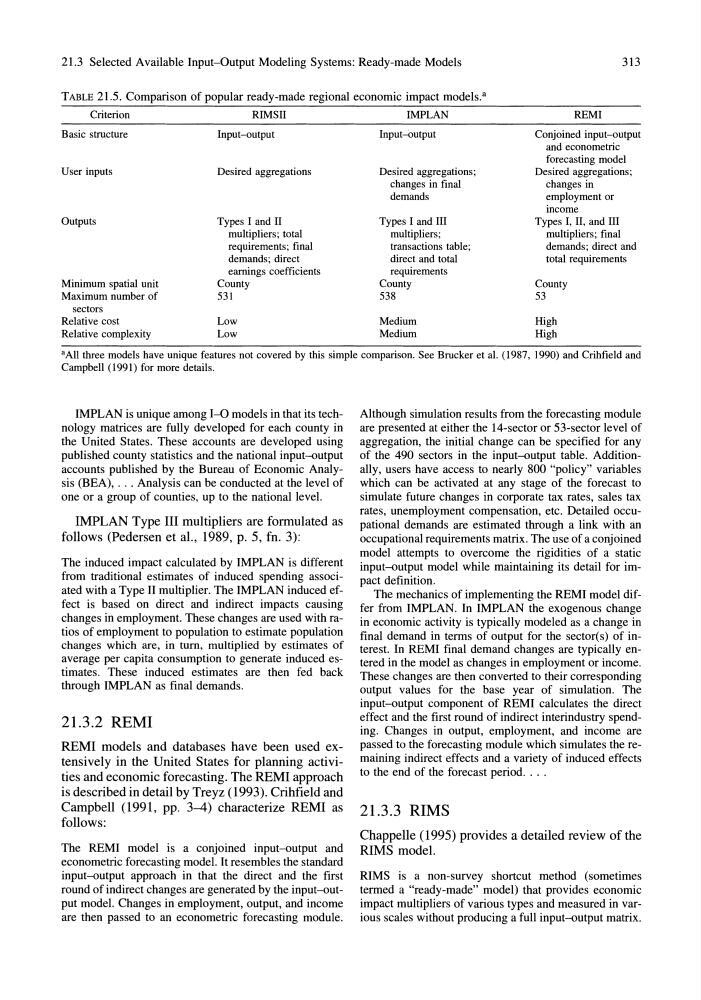
TABLE 21.5. Comparison of popular ready-made regional economic impact models."
Criterion
RIMSII
IMPLAN
REMI
Basic structure
User inputs
Outputs
Minimum spatial unit
Maximum number of
sectors
Relative cost
Relative complexity
Input-output
Desired aggregations
Types I and II
multipliers; total
requirements; final
demands; direct
earnings coefficients
County
531
Low
Low
Input-output
Desired aggregations;
changes in final
demands
Types I and III
multipliers;
transactions table;
direct and total
requirements
County
538
Medium
Medium
Conjoined input-output
and econometric
forecasting model
Desired aggregations;
changes in
employment or
income
Types I. II. and III
multipliers; final
demands; direct and
total requirements
County
53
High
High
aAli three models have unique features not covered by this simple comparison. See Brucker et al. (1987, 1990) and Crihfield and
Campbell (1991) for more details.
IMPLAN is unique among 1-0 models in that its technology matrices are fully developed for each county in
the United States. These accounts are developed using
published county statistics and the national input-output
accounts published by the Bureau of Economic Analysis (BEA), ... Analysis can be conducted at the level of
one or a group of counties, up to the national level.
IMPLAN Type III multipliers are formulated as
follows (Pedersen et aI., 1989, p. 5, fn. 3):
The induced impact calculated by IMPLAN is different
from traditional estimates of induced spending associated with a Type II multiplier. The IMPLAN induced effect is based on direct and indirect impacts causing
changes in employment. These changes are used with ratios of employment to population to estimate population
changes which are, in turn, multiplied by estimates of
average per capita consumption to generate induced estimates. These induced estimates are then fed back
through IMPLAN as final demands.
21.3.2 REMI
REMI models and databases have been used extensively in the United States for planning activities and economic forecasting. The REMI approach
is described in detail by Treyz (1993). Crihfield and
Campbell (1991, pp. 3-4) characterize REMI as
follows:
The REMI model is a conjoined input-output and
econometric forecasting model. It resembles the standard
input-output approach in that the direct and the first
round of indirect changes are generated by the input-output model. Changes in employment, output, and income
are then passed to an econometric forecasting module.
Although simulation results from the forecasting module
are presented at either the 14-sector or 53-sector level of
aggregation, the initial change can be specified for any
of the 490 sectors in the input-output table. Additionally, users have access to nearly 800 "policy" variables
which can be activated at any stage of the forecast to
simulate future changes in corporate tax rates, sales tax
rates, unemployment compensation, etc. Detailed occupational demands are estimated through a link with an
occupational requirements matrix. The use of a conjoined
model attempts to overcome the rigidities of a static
input-output model while maintaining its detail for impact definition.
The mechanics of implementing the REMI model differ from IMPLAN. In IMPLAN the exogenous change
in economic activity is typically modeled as a change in
final demand in terms of output for the sector(s) of interest. In REMI final demand changes are typically entered in the model as changes in employment or income.
These changes are then converted to their corresponding
output values for the base year of simulation. The
input-output component of REMI calculates the direct
effect and the first round of indirect interindustry spending. Changes in output, employment, and income are
passed to the forecasting module which simulates the remaining indirect effects and a variety of induced effects
to the end of the forecast period ....
21.3.3 RIMS
Chappelle (1995) provides a detailed review of the
RIMS model.
RIMS is a non-survey shortcut method (sometimes
termed a "ready-made" model) that provides economic
impact multipliers of various types and measured in various scales without producing a full input-output matrix.
313
TABLE 21.5. Comparison of popular ready-made regional economic impact models."
Criterion
RIMSII
IMPLAN
REMI
Basic structure
User inputs
Outputs
Minimum spatial unit
Maximum number of
sectors
Relative cost
Relative complexity
Input-output
Desired aggregations
Types I and II
multipliers; total
requirements; final
demands; direct
earnings coefficients
County
531
Low
Low
Input-output
Desired aggregations;
changes in final
demands
Types I and III
multipliers;
transactions table;
direct and total
requirements
County
538
Medium
Medium
Conjoined input-output
and econometric
forecasting model
Desired aggregations;
changes in
employment or
income
Types I. II. and III
multipliers; final
demands; direct and
total requirements
County
53
High
High
aAli three models have unique features not covered by this simple comparison. See Brucker et al. (1987, 1990) and Crihfield and
Campbell (1991) for more details.
IMPLAN is unique among 1-0 models in that its technology matrices are fully developed for each county in
the United States. These accounts are developed using
published county statistics and the national input-output
accounts published by the Bureau of Economic Analysis (BEA), ... Analysis can be conducted at the level of
one or a group of counties, up to the national level.
IMPLAN Type III multipliers are formulated as
follows (Pedersen et aI., 1989, p. 5, fn. 3):
The induced impact calculated by IMPLAN is different
from traditional estimates of induced spending associated with a Type II multiplier. The IMPLAN induced effect is based on direct and indirect impacts causing
changes in employment. These changes are used with ratios of employment to population to estimate population
changes which are, in turn, multiplied by estimates of
average per capita consumption to generate induced estimates. These induced estimates are then fed back
through IMPLAN as final demands.
21.3.2 REMI
REMI models and databases have been used extensively in the United States for planning activities and economic forecasting. The REMI approach
is described in detail by Treyz (1993). Crihfield and
Campbell (1991, pp. 3-4) characterize REMI as
follows:
The REMI model is a conjoined input-output and
econometric forecasting model. It resembles the standard
input-output approach in that the direct and the first
round of indirect changes are generated by the input-output model. Changes in employment, output, and income
are then passed to an econometric forecasting module.
Although simulation results from the forecasting module
are presented at either the 14-sector or 53-sector level of
aggregation, the initial change can be specified for any
of the 490 sectors in the input-output table. Additionally, users have access to nearly 800 "policy" variables
which can be activated at any stage of the forecast to
simulate future changes in corporate tax rates, sales tax
rates, unemployment compensation, etc. Detailed occupational demands are estimated through a link with an
occupational requirements matrix. The use of a conjoined
model attempts to overcome the rigidities of a static
input-output model while maintaining its detail for impact definition.
The mechanics of implementing the REMI model differ from IMPLAN. In IMPLAN the exogenous change
in economic activity is typically modeled as a change in
final demand in terms of output for the sector(s) of interest. In REMI final demand changes are typically entered in the model as changes in employment or income.
These changes are then converted to their corresponding
output values for the base year of simulation. The
input-output component of REMI calculates the direct
effect and the first round of indirect interindustry spending. Changes in output, employment, and income are
passed to the forecasting module which simulates the remaining indirect effects and a variety of induced effects
to the end of the forecast period ....
21.3.3 RIMS
Chappelle (1995) provides a detailed review of the
RIMS model.
RIMS is a non-survey shortcut method (sometimes
termed a "ready-made" model) that provides economic
impact multipliers of various types and measured in various scales without producing a full input-output matrix.