

20
An Overview of Ecological Assessment Principles and Applications
Ve2etation Hierarchy
e o
0E
.,
r
Social Hierarchy
16
\0
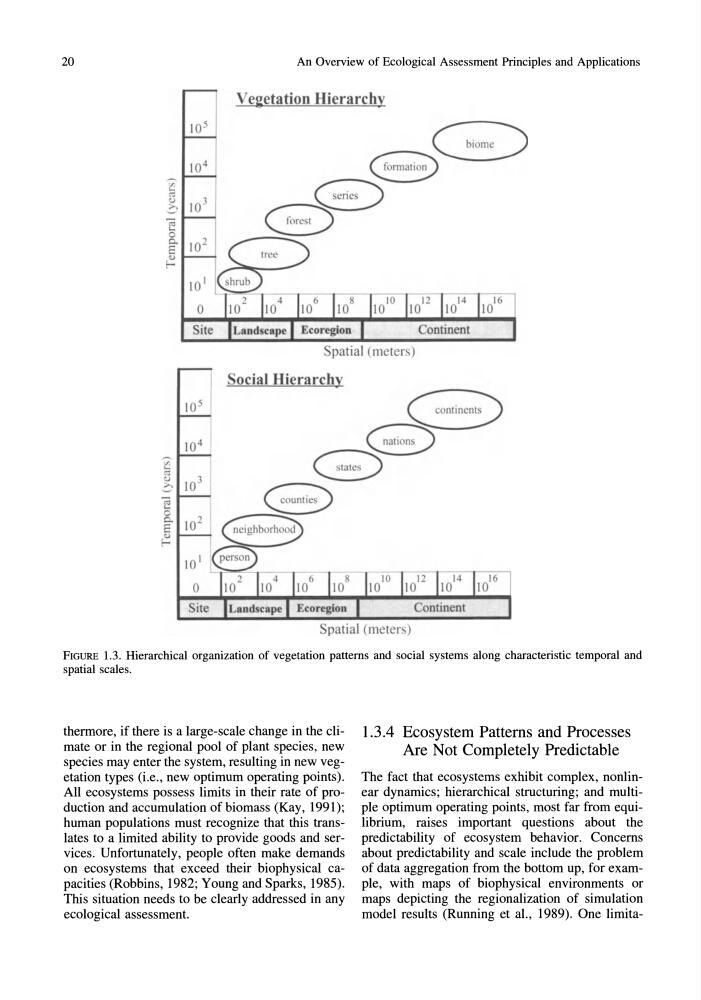
FIGURE 1.3. Hierarchical organization of vegetation patterns and social systems along characteristic temporal and
spatial scales.
thermore, if there is a large-scale change in the climate or in the regional pool of plant species, new
species may enter the system, resulting in new vegetation types (i.e., new optimum operating points).
All ecosystems possess limits in their rate of production and accumulation of biomass (Kay, 1991);
human popUlations must recognize that this translates to a limited ability to provide goods and services. Unfortunately, people often make demands
on ecosystems that exceed their biophysical capacities (Robbins, 1982; Young and Sparks, 1985).
This situation needs to be clearly addressed in any
ecological assessment.
1.3.4 Ecosystem Patterns and Processes
Are Not Completely Predictable
The fact that ecosystems exhibit complex, nonlinear dynamics; hierarchical structuring; and multiple optimum operating points, most far from equilibrium, raises important questions about the
predictability of ecosystem behavior. Concerns
about predictability and scale include the problem
of data aggregation from the bottom up, for example, with maps of biophysical environments or
maps depicting the regionalization of simulation
model results (Running et aI., 1989). One limita-
An Overview of Ecological Assessment Principles and Applications
Ve2etation Hierarchy
e o
0E
.,
r
Social Hierarchy
16
\0
FIGURE 1.3. Hierarchical organization of vegetation patterns and social systems along characteristic temporal and
spatial scales.
thermore, if there is a large-scale change in the climate or in the regional pool of plant species, new
species may enter the system, resulting in new vegetation types (i.e., new optimum operating points).
All ecosystems possess limits in their rate of production and accumulation of biomass (Kay, 1991);
human popUlations must recognize that this translates to a limited ability to provide goods and services. Unfortunately, people often make demands
on ecosystems that exceed their biophysical capacities (Robbins, 1982; Young and Sparks, 1985).
This situation needs to be clearly addressed in any
ecological assessment.
1.3.4 Ecosystem Patterns and Processes
Are Not Completely Predictable
The fact that ecosystems exhibit complex, nonlinear dynamics; hierarchical structuring; and multiple optimum operating points, most far from equilibrium, raises important questions about the
predictability of ecosystem behavior. Concerns
about predictability and scale include the problem
of data aggregation from the bottom up, for example, with maps of biophysical environments or
maps depicting the regionalization of simulation
model results (Running et aI., 1989). One limita-