

18
An Overview of Ecological Assessment Principles and Applications
. . CROWN FIRE
~ GROUND FIRE
100
80
60
40
20
1000 1200 1300 1400 1500 1600 1700 1800 1900 2000 2100
YEARS
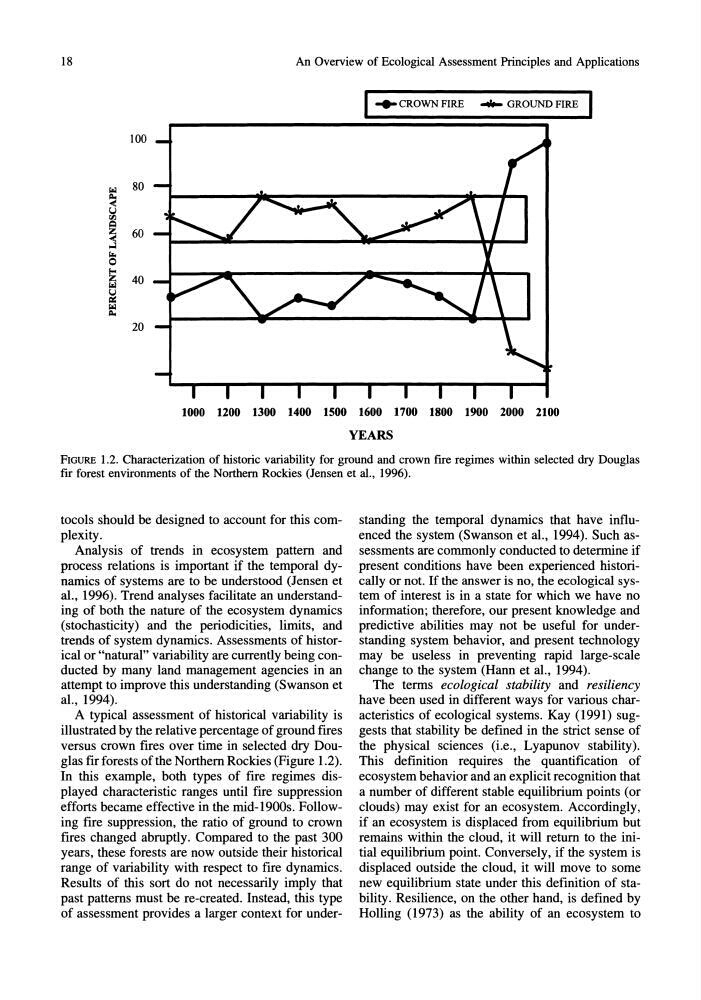
FIGURE 1.2. Characterization of historic variability for ground and crown fire regimes within selected dry Douglas
fir forest environments of the Northern Rockies (Jensen et aI., 1996).
tocols should be designed to account for this complexity.
Analysis of trends in ecosystem pattern and
process relations is important if the temporal dynamics of systems are to be understood (Jensen et
al., 1996). Trend analyses facilitate an understanding of both the nature of the ecosystem dynamics
(stochasticity) and the periodicities, limits, and
trends of system dynamics. Assessments of historical or "natural" variability are currently being conducted by many land management agencies in an
attempt to improve this understanding (Swanson et
aI., 1994).
A typical assessment of historical variability is
illustrated by the relative percentage of ground fires
versus crown fires over time in selected dry Douglas fir forests of the Northern Rockies (Figure 1.2).
In this example, both types of fire regimes displayed characteristic ranges until fire suppression
efforts became effective in the mid-1900s. Following fire suppression, the ratio of ground to crown
fires changed abruptly. Compared to the past 300
years, these forests are now outside their historical
range of variability with respect to fire dynamics.
Results of this sort do not necessarily imply that
past patterns must be re-created. Instead, this type
of assessment provides a larger context for understanding the temporal dynamics that have influenced the system (Swanson et aI., 1994). Such assessments are commonly conducted to determine if
present conditions have been experienced historically or not. If the answer is no, the ecological system of interest is in a state for which we have no
information; therefore, our present knowledge and
predictive abilities may not be useful for understanding system behavior, and present technology
may be useless in preventing rapid large-scale
change to the system (Hann et aI., 1994).
The terms ecological stability and resiliency
have been used in different ways for various characteristics of ecological systems. Kay (1991) suggests that stability be defined in the strict sense of
the physical sciences (i.e., Lyapunov stability).
This definition requires the quantification of
ecosystem behavior and an explicit recognition that
a number of different stable eqUilibrium points (or
clouds) may exist for an ecosystem. Accordingly,
if an ecosystem is displaced from equilibrium but
remains within the cloud, it will return to the initial eqUilibrium point. Conversely, if the system is
displaced outside the cloud, it will move to some
new equilibrium state under this definition of stability. Resilience, on the other hand, is defined by
Holling (1973) as the ability of an ecosystem to
An Overview of Ecological Assessment Principles and Applications
. . CROWN FIRE
~ GROUND FIRE
100
80
60
40
20
1000 1200 1300 1400 1500 1600 1700 1800 1900 2000 2100
YEARS
FIGURE 1.2. Characterization of historic variability for ground and crown fire regimes within selected dry Douglas
fir forest environments of the Northern Rockies (Jensen et aI., 1996).
tocols should be designed to account for this complexity.
Analysis of trends in ecosystem pattern and
process relations is important if the temporal dynamics of systems are to be understood (Jensen et
al., 1996). Trend analyses facilitate an understanding of both the nature of the ecosystem dynamics
(stochasticity) and the periodicities, limits, and
trends of system dynamics. Assessments of historical or "natural" variability are currently being conducted by many land management agencies in an
attempt to improve this understanding (Swanson et
aI., 1994).
A typical assessment of historical variability is
illustrated by the relative percentage of ground fires
versus crown fires over time in selected dry Douglas fir forests of the Northern Rockies (Figure 1.2).
In this example, both types of fire regimes displayed characteristic ranges until fire suppression
efforts became effective in the mid-1900s. Following fire suppression, the ratio of ground to crown
fires changed abruptly. Compared to the past 300
years, these forests are now outside their historical
range of variability with respect to fire dynamics.
Results of this sort do not necessarily imply that
past patterns must be re-created. Instead, this type
of assessment provides a larger context for understanding the temporal dynamics that have influenced the system (Swanson et aI., 1994). Such assessments are commonly conducted to determine if
present conditions have been experienced historically or not. If the answer is no, the ecological system of interest is in a state for which we have no
information; therefore, our present knowledge and
predictive abilities may not be useful for understanding system behavior, and present technology
may be useless in preventing rapid large-scale
change to the system (Hann et aI., 1994).
The terms ecological stability and resiliency
have been used in different ways for various characteristics of ecological systems. Kay (1991) suggests that stability be defined in the strict sense of
the physical sciences (i.e., Lyapunov stability).
This definition requires the quantification of
ecosystem behavior and an explicit recognition that
a number of different stable eqUilibrium points (or
clouds) may exist for an ecosystem. Accordingly,
if an ecosystem is displaced from equilibrium but
remains within the cloud, it will return to the initial eqUilibrium point. Conversely, if the system is
displaced outside the cloud, it will move to some
new equilibrium state under this definition of stability. Resilience, on the other hand, is defined by
Holling (1973) as the ability of an ecosystem to