

274
Methods for Determining Historical Range of Variability
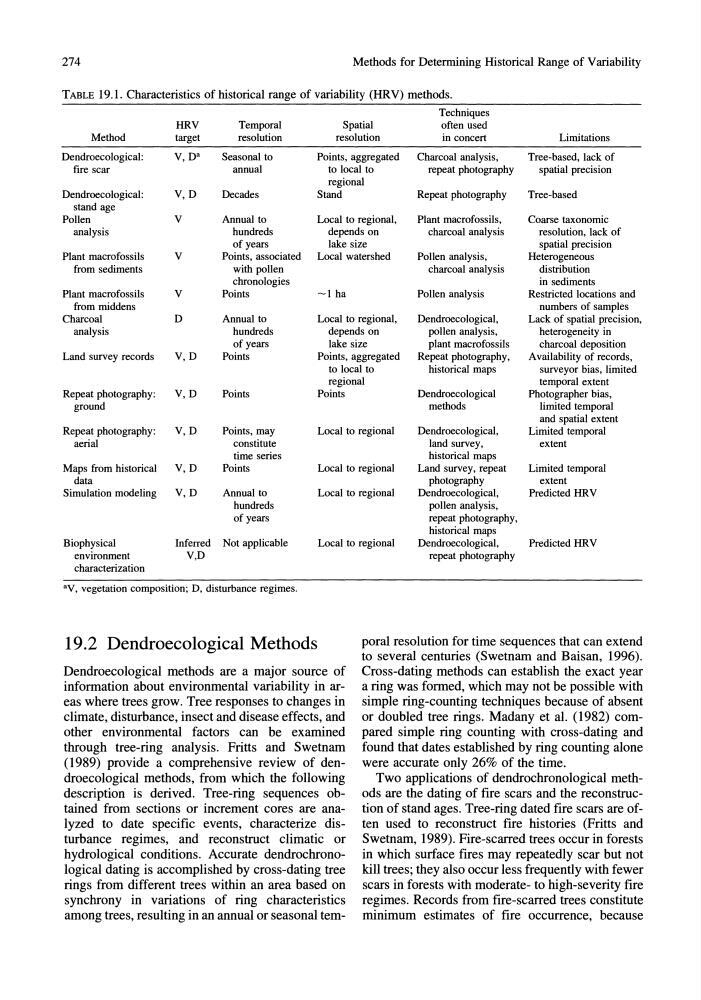
TABLE 19.1. Characteristics of historical range of variability (HRV) methods.
Techniques
HRV
Temporal
Spatial
often used
Method
target
resolution
resolution
in concert
Limitations
Dendroecological:
V,Da
Seasonal to
Points, aggregated
Charcoal analysis,
Tree-based, lack of
fire scar
annual
to local to
repeat photography
spatial precision
regional
Dendroecological:
V,D
Decades
Stand
Repeat photography
Tree-based
stand age
Pollen
V
Annual to
Local to regional.
Plant macrofossils,
Coarse taxonomic
analysis
hundreds
depends on
charcoal analysis
resolution, lack of
of years
lake size
spatial precision
Plant macrofossils
V
Points, associated Local watershed
Pollen analysis,
Heterogeneous
from sediments
with pollen
charcoal analysis
distribution
chronologies
in sediments
Plant macrofossils
V
Points
~l ha
Pollen analysis
Restricted locations and
from middens
numbers of samples
Charcoal
D
Annual to
Local to regional,
Dendroecological,
Lack of spatial precision,
analysis
hundreds
depends on
pollen analysis,
heterogeneity in
of years
lake size
plant macrofossils
charcoal deposition
Land survey records
V,D
Points
Points, aggregated
Repeat photography,
Availability of records,
to local to
historical maps
surveyor bias, limited
regional
temporal extent
Repeat photography:
V,D
Points
Points
Dendroecological
Photographer bias,
ground
methods
limited temporal
and spatial extent
Repeat photography:
V,D
Points, may
Local to regional
Dendroecological,
Limited temporal
aerial
constitute
land survey,
extent
time series
historical maps
Maps from historical
V,D
Points
Local to regional
Land survey, repeat
Limited temporal
data
photography
extent
Simulation modeling
V,D
Annual to
Local to regional
Dendroecological,
Predicted HRV
hundreds
pollen analysis,
of years
repeat photography,
historical maps
Biophysical
Inferred Not applicable
Local to regional
Dendroecological,
Predicted HRV
environment
V,D
characterization
av, vegetation composition; D. disturbance regimes.
19.2 Dendroecological Methods
Dendroecological methods are a major source of
information about environmental variability in areas where trees grow. Tree responses to changes in
climate, disturbance, insect and disease effects, and
other environmental factors can be examined
through tree-ring analysis. Fritts and Swetnam
(1989) provide a comprehensive review of dendroecological methods, from which the following
description is derived. Tree-ring sequences obtained from sections or increment cores are analyzed to date specific events, characterize disturbance regimes, and reconstruct climatic or
hydrological conditions. Accurate dendrochronological dating is accomplished by cross-dating tree
rings from different trees within an area based on
synchrony in variations of ring characteristics
among trees, resulting in an annual or seasonal temrepeat photography
poral resolution for time sequences that can extend
to several centuries (Swetnam and Baisan, 1996).
Cross-dating methods can establish the exact year
a ring was formed, which may not be possible with
simple ring-counting techniques because of absent
or doubled tree rings. Madany et al. (1982) compared simple ring counting with cross-dating and
found that dates established by ring counting alone
were accurate only 26% of the time.
Two applications of dendrochronological methods are the dating of fire scars and the reconstruction of stand ages. Tree-ring dated fire scars are often used to reconstruct fire histories (Fritts and
Swetnam, 1989). Fire-scarred trees occur in forests
in which surface fires may repeatedly scar but not
kill trees; they also occur less frequently with fewer
scars in forests with moderate- to high-severity fire
regimes. Records from fire-scarred trees constitute
minimum estimates of fire occurrence, because
Methods for Determining Historical Range of Variability
TABLE 19.1. Characteristics of historical range of variability (HRV) methods.
Techniques
HRV
Temporal
Spatial
often used
Method
target
resolution
resolution
in concert
Limitations
Dendroecological:
V,Da
Seasonal to
Points, aggregated
Charcoal analysis,
Tree-based, lack of
fire scar
annual
to local to
repeat photography
spatial precision
regional
Dendroecological:
V,D
Decades
Stand
Repeat photography
Tree-based
stand age
Pollen
V
Annual to
Local to regional.
Plant macrofossils,
Coarse taxonomic
analysis
hundreds
depends on
charcoal analysis
resolution, lack of
of years
lake size
spatial precision
Plant macrofossils
V
Points, associated Local watershed
Pollen analysis,
Heterogeneous
from sediments
with pollen
charcoal analysis
distribution
chronologies
in sediments
Plant macrofossils
V
Points
~l ha
Pollen analysis
Restricted locations and
from middens
numbers of samples
Charcoal
D
Annual to
Local to regional,
Dendroecological,
Lack of spatial precision,
analysis
hundreds
depends on
pollen analysis,
heterogeneity in
of years
lake size
plant macrofossils
charcoal deposition
Land survey records
V,D
Points
Points, aggregated
Repeat photography,
Availability of records,
to local to
historical maps
surveyor bias, limited
regional
temporal extent
Repeat photography:
V,D
Points
Points
Dendroecological
Photographer bias,
ground
methods
limited temporal
and spatial extent
Repeat photography:
V,D
Points, may
Local to regional
Dendroecological,
Limited temporal
aerial
constitute
land survey,
extent
time series
historical maps
Maps from historical
V,D
Points
Local to regional
Land survey, repeat
Limited temporal
data
photography
extent
Simulation modeling
V,D
Annual to
Local to regional
Dendroecological,
Predicted HRV
hundreds
pollen analysis,
of years
repeat photography,
historical maps
Biophysical
Inferred Not applicable
Local to regional
Dendroecological,
Predicted HRV
environment
V,D
characterization
av, vegetation composition; D. disturbance regimes.
19.2 Dendroecological Methods
Dendroecological methods are a major source of
information about environmental variability in areas where trees grow. Tree responses to changes in
climate, disturbance, insect and disease effects, and
other environmental factors can be examined
through tree-ring analysis. Fritts and Swetnam
(1989) provide a comprehensive review of dendroecological methods, from which the following
description is derived. Tree-ring sequences obtained from sections or increment cores are analyzed to date specific events, characterize disturbance regimes, and reconstruct climatic or
hydrological conditions. Accurate dendrochronological dating is accomplished by cross-dating tree
rings from different trees within an area based on
synchrony in variations of ring characteristics
among trees, resulting in an annual or seasonal temrepeat photography
poral resolution for time sequences that can extend
to several centuries (Swetnam and Baisan, 1996).
Cross-dating methods can establish the exact year
a ring was formed, which may not be possible with
simple ring-counting techniques because of absent
or doubled tree rings. Madany et al. (1982) compared simple ring counting with cross-dating and
found that dates established by ring counting alone
were accurate only 26% of the time.
Two applications of dendrochronological methods are the dating of fire scars and the reconstruction of stand ages. Tree-ring dated fire scars are often used to reconstruct fire histories (Fritts and
Swetnam, 1989). Fire-scarred trees occur in forests
in which surface fires may repeatedly scar but not
kill trees; they also occur less frequently with fewer
scars in forests with moderate- to high-severity fire
regimes. Records from fire-scarred trees constitute
minimum estimates of fire occurrence, because