

258
Ecosystem Structure and Function Modeling
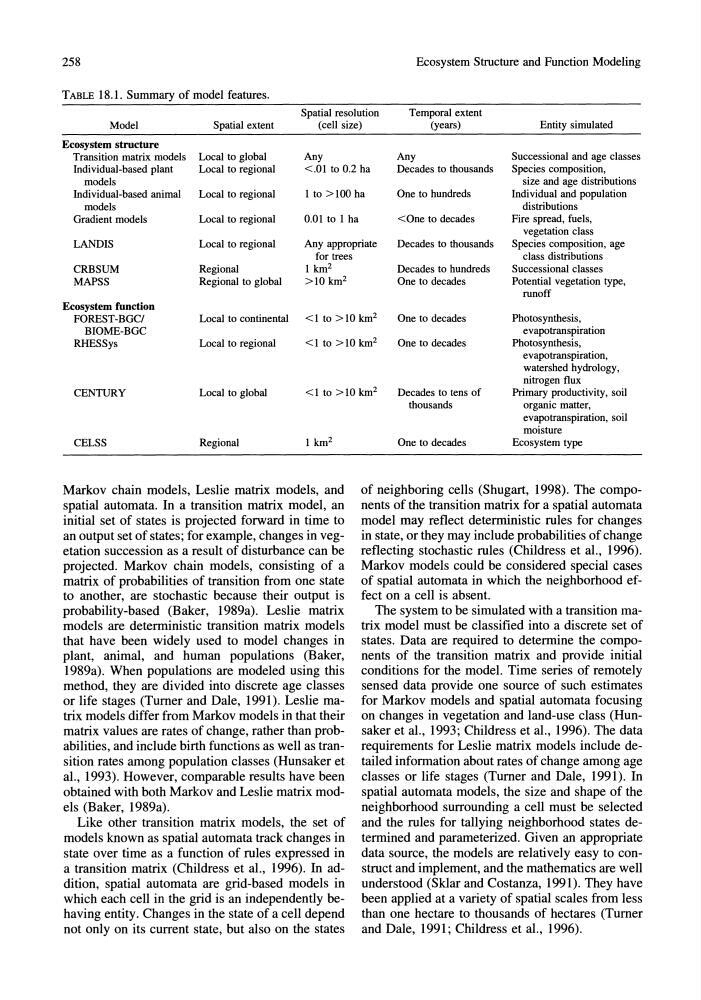
TABLE 18.1. Summary of model features.
Spatial resolution
Temporal extent
Model
Spatial extent
(cell size)
(years)
Entity simulated
Ecosystem structure
Transition matrix models Local to global
Any
Any
Successional and age classes
Individual-based plant
Local to regional
<.01 to 0.2 ha
Decades to thousands
Species composition,
models
size and age distributions
Individual-based animal
Local to regional
1 to >100 ha
One to hundreds
Individual and population
models
distributions
Gradient models
Local to regional
0.01 to I ha
vegetation class
LANDIS
Local to regional
Any appropriate
Decades to thousands
Species composition, age
for trees
class distributions
CRBSUM
Regional
1 km 2
Decades to hundreds
Successional classes
MAPSS
Regional to global
>10 km 2
One to decades
Potential vegetation type,
runoff
Ecosystem function
FOREST-BGCI
Local to continental
<1 to >10 km 2
One to decades
Photosynthesis,
BIOME-BGC
evapotranspiration
RHESSys
Local to regional
<1 to >10 km 2
One to decades
Photosynthesis,
evapotranspiration,
watershed hydrology,
nitrogen flux
CENTURY
Local to global
10 km 2
Decades to tens of
Primary productivity, soil
CELSS
Regional
I km 2
Markov chain models, Leslie matrix models, and
spatial automata. In a transition matrix model, an
initial set of states is projected forward in time to
an output set of states; for example, changes in vegetation succession as a result of disturbance can be
projected. Markov chain models, consisting of a
matrix of probabilities of transition from one state
to another, are stochastic because their output is
probability-based (Baker, 1989a). Leslie matrix
models are deterministic transition matrix models
that have been widely used to model changes in
plant, animal, and human populations (Baker,
1989a). When popUlations are modeled using this
method, they are divided into discrete age classes
or life stages (Turner and Dale, 1991). Leslie matrix models differ from Markov models in that their
matrix values are rates of change, rather than probabilities, and include birth functions as well as transition rates among population classes (Hunsaker et
aI., 1993). However, comparable results have been
obtained with both Markov and Leslie matrix models (Baker, 1989a).
Like other transition matrix models, the set of
models known as spatial automata track changes in
state over time as a function of rules expressed in
a transition matrix (Childress et aI., 1996). In addition, spatial automata are grid-based models in
which each cell in the grid is an independently behaving entity. Changes in the state of a cell depend
not only on its current state, but also on the states
thousands
organic matter,
evapotranspiration, soil
moisture
One to decades
Ecosystem type
of neighboring cells (Shugart, 1998). The components of the transition matrix for a spatial automata
model may reflect deterministic rules for changes
in state, or they may include probabilities of change
reflecting stochastic rules (Childress et aI., 1996).
Markov models could be considered special cases
of spatial automata in which the neighborhood effect on a cell is absent.
The system to be simulated with a transition matrix model must be classified into a discrete set of
states. Data are required to determine the components of the transition matrix and provide initial
conditions for the model. Time series of remotely
sensed data provide one source of such estimates
for Markov models and spatial automata focusing
on changes in vegetation and land-use class (Hunsaker et aI., 1993; Childress et aI., 1996). The data
requirements for Leslie matrix models include detailed information about rates of change among age
classes or life stages (Turner and Dale, 1991). In
spatial automata models, the size and shape of the
neighborhood surrounding a cell must be selected
and the rules for tallying neighborhood states determined and parameterized. Given an appropriate
data source, the models are relatively easy to construct and implement, and the mathematics are well
understood (Sklar and Costanza, 1991). They have
been applied at a variety of spatial scales from less
than one hectare to thousands of hectares (Turner
and Dale, 1991; Childress et aI., 1996).
Ecosystem Structure and Function Modeling
TABLE 18.1. Summary of model features.
Spatial resolution
Temporal extent
Model
Spatial extent
(cell size)
(years)
Entity simulated
Ecosystem structure
Transition matrix models Local to global
Any
Any
Successional and age classes
Individual-based plant
Local to regional
<.01 to 0.2 ha
Decades to thousands
Species composition,
models
size and age distributions
Individual-based animal
Local to regional
1 to >100 ha
One to hundreds
Individual and population
models
distributions
Gradient models
Local to regional
0.01 to I ha
vegetation class
LANDIS
Local to regional
Any appropriate
Decades to thousands
Species composition, age
for trees
class distributions
CRBSUM
Regional
1 km 2
Decades to hundreds
Successional classes
MAPSS
Regional to global
>10 km 2
One to decades
Potential vegetation type,
runoff
Ecosystem function
FOREST-BGCI
Local to continental
<1 to >10 km 2
One to decades
Photosynthesis,
BIOME-BGC
evapotranspiration
RHESSys
Local to regional
<1 to >10 km 2
One to decades
Photosynthesis,
evapotranspiration,
watershed hydrology,
nitrogen flux
CENTURY
Local to global
10 km 2
Decades to tens of
Primary productivity, soil
CELSS
Regional
I km 2
Markov chain models, Leslie matrix models, and
spatial automata. In a transition matrix model, an
initial set of states is projected forward in time to
an output set of states; for example, changes in vegetation succession as a result of disturbance can be
projected. Markov chain models, consisting of a
matrix of probabilities of transition from one state
to another, are stochastic because their output is
probability-based (Baker, 1989a). Leslie matrix
models are deterministic transition matrix models
that have been widely used to model changes in
plant, animal, and human populations (Baker,
1989a). When popUlations are modeled using this
method, they are divided into discrete age classes
or life stages (Turner and Dale, 1991). Leslie matrix models differ from Markov models in that their
matrix values are rates of change, rather than probabilities, and include birth functions as well as transition rates among population classes (Hunsaker et
aI., 1993). However, comparable results have been
obtained with both Markov and Leslie matrix models (Baker, 1989a).
Like other transition matrix models, the set of
models known as spatial automata track changes in
state over time as a function of rules expressed in
a transition matrix (Childress et aI., 1996). In addition, spatial automata are grid-based models in
which each cell in the grid is an independently behaving entity. Changes in the state of a cell depend
not only on its current state, but also on the states
thousands
organic matter,
evapotranspiration, soil
moisture
One to decades
Ecosystem type
of neighboring cells (Shugart, 1998). The components of the transition matrix for a spatial automata
model may reflect deterministic rules for changes
in state, or they may include probabilities of change
reflecting stochastic rules (Childress et aI., 1996).
Markov models could be considered special cases
of spatial automata in which the neighborhood effect on a cell is absent.
The system to be simulated with a transition matrix model must be classified into a discrete set of
states. Data are required to determine the components of the transition matrix and provide initial
conditions for the model. Time series of remotely
sensed data provide one source of such estimates
for Markov models and spatial automata focusing
on changes in vegetation and land-use class (Hunsaker et aI., 1993; Childress et aI., 1996). The data
requirements for Leslie matrix models include detailed information about rates of change among age
classes or life stages (Turner and Dale, 1991). In
spatial automata models, the size and shape of the
neighborhood surrounding a cell must be selected
and the rules for tallying neighborhood states determined and parameterized. Given an appropriate
data source, the models are relatively easy to construct and implement, and the mathematics are well
understood (Sklar and Costanza, 1991). They have
been applied at a variety of spatial scales from less
than one hectare to thousands of hectares (Turner
and Dale, 1991; Childress et aI., 1996).