

218
Fuzzy Statistical and Modeling Approach to Ecological Assessments
Sampling
Data
A priori
Knowledge
about Hazard
IF ...
THEN ...
Fuzzy Rule
Generation
(Learning)
Fuzzy System
Optimization
(Learning)
Fuzzy System
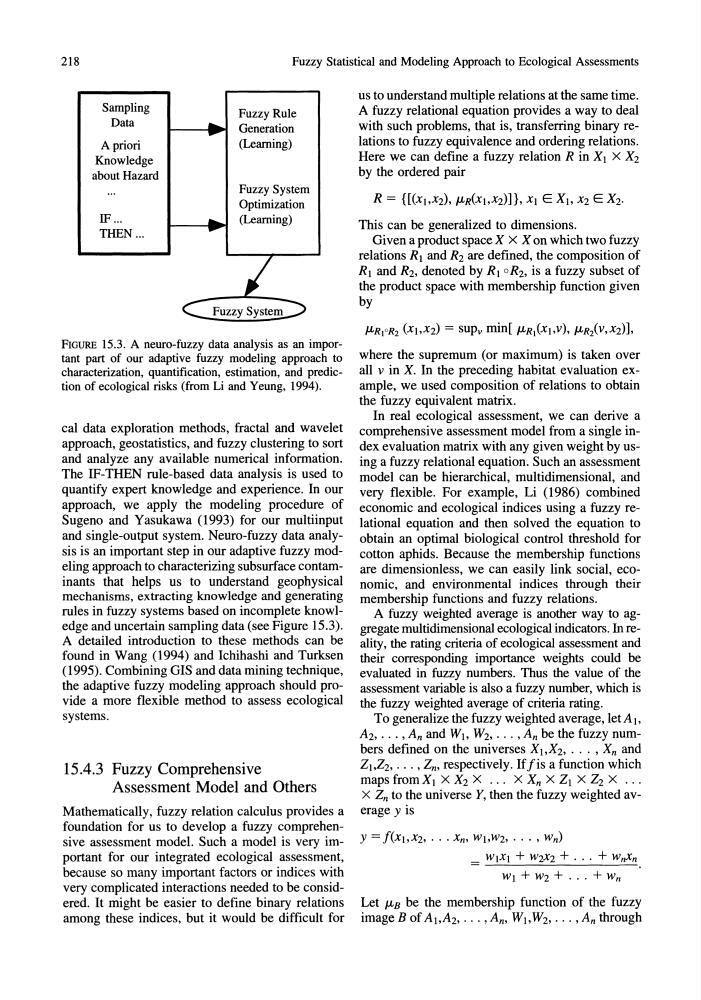
FiGURE 15.3. A neuro-fuzzy data analysis as an important part of our adaptive fuzzy modeling approach to
characterization, quantification, estimation, and prediction of ecological risks (from Li and Yeung, 1994).
cal data exploration methods, fractal and wavelet
approach, geostatistics, and fuzzy clustering to sort
and analyze any available numerical information.
The IF-THEN rule-based data analysis is used to
quantify expert knowledge and experience. In our
approach, we apply the modeling procedure of
Sugeno and Yasukawa (1993) for our multiinput
and single-output system. Neuro-fuzzy data analysis is an important step in our adaptive fuzzy modeling approach to characterizing subsurface contaminants that helps us to understand geophysical
mechanisms, extracting knowledge and generating
rules in fuzzy systems based on incomplete knowledge and uncertain sampling data (see Figure 15.3).
A detailed introduction to these methods can be
found in Wang (1994) and Ichihashi and Turksen
(1995). Combining GIS and data mining technique,
the adaptive fuzzy modeling approach should provide a more flexible method to assess ecological
systems.
15.4.3 Fuzzy Comprehensive
Assessment Model and Others
Mathematically, fuzzy relation calculus provides a
foundation for us to develop a fuzzy comprehensive assessment model. Such a model is very important for our integrated ecological assessment,
because so many important factors or indices with
very complicated interactions needed to be considered. It might be easier to define binary relations
among these indices, but it would be difficult for
us to understand multiple relations at the same time.
A fuzzy relational equation provides a way to deal
with such problems, that is, transferring binary relations to fuzzy equiValence and ordering relations.
Here we can define a fuzzy relation R in Xl X X 2
by the ordered pair
R = {[(Xl,X2), ILR(XI,X2)]}, Xl E XI. X2 E X2·
This can be generalized to dimensions.
Given a product space X X X on which two fuzzy
relations Rl and R2 are defined, the composition of
Rl and R2, denoted by Rl oR2, is a fuzzy subset of
the product space with membership function given
by
ILR]oR2 (XJ, X2) = supv min[ ILR](XJ,V), ILR2(V,X2)],
where the supremum (or maximum) is taken over
all v in X. In the preceding habitat evaluation example, we used composition of relations to obtain
the fuzzy equivalent matrix.
In real ecological assessment, we can derive a
comprehensive assessment model from a single index evaluation matrix with any given weight by using a fuzzy relational equation. Such an assessment
model can be hierarchical, multidimensional, and
very flexible. For example, Li (1986) combined
economic and ecological indices using a fuzzy relational equation and then solved the equation to
obtain an optimal biological control threshold for
cotton aphids. Because the membership functions
are dimensionless, we can easily link social, economic, and environmental indices through their
membership functions and fuzzy relations.
A fuzzy weighted average is another way to aggregate multidimensional ecological indicators. In reality, the rating criteria of ecological assessment and
their corresponding importance weights could be
evaluated in fuzzy numbers. Thus the value of the
assessment variable is also a fuzzy number, which is
the fuzzy weighted average of criteria rating.
To generalize the fuzzy weighted average, letA l ,
A 2, ... ,An and WI. W2, ... , An be the fuzzy numbers defined on the universes Xl,X2, . . . , Xn and
ZJ,~, ... ,Zm respectively. If/is a function which
maps from Xl X X 2 X ... X Xn X Zl X Z2 X ...
X Zn to the universe Y, then the fuzzy weighted average y is
y = /(XJ,X2, ... Xn, Wl,W2, ... , wn)
= WlXl + W2X2 + ... + WnXn
WI + W2 + ... + Wn
Let ILB be the membership function of the fuzzy
image B of A],A2, ... , Am WJ, W2, ... ,An through
Fuzzy Statistical and Modeling Approach to Ecological Assessments
Sampling
Data
A priori
Knowledge
about Hazard
IF ...
THEN ...
Fuzzy Rule
Generation
(Learning)
Fuzzy System
Optimization
(Learning)
Fuzzy System
FiGURE 15.3. A neuro-fuzzy data analysis as an important part of our adaptive fuzzy modeling approach to
characterization, quantification, estimation, and prediction of ecological risks (from Li and Yeung, 1994).
cal data exploration methods, fractal and wavelet
approach, geostatistics, and fuzzy clustering to sort
and analyze any available numerical information.
The IF-THEN rule-based data analysis is used to
quantify expert knowledge and experience. In our
approach, we apply the modeling procedure of
Sugeno and Yasukawa (1993) for our multiinput
and single-output system. Neuro-fuzzy data analysis is an important step in our adaptive fuzzy modeling approach to characterizing subsurface contaminants that helps us to understand geophysical
mechanisms, extracting knowledge and generating
rules in fuzzy systems based on incomplete knowledge and uncertain sampling data (see Figure 15.3).
A detailed introduction to these methods can be
found in Wang (1994) and Ichihashi and Turksen
(1995). Combining GIS and data mining technique,
the adaptive fuzzy modeling approach should provide a more flexible method to assess ecological
systems.
15.4.3 Fuzzy Comprehensive
Assessment Model and Others
Mathematically, fuzzy relation calculus provides a
foundation for us to develop a fuzzy comprehensive assessment model. Such a model is very important for our integrated ecological assessment,
because so many important factors or indices with
very complicated interactions needed to be considered. It might be easier to define binary relations
among these indices, but it would be difficult for
us to understand multiple relations at the same time.
A fuzzy relational equation provides a way to deal
with such problems, that is, transferring binary relations to fuzzy equiValence and ordering relations.
Here we can define a fuzzy relation R in Xl X X 2
by the ordered pair
R = {[(Xl,X2), ILR(XI,X2)]}, Xl E XI. X2 E X2·
This can be generalized to dimensions.
Given a product space X X X on which two fuzzy
relations Rl and R2 are defined, the composition of
Rl and R2, denoted by Rl oR2, is a fuzzy subset of
the product space with membership function given
by
ILR]oR2 (XJ, X2) = supv min[ ILR](XJ,V), ILR2(V,X2)],
where the supremum (or maximum) is taken over
all v in X. In the preceding habitat evaluation example, we used composition of relations to obtain
the fuzzy equivalent matrix.
In real ecological assessment, we can derive a
comprehensive assessment model from a single index evaluation matrix with any given weight by using a fuzzy relational equation. Such an assessment
model can be hierarchical, multidimensional, and
very flexible. For example, Li (1986) combined
economic and ecological indices using a fuzzy relational equation and then solved the equation to
obtain an optimal biological control threshold for
cotton aphids. Because the membership functions
are dimensionless, we can easily link social, economic, and environmental indices through their
membership functions and fuzzy relations.
A fuzzy weighted average is another way to aggregate multidimensional ecological indicators. In reality, the rating criteria of ecological assessment and
their corresponding importance weights could be
evaluated in fuzzy numbers. Thus the value of the
assessment variable is also a fuzzy number, which is
the fuzzy weighted average of criteria rating.
To generalize the fuzzy weighted average, letA l ,
A 2, ... ,An and WI. W2, ... , An be the fuzzy numbers defined on the universes Xl,X2, . . . , Xn and
ZJ,~, ... ,Zm respectively. If/is a function which
maps from Xl X X 2 X ... X Xn X Zl X Z2 X ...
X Zn to the universe Y, then the fuzzy weighted average y is
y = /(XJ,X2, ... Xn, Wl,W2, ... , wn)
= WlXl + W2X2 + ... + WnXn
WI + W2 + ... + Wn
Let ILB be the membership function of the fuzzy
image B of A],A2, ... , Am WJ, W2, ... ,An through