

14.3 Current Fractal Applications in Landscape Ecology
14.3.2 Information Fractals of
Landscape Diversity
The information fractal dimension, Db is a generalization of the box -counting method that takes into
account the relative probability of the patchy types
that cover the landscape. The information fractal
dimension as the natural measure dimension has
been used in calculating the dimensionality of
strange attractors (Farmer et al., 1983; Grassberger
and Procaccia, 1983; Ruelle, 1989).
The information fractal dimension is given by
1 .
H(e)
D j = 1m
e ..... O Ln(lIe)
where H(e) is a given Shannon function (Shannon,
1948),
n(e)
H(e) = - L Pi(e) Ln Pi(e),
. ;=0
where Pi is the probability of observing the ith patch
element measured using samples of e units in size.
For very complicated landscapes (e.g., n-phase mosaics of different vegetation types in a natural landscape), we can extend the above formula to a generalized hierarchical diversity function, for example,
Pielou's hierarchical diversity index (Pielou, 1977)
to count the total patch diversity in the landscape.
"
203
In practical applications, we could use the following relationship to estimate Di , that is, the diversity
H(e) will vary e according to
H(e) = H(O) - D j Ln e,
where D j is the lower bound to the Hausdorff Besicovich dimension or information fractal dimension.
In many cases, the lower bound is numerically
identical to it (e.g., linear regression estimation).
Comparing with the fractal dimension D from the
box-counting method, in general, D 2:: Dj (Farmer
et al., 1983). If all boxes have equal probability of
the patchy types, D = Dj •
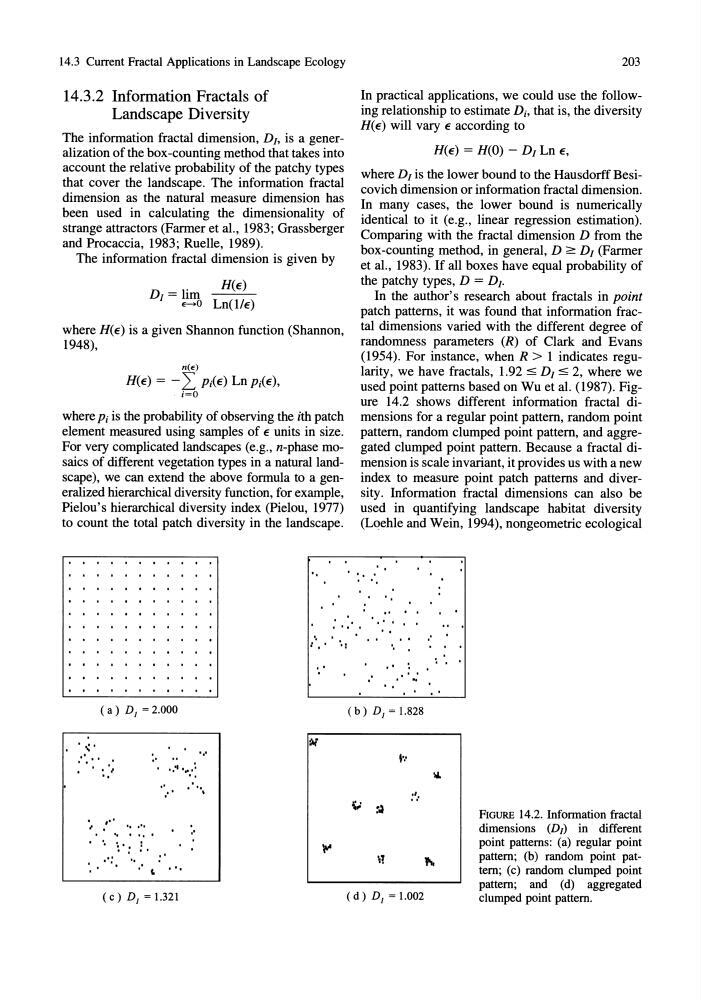
In the author's research about fractals in point
patch patterns, it was found that information fractal dimensions varied with the different degree of
randonmess parameters (R) of Clark and Evans
(1954). For instance, when R> 1 indicates regularity, we have fractals, 1.92:5 D j :5 2, where we
used point patterns based on Wu et al. (1987). Figure 14.2 shows different information fractal dimensions for a regular point pattern, random point
pattern, random clumped point pattern, and aggregated clumped point pattern. Because a fractal dimension is scale invariant, it provides us with a new
index to measure point patch patterns and diversity. Information fractal dimensions can also be
used in quantifying landscape habitat diversity
(Loehle and Wein, 1994), nongeometric ecological
. ' ..
, '.
"
'.
, ,,'
.,1.- .
(a) D] =2.000
, I
"
"
•• '1, ... ,
"
','
"
I'.
"I
,
I., ••
",",
"
•
I I
•
•
"I
~': : .
"
"
I
I "
", ",
(c) D] =1.321
"
\
I
.;
. '
~
"
:
"
(b) D] = 1.828
I','
:' ..
it
(d) D] = 1.002
:
~
FIGURE 14.2. Infonnation fractal
dimensions (VI) in different
point patterns: (a) regular point
pattern; (b) random point pattern; (c) random clumped point
pattern; and (d) aggregated
clumped point pattern.
14.3.2 Information Fractals of
Landscape Diversity
The information fractal dimension, Db is a generalization of the box -counting method that takes into
account the relative probability of the patchy types
that cover the landscape. The information fractal
dimension as the natural measure dimension has
been used in calculating the dimensionality of
strange attractors (Farmer et al., 1983; Grassberger
and Procaccia, 1983; Ruelle, 1989).
The information fractal dimension is given by
1 .
H(e)
D j = 1m
e ..... O Ln(lIe)
where H(e) is a given Shannon function (Shannon,
1948),
n(e)
H(e) = - L Pi(e) Ln Pi(e),
. ;=0
where Pi is the probability of observing the ith patch
element measured using samples of e units in size.
For very complicated landscapes (e.g., n-phase mosaics of different vegetation types in a natural landscape), we can extend the above formula to a generalized hierarchical diversity function, for example,
Pielou's hierarchical diversity index (Pielou, 1977)
to count the total patch diversity in the landscape.
"
203
In practical applications, we could use the following relationship to estimate Di , that is, the diversity
H(e) will vary e according to
H(e) = H(O) - D j Ln e,
where D j is the lower bound to the Hausdorff Besicovich dimension or information fractal dimension.
In many cases, the lower bound is numerically
identical to it (e.g., linear regression estimation).
Comparing with the fractal dimension D from the
box-counting method, in general, D 2:: Dj (Farmer
et al., 1983). If all boxes have equal probability of
the patchy types, D = Dj •
In the author's research about fractals in point
patch patterns, it was found that information fractal dimensions varied with the different degree of
randonmess parameters (R) of Clark and Evans
(1954). For instance, when R> 1 indicates regularity, we have fractals, 1.92:5 D j :5 2, where we
used point patterns based on Wu et al. (1987). Figure 14.2 shows different information fractal dimensions for a regular point pattern, random point
pattern, random clumped point pattern, and aggregated clumped point pattern. Because a fractal dimension is scale invariant, it provides us with a new
index to measure point patch patterns and diversity. Information fractal dimensions can also be
used in quantifying landscape habitat diversity
(Loehle and Wein, 1994), nongeometric ecological
. ' ..
, '.
"
'.
, ,,'
.,1.- .
(a) D] =2.000
, I
"
"
•• '1, ... ,
"
','
"
I'.
"I
,
I., ••
",",
"
•
I I
•
•
"I
~': : .
"
"
I
I "
", ",
(c) D] =1.321
"
\
I
.;
. '
~
"
:
"
(b) D] = 1.828
I','
:' ..
it
(d) D] = 1.002
:
~
FIGURE 14.2. Infonnation fractal
dimensions (VI) in different
point patterns: (a) regular point
pattern; (b) random point pattern; (c) random clumped point
pattern; and (d) aggregated
clumped point pattern.