

14.2 What Are Fractals?
biological spatial-temporal structure in nature,
which are the pansystem holography in space and
the pansystem repetition in time (Li, 1986). Recent
studies have included measures of the fractal geometry of landscape patterns and percolation-based
phase transitions in ecological literature (Burrough,
1981, 1983a, b; MacKay and Jan, 1984; Frontier,
1987; Gardner et aI., 1987; Goodchild and Mark,
1987; Milne, 1988, 1992; Palmer, 1988, 1992;
Wiens and Milne, 1989; Loehle, 1990; Warner and
Fry, 1990; Bartoli et aI., 1991; Williamson and
Lawton, 1991; Young and Crawford, 1991; Zeide,
1991; Li et aI., 1992; Montgomery and Dietrich,
1992; Berntson, 1994; Loehle et aI., 1996; Milne
et aI., 1996; Harte et aI., 1999).
This chapter will summarize the state of the art
and introduce several updated developments in
analysis and description of landscape patterns and
landscape dynamics under Mandelbrot' s fractal and
percolation framework, with an emphasis on this
author's current research results and with a personal view. A fractal analysis of southern Texas savanna landscape dynamics and a percolation model
for the forest-prairie ecotonal phase transitions in
Kansas are included. Future directions of fractal
geometry and percolation theory in ecological assessment applications are also discussed.
14.2 What Are Fractals?
A line is a one-dimensional object, a square is twodimensional, and a cube is three-dimensional. Most
objects in nature are much more complicated geometric figures. It should not be surprising that the
dimension of a tree, say, is not integral. Fractal
geometry theory tells us that most objects in nature
have fractional dimensions, for example, 1.5 for a
tree. Fractals are conceptual objects showing structures at all spatial scales, with a scale-dependent
self-similarity (Mandelbrot, 1977). The shape of
fractals is nonrectifiable, consisting of an infinite
sequence of clusters within clusters or waves within
waves. Perhaps we have seen that snow crystals all
have the same pattern, each part of a branch being
similar to itself. In rectifiable objects, increasingly
accurate measurements based on successive scale
reductions give series converging to a limit: the true
extent of the object. By contrast, in fractals the
same procedure generates infinite series, according
to the relationship N(E)rxE- D , where N(E) is a number measure corresponding to the scale unit E and
D is the fractal dimension. The length of the object
is then L(E)rxE 1 - D and D > 1. The length diverges
as E ~ O. In a volume of Euclidean dimension, E,
201
the volume occupied by an object of fractal dimension D, is given by V(E)rxE E - D (Mandelbrot,
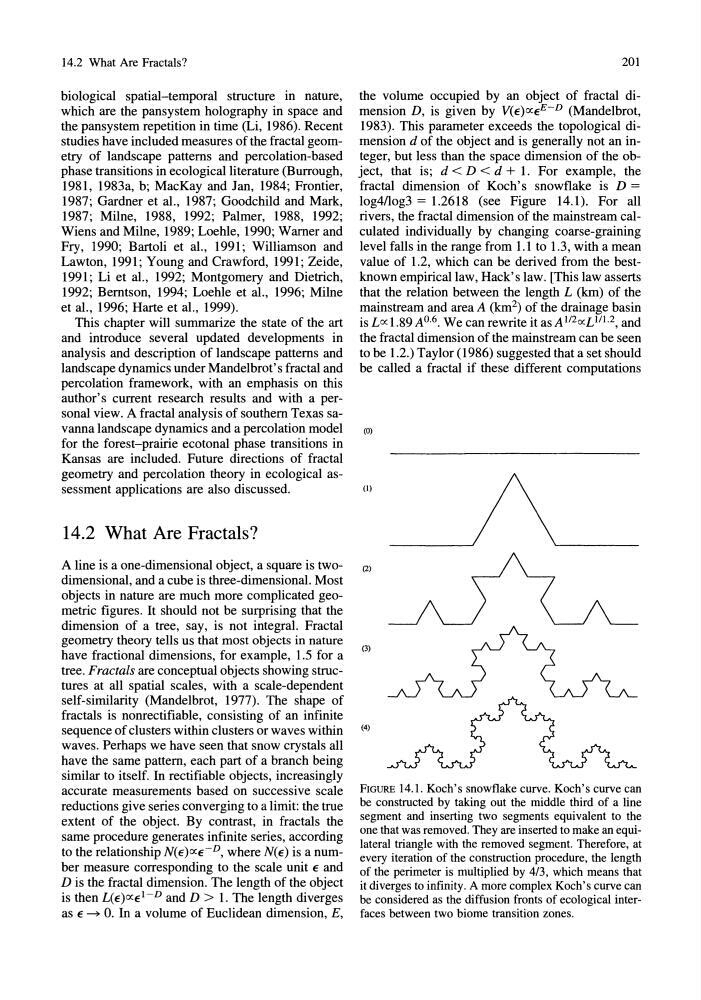
1983). This parameter exceeds the topological dimension d of the object and is generally not an integer, but less than the space dimension of the object, that is; d < D < d + 1. For example, the
fractal dimension of Koch's snowflake is D =
log41l0g3 = 1.2618 (see Figure 14.1). For all
rivers, the fractal dimension of the mainstream calculated individually by changing coarse-graining
level falls in the range from 1.1 to 1.3, with a mean
value of 1.2, which can be derived from the bestknown empirical law, Hack's law. [This law asserts
that the relation between the length L (km) of the
mainstream and area A (km 2 ) of the drainage basin
is Lrx 1.89 AO.6. We can rewrite it as A 112 rxL 111.2, and
the fractal dimension of the mainstream can be seen
to be 1.2.) Taylor (1986) suggested that a set should
be called a fractal if these different computations
(3)
(4)
FIGURE 14.1. Koch's snowflake curve. Koch's curve can
be constructed by taking out the middle third of a line
segment and inserting two segments equivalent to the
one that was removed. They are inserted to make an equilateral triangle with the removed segment. Therefore, at
every iteration of the construction procedure, the length
of the perimeter is multiplied by 4/3, which means that
it diverges to infinity. A more complex Koch's curve can
be considered as the diffusion fronts of ecological interfaces between two biome transition zones.
biological spatial-temporal structure in nature,
which are the pansystem holography in space and
the pansystem repetition in time (Li, 1986). Recent
studies have included measures of the fractal geometry of landscape patterns and percolation-based
phase transitions in ecological literature (Burrough,
1981, 1983a, b; MacKay and Jan, 1984; Frontier,
1987; Gardner et aI., 1987; Goodchild and Mark,
1987; Milne, 1988, 1992; Palmer, 1988, 1992;
Wiens and Milne, 1989; Loehle, 1990; Warner and
Fry, 1990; Bartoli et aI., 1991; Williamson and
Lawton, 1991; Young and Crawford, 1991; Zeide,
1991; Li et aI., 1992; Montgomery and Dietrich,
1992; Berntson, 1994; Loehle et aI., 1996; Milne
et aI., 1996; Harte et aI., 1999).
This chapter will summarize the state of the art
and introduce several updated developments in
analysis and description of landscape patterns and
landscape dynamics under Mandelbrot' s fractal and
percolation framework, with an emphasis on this
author's current research results and with a personal view. A fractal analysis of southern Texas savanna landscape dynamics and a percolation model
for the forest-prairie ecotonal phase transitions in
Kansas are included. Future directions of fractal
geometry and percolation theory in ecological assessment applications are also discussed.
14.2 What Are Fractals?
A line is a one-dimensional object, a square is twodimensional, and a cube is three-dimensional. Most
objects in nature are much more complicated geometric figures. It should not be surprising that the
dimension of a tree, say, is not integral. Fractal
geometry theory tells us that most objects in nature
have fractional dimensions, for example, 1.5 for a
tree. Fractals are conceptual objects showing structures at all spatial scales, with a scale-dependent
self-similarity (Mandelbrot, 1977). The shape of
fractals is nonrectifiable, consisting of an infinite
sequence of clusters within clusters or waves within
waves. Perhaps we have seen that snow crystals all
have the same pattern, each part of a branch being
similar to itself. In rectifiable objects, increasingly
accurate measurements based on successive scale
reductions give series converging to a limit: the true
extent of the object. By contrast, in fractals the
same procedure generates infinite series, according
to the relationship N(E)rxE- D , where N(E) is a number measure corresponding to the scale unit E and
D is the fractal dimension. The length of the object
is then L(E)rxE 1 - D and D > 1. The length diverges
as E ~ O. In a volume of Euclidean dimension, E,
201
the volume occupied by an object of fractal dimension D, is given by V(E)rxE E - D (Mandelbrot,
1983). This parameter exceeds the topological dimension d of the object and is generally not an integer, but less than the space dimension of the object, that is; d < D < d + 1. For example, the
fractal dimension of Koch's snowflake is D =
log41l0g3 = 1.2618 (see Figure 14.1). For all
rivers, the fractal dimension of the mainstream calculated individually by changing coarse-graining
level falls in the range from 1.1 to 1.3, with a mean
value of 1.2, which can be derived from the bestknown empirical law, Hack's law. [This law asserts
that the relation between the length L (km) of the
mainstream and area A (km 2 ) of the drainage basin
is Lrx 1.89 AO.6. We can rewrite it as A 112 rxL 111.2, and
the fractal dimension of the mainstream can be seen
to be 1.2.) Taylor (1986) suggested that a set should
be called a fractal if these different computations
(3)
(4)
FIGURE 14.1. Koch's snowflake curve. Koch's curve can
be constructed by taking out the middle third of a line
segment and inserting two segments equivalent to the
one that was removed. They are inserted to make an equilateral triangle with the removed segment. Therefore, at
every iteration of the construction procedure, the length
of the perimeter is multiplied by 4/3, which means that
it diverges to infinity. A more complex Koch's curve can
be considered as the diffusion fronts of ecological interfaces between two biome transition zones.