

170
Decision Support for Ecosystem Management and Ecological Assessments
ever, critically important that we choose several
and then use the adaptive management philosophy
to test and improve them in real-life situations
(Kimmins, 1991).
12.4 Decision Support
Systems Defined
DSSs help managers make decisions in situations
where human judgment is an important contributor
to the problem-solving process, but where limitations in human information processing impede decision making (Rauscher, 1995). The goal of a DSS
is to amplify the power of the decision makers without usurping their right to use human judgment and
make choices. DSSs attempt to bring together the
intellectual flexibility and imagination of humans
with the speed, accuracy, and tirelessness of the
computer (Klein and Methlie, 1990; Sage, 1991;
Turban, 1993; Holsapple and Whinston, 1996).
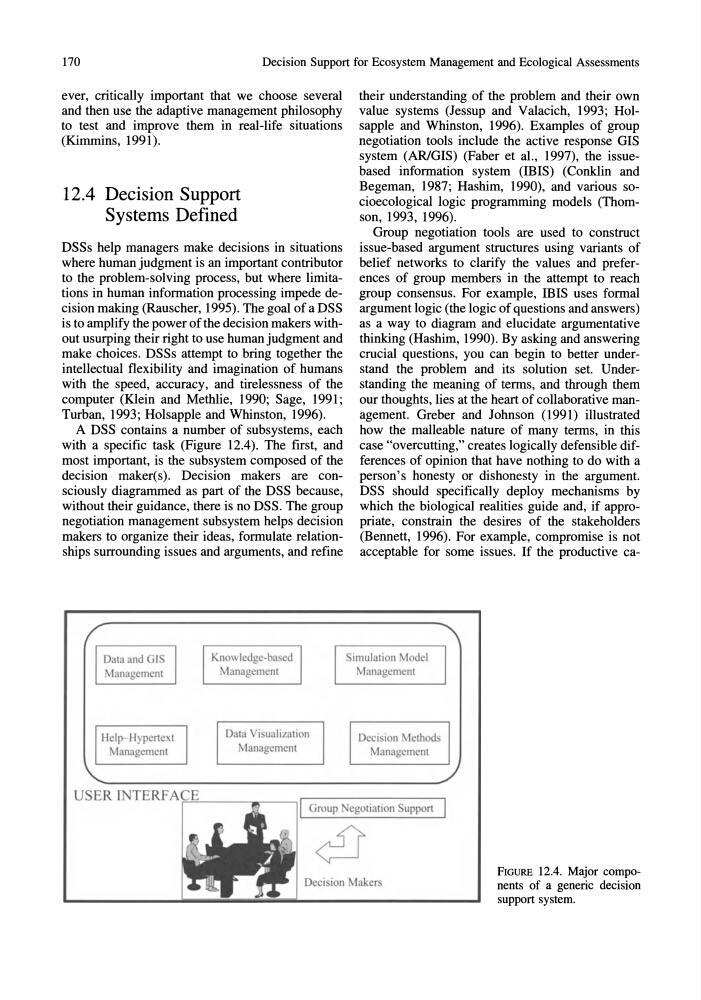
A DSS contains a number of subsystems, each
with a specific task (Figure 12.4). The first, and
most important, is the subsystem composed of the
decision maker(s). Decision makers are consciously diagrammed as part of the DSS because,
without their guidance, there is no DSS. The group
negotiation management subsystem helps decision
makers to organize their ideas, formulate relationships surrounding issues and arguments, and refine
USERINTERF
Data Visualization
anagement
their understanding of the problem and their own
value systems (Jessup and Valacich, 1993; Holsapple and Whinston, 1996). Examples of group
negotiation tools include the active response GIS
system (AR/GIS) (Faber et aI., 1997), the issuebased information system (IBIS) (Conklin and
Begeman, 1987; Hashim, 1990), and various socioecological logic programming models (Thomson, 1993, 1996).
Group negotiation tools are used to construct
issue-based argument structures using variants of
belief networks to clarify the values and preferences of group members in the attempt to reach
group consensus. For example, IBIS uses formal
argument logic (the logic of questions and answers)
as a way to diagram and elucidate argumentative
thinking (Hashim, 1990). By asking and answering
crucial questions, you can begin to better understand the problem and its solution set. Understanding the meaning of terms, and through them
our thoughts, lies at the heart of collaborative management. Greber and Johnson (1991) illustrated
how the malleable nature of many terms, in this
case "overcutting," creates logically defensible differences of opinion that have nothing to do with a
person's honesty or dishonesty in the argument.
DSS should specifically deploy mechanisms by
which the biological realities guide and, if appropriate, constrain the desires of the stakeholders
(Bennett, 1996). For example, compromise is not
acceptable for some issues. If the productive caimulation Model
Management
Decision Methods
Management
Group Negotiation upport
Decision Makers
FIGURE 12.4. Major components of a generic decision
support system.
Decision Support for Ecosystem Management and Ecological Assessments
ever, critically important that we choose several
and then use the adaptive management philosophy
to test and improve them in real-life situations
(Kimmins, 1991).
12.4 Decision Support
Systems Defined
DSSs help managers make decisions in situations
where human judgment is an important contributor
to the problem-solving process, but where limitations in human information processing impede decision making (Rauscher, 1995). The goal of a DSS
is to amplify the power of the decision makers without usurping their right to use human judgment and
make choices. DSSs attempt to bring together the
intellectual flexibility and imagination of humans
with the speed, accuracy, and tirelessness of the
computer (Klein and Methlie, 1990; Sage, 1991;
Turban, 1993; Holsapple and Whinston, 1996).
A DSS contains a number of subsystems, each
with a specific task (Figure 12.4). The first, and
most important, is the subsystem composed of the
decision maker(s). Decision makers are consciously diagrammed as part of the DSS because,
without their guidance, there is no DSS. The group
negotiation management subsystem helps decision
makers to organize their ideas, formulate relationships surrounding issues and arguments, and refine
USERINTERF
Data Visualization
anagement
their understanding of the problem and their own
value systems (Jessup and Valacich, 1993; Holsapple and Whinston, 1996). Examples of group
negotiation tools include the active response GIS
system (AR/GIS) (Faber et aI., 1997), the issuebased information system (IBIS) (Conklin and
Begeman, 1987; Hashim, 1990), and various socioecological logic programming models (Thomson, 1993, 1996).
Group negotiation tools are used to construct
issue-based argument structures using variants of
belief networks to clarify the values and preferences of group members in the attempt to reach
group consensus. For example, IBIS uses formal
argument logic (the logic of questions and answers)
as a way to diagram and elucidate argumentative
thinking (Hashim, 1990). By asking and answering
crucial questions, you can begin to better understand the problem and its solution set. Understanding the meaning of terms, and through them
our thoughts, lies at the heart of collaborative management. Greber and Johnson (1991) illustrated
how the malleable nature of many terms, in this
case "overcutting," creates logically defensible differences of opinion that have nothing to do with a
person's honesty or dishonesty in the argument.
DSS should specifically deploy mechanisms by
which the biological realities guide and, if appropriate, constrain the desires of the stakeholders
(Bennett, 1996). For example, compromise is not
acceptable for some issues. If the productive caimulation Model
Management
Decision Methods
Management
Group Negotiation upport
Decision Makers
FIGURE 12.4. Major components of a generic decision
support system.