

164
Decision Support for Ecosystem Management and Ecological Assessments
Ecosystem Management Decision Environment
I
(Goals, Values, Constraints)
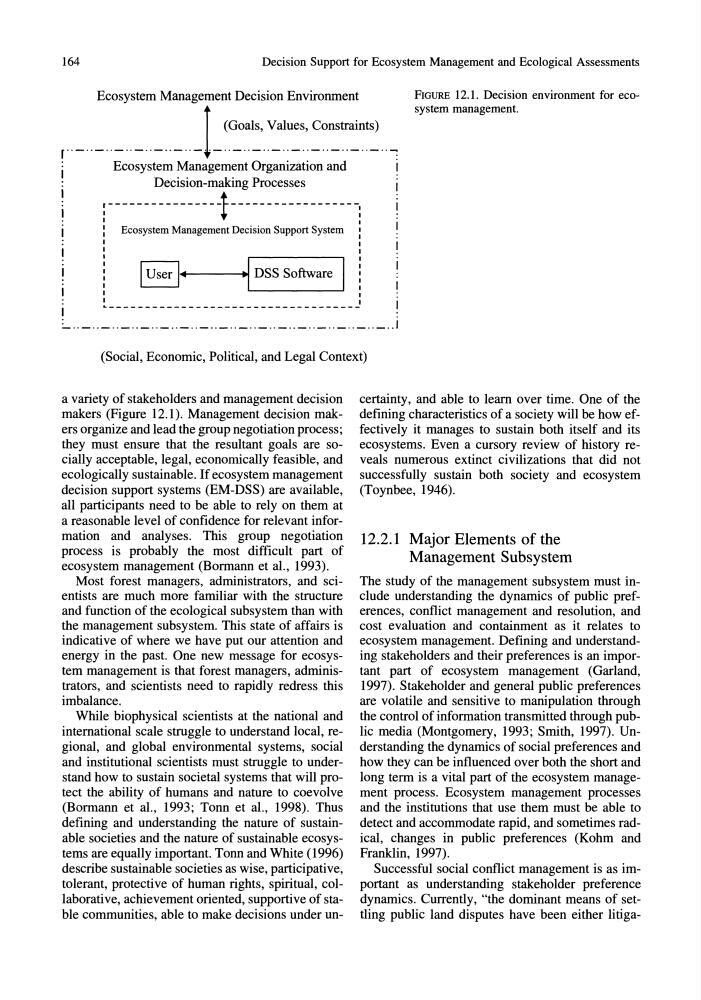
r··_··_··_··_··_··_··_··_··_··_··_··_··_··_··_··_··FIGURE 12.1. Decision environment for ecosystem management.
Ecosystem Management Organization and
Decision-making Processes
----------------}----------------Ecosystem Management Decision Support System
1 User 1 ... ----+1.1 DSS Software 1
_ .. _ .. _ .. _ .• _ .. _ .. _ .. _ •. _ .. _ .. _ .. _ .. _ .. _ .. _ .. _ .. _ .. 1
(Social, Economic, Political, and Legal Context)
a variety of stakeholders and management decision
makers (Figure 12.1). Management decision makers organize and lead the group negotiation process;
they must ensure that the resultant goals are socially acceptable, legal, economically feasible, and
ecologically sustainable. If ecosystem management
decision support systems (EM-DSS) are available,
all participants need to be able to rely on them at
a reasonable level of confidence for relevant information and analyses. This group negotiation
process is probably the most difficult part of
ecosystem management (Bormann et aI., 1993).
Most forest managers, administrators, and scientists are much more familiar with the structure
and function of the ecological subsystem than with
the management subsystem. This state of affairs is
indicative of where we have put our attention and
energy in the past. One new message for ecosystem management is that forest managers, administrators, and scientists need to rapidly redress this
imbalance.
While biophysical scientists at the national and
international scale struggle to understand local, regional, and global environmental systems, social
and institutional scientists must struggle to understand how to sustain societal systems that will protect the ability of humans and nature to coevolve
(Bormann et aI., 1993; Tonn et aI., 1998). Thus
defining and understanding the nature of sustainable societies and the nature of sustainable ecosystems are equally important. Tonn and White (1996)
describe sustainable societies as wise, participative,
tolerant, protective of human rights, spiritual, collaborative, achievement oriented, supportive of stable communities, able to make decisions under uncertainty, and able to learn over time. One of the
defining characteristics of a society will be how effectively it manages to sustain both itself and its
ecosystems. Even a cursory review of history reveals numerous extinct civilizations that did not
successfully sustain both society and ecosystem
(Toynbee, 1946).
12.2.1 Major Elements of the
Management Subsystem
The study of the management subsystem must include understanding the dynamics of public preferences, conflict management and resolution, and
cost evaluation and containment as it relates to
ecosystem management. Defining and understanding stakeholders and their preferences is an important part of ecosystem management (Garland,
1997). Stakeholder and general public preferences
are volatile and sensitive to manipulation through
the control of information transmitted through public media (Montgomery, 1993; Smith, 1997). Understanding the dynamics of social preferences and
how they can be influenced over both the short and
long term is a vital part of the ecosystem management process. Ecosystem management processes
and the institutions that use them must be able to
detect and accommodate rapid, and sometimes radical, changes in public preferences (Kohm and
Franklin, 1997).
Successful social conflict management is as important as understanding stakeholder preference
dynamics. Currently, "the dominant means of settling public land disputes have been either litiga-
Decision Support for Ecosystem Management and Ecological Assessments
Ecosystem Management Decision Environment
I
(Goals, Values, Constraints)
r··_··_··_··_··_··_··_··_··_··_··_··_··_··_··_··_··FIGURE 12.1. Decision environment for ecosystem management.
Ecosystem Management Organization and
Decision-making Processes
----------------}----------------Ecosystem Management Decision Support System
1 User 1 ... ----+1.1 DSS Software 1
_ .. _ .. _ .. _ .• _ .. _ .. _ .. _ •. _ .. _ .. _ .. _ .. _ .. _ .. _ .. _ .. _ .. 1
(Social, Economic, Political, and Legal Context)
a variety of stakeholders and management decision
makers (Figure 12.1). Management decision makers organize and lead the group negotiation process;
they must ensure that the resultant goals are socially acceptable, legal, economically feasible, and
ecologically sustainable. If ecosystem management
decision support systems (EM-DSS) are available,
all participants need to be able to rely on them at
a reasonable level of confidence for relevant information and analyses. This group negotiation
process is probably the most difficult part of
ecosystem management (Bormann et aI., 1993).
Most forest managers, administrators, and scientists are much more familiar with the structure
and function of the ecological subsystem than with
the management subsystem. This state of affairs is
indicative of where we have put our attention and
energy in the past. One new message for ecosystem management is that forest managers, administrators, and scientists need to rapidly redress this
imbalance.
While biophysical scientists at the national and
international scale struggle to understand local, regional, and global environmental systems, social
and institutional scientists must struggle to understand how to sustain societal systems that will protect the ability of humans and nature to coevolve
(Bormann et aI., 1993; Tonn et aI., 1998). Thus
defining and understanding the nature of sustainable societies and the nature of sustainable ecosystems are equally important. Tonn and White (1996)
describe sustainable societies as wise, participative,
tolerant, protective of human rights, spiritual, collaborative, achievement oriented, supportive of stable communities, able to make decisions under uncertainty, and able to learn over time. One of the
defining characteristics of a society will be how effectively it manages to sustain both itself and its
ecosystems. Even a cursory review of history reveals numerous extinct civilizations that did not
successfully sustain both society and ecosystem
(Toynbee, 1946).
12.2.1 Major Elements of the
Management Subsystem
The study of the management subsystem must include understanding the dynamics of public preferences, conflict management and resolution, and
cost evaluation and containment as it relates to
ecosystem management. Defining and understanding stakeholders and their preferences is an important part of ecosystem management (Garland,
1997). Stakeholder and general public preferences
are volatile and sensitive to manipulation through
the control of information transmitted through public media (Montgomery, 1993; Smith, 1997). Understanding the dynamics of social preferences and
how they can be influenced over both the short and
long term is a vital part of the ecosystem management process. Ecosystem management processes
and the institutions that use them must be able to
detect and accommodate rapid, and sometimes radical, changes in public preferences (Kohm and
Franklin, 1997).
Successful social conflict management is as important as understanding stakeholder preference
dynamics. Currently, "the dominant means of settling public land disputes have been either litiga-