

124
Integration of Physical, Biological, and Socioeconomic Information
at the small scale (see Chapters 6 and 7). A useful
overall approach in the face of limited resources is
to develop sufficient general, macroscopic understanding of a region to allow relatively few, focused
site-specific studies to provide detailed information
that can be generalized to other similar sites in the
region.
9.4 Process Tools and Approaches
The degree of success achieved in integrating information depends on the process used or can at
least be improved by a process that is well planned
in advance. Advance planning is especially key
when integration is to be part of a process that is
generating much of the information, not simply collecting existing information. At root, information
integration itself is a process-one of exchange and
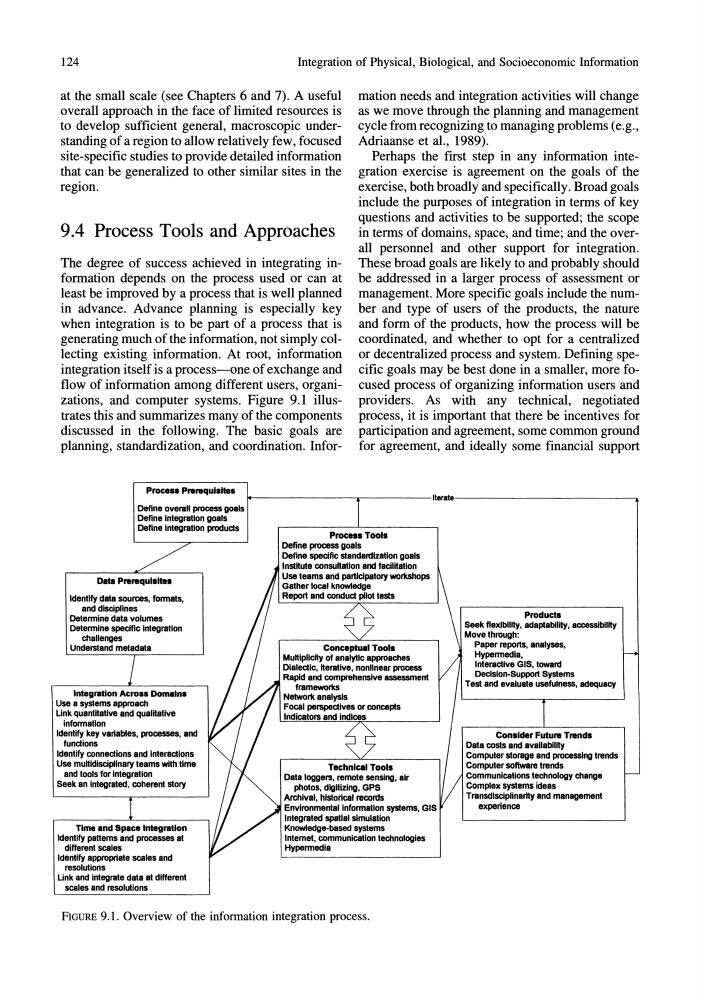
flow of information among different users, organizations, and computer systems. Figure 9.1 illustrates this and summarizes many of the components
discussed in the following. The basic goals are
planning, standardization, and coordination. Information needs and integration activities will change
as we move through the planning and management
cycle from recognizing to managing problems (e.g.,
Adriaanse et aI., 1989).
Perhaps the first step in any information integration exercise is agreement on the goals of the
exercise, both broadly and specifically. Broad goals
include the purposes of integration in terms of key
questions and activities to be supported; the scope
in terms of domains, space, and time; and the overall personnel and other support for integration.
These broad goals are likely to and probably should
be addressed in a larger process of assessment or
management. More specific goals include the number and type of users of the products, the nature
and form of the products, how the process will be
coordinated, and whether to opt for a centralized
or decentralized process and system. Defining specific goals may be best done in a smaller, more focused process of organizing information users and
providers. As with any technical, negotiated
process, it is important that there be incentives for
participation and agreement, some common ground
for agreement, and ideally some financial support
Process Prerequisites
Deline overall process goals
Deline Integration goals
Deline Integration products
\ < - - - - - - - -.... - - - - - I t e r a t . , - - - - - - - - - - - - - - .
Data Prerequisites
Identify data sources, formats,
and disciplines
Determine data volumes
Determine specilic Integration
challenges
Understand metadata
Integration Across Domains
Use a systems approach
Link quantHatlve and qualHative
information
Identify key variables, processes, and
functions
Identify connections and Interactions
Use muHldiscipilnary teams with time
and tools for integration
Seek an integrated, coherent story
Time and Space Integration
Identify pattems and processes at
different scales
Identify appropriate scales and
resolutions
Link and Integrate data at different
scales and resolutions
Process Tools
Define process goals
Define specific standardization goals
InstRute consultation and facilHation
Use teams and participatory workshops
Gather local knowledge
Report and conduct pilot tests
TechnlCIII Tools
Data loggers, remote sensing, air
photos, dlgHlzing, GPS
Archival, historical records
Environmental Information systems, GIS
Integrated spatial simulation
Knowledge-based systems
Intemet, communication technologies
Hypermedia
FIGURE 9.1. Overview of the information integration process.
Products
Seek flexlbilHy, adaptabilHy, accesslbilHy
Move through:
Paper reports, analyses,
Hypermedia,
Interactive GIS, toward
Decision-Support Systems
Test and evaluate usefulness, adequacy
Consider Future Trends
Data costs and avallabllHy
Computer storage and processing trends
Computer software trends
Communications technology change
Complex systems Ideas
Transdlsciplinarily and management
experience
Integration of Physical, Biological, and Socioeconomic Information
at the small scale (see Chapters 6 and 7). A useful
overall approach in the face of limited resources is
to develop sufficient general, macroscopic understanding of a region to allow relatively few, focused
site-specific studies to provide detailed information
that can be generalized to other similar sites in the
region.
9.4 Process Tools and Approaches
The degree of success achieved in integrating information depends on the process used or can at
least be improved by a process that is well planned
in advance. Advance planning is especially key
when integration is to be part of a process that is
generating much of the information, not simply collecting existing information. At root, information
integration itself is a process-one of exchange and
flow of information among different users, organizations, and computer systems. Figure 9.1 illustrates this and summarizes many of the components
discussed in the following. The basic goals are
planning, standardization, and coordination. Information needs and integration activities will change
as we move through the planning and management
cycle from recognizing to managing problems (e.g.,
Adriaanse et aI., 1989).
Perhaps the first step in any information integration exercise is agreement on the goals of the
exercise, both broadly and specifically. Broad goals
include the purposes of integration in terms of key
questions and activities to be supported; the scope
in terms of domains, space, and time; and the overall personnel and other support for integration.
These broad goals are likely to and probably should
be addressed in a larger process of assessment or
management. More specific goals include the number and type of users of the products, the nature
and form of the products, how the process will be
coordinated, and whether to opt for a centralized
or decentralized process and system. Defining specific goals may be best done in a smaller, more focused process of organizing information users and
providers. As with any technical, negotiated
process, it is important that there be incentives for
participation and agreement, some common ground
for agreement, and ideally some financial support
Process Prerequisites
Deline overall process goals
Deline Integration goals
Deline Integration products
\ < - - - - - - - -.... - - - - - I t e r a t . , - - - - - - - - - - - - - - .
Data Prerequisites
Identify data sources, formats,
and disciplines
Determine data volumes
Determine specilic Integration
challenges
Understand metadata
Integration Across Domains
Use a systems approach
Link quantHatlve and qualHative
information
Identify key variables, processes, and
functions
Identify connections and Interactions
Use muHldiscipilnary teams with time
and tools for integration
Seek an integrated, coherent story
Time and Space Integration
Identify pattems and processes at
different scales
Identify appropriate scales and
resolutions
Link and Integrate data at different
scales and resolutions
Process Tools
Define process goals
Define specific standardization goals
InstRute consultation and facilHation
Use teams and participatory workshops
Gather local knowledge
Report and conduct pilot tests
TechnlCIII Tools
Data loggers, remote sensing, air
photos, dlgHlzing, GPS
Archival, historical records
Environmental Information systems, GIS
Integrated spatial simulation
Knowledge-based systems
Intemet, communication technologies
Hypermedia
FIGURE 9.1. Overview of the information integration process.
Products
Seek flexlbilHy, adaptabilHy, accesslbilHy
Move through:
Paper reports, analyses,
Hypermedia,
Interactive GIS, toward
Decision-Support Systems
Test and evaluate usefulness, adequacy
Consider Future Trends
Data costs and avallabllHy
Computer storage and processing trends
Computer software trends
Communications technology change
Complex systems Ideas
Transdlsciplinarily and management
experience