

120
Integration of Physical, Biological, and Socioeconomic Information
TABLE 9.1. Basic functions and data integration goals for representative environmental management activities.
Basic functions
Data integration goal
Examples
Ecological
Survey, analysis
Relating information on different
Southern Appalachia
assessment
ecosystem dimensions to produce
Assessment, FEMAT,
more complete ecosystem
Bow Valley Task Force
understanding
Ecological
Survey, design
Understanding ecological
Great Lakes Remedial
restoration
possibilities and human
Action Plans,
needs and desires for an ecosystem
Baltic Sea
Environmental
Analysis,
Understanding relationships among
Beaufort Sea EA. CARC
impact
decision making
different ecosystem dimensions to
Hudson's Bay Program,
assessment
better assess nature and significance
of activity effects
EcosystemPlanning,
Comparing varied human needs and
Greater Yellowstone.
based
decision making
expectation with ecological
Australian Alps,
management
conditions to identify and pursue
Adirondacks
complex goals such as sustainability
FEMA T is Forest Ecosystem Management Assessment Team; CARC is Canadian Arctic Resources Committee.
forts in the 1920s and 1930s, integrated resource
management from the 1960s onward, environmental impact assessment from the 1970s, adaptive environmental assessment and management from the
late 1970s, and ecosystem management since the
late 1980s (see, for example, Lang, 1986; Slocombe, 1993). But this kind of integration remains
a challenge for all the technical, sociological, and
philosophical reasons discussed in the following.
Growing recognition of the need for and feasibility of integration is finally combining with a body
of experience, tools, and methods to make integration more common and feasible.
In the next section, the basic conceptual challenge of information integration is defined in more
detail. Then approaches to integration across disciplines and across space and time are discussed as
the fundamentals on which most other approaches
build; this is followed by a review of process, conceptual, and technical tools for integration. In conclusion, a summary is provided and current trends
and their impact on data integration are assessed.
9.2 Data Sources and
Integration Challenges
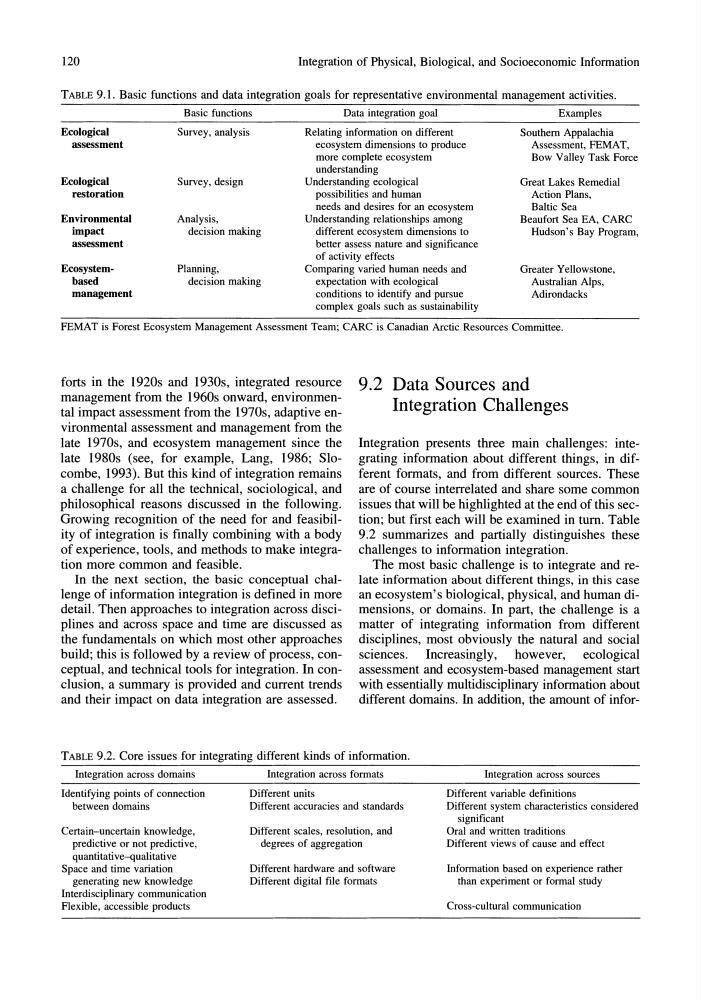
Integration presents three main challenges: integrating information about different things, in different formats, and from different sources. These
are of course interrelated and share some common
issues that will be highlighted at the end of this section; but first each will be examined in tum. Table
9.2 summarizes and partially distinguishes these
challenges to information integration.
The most basic challenge is to integrate and relate information about different things, in this case
an ecosystem's biological, physical, and human dimensions, or domains. In part, the challenge is a
matter of integrating information from different
disciplines, most obviously the natural and social
sciences. Increasingly, however, ecological
assessment and ecosystem-based management start
with essentially multidisciplinary information about
different domains. In addition, the amount of inforTABLE 9.2. Core issues for integrating different kinds of information.
Integration across domains
Identifying points of connection
between domains
Certain-uncertain knowledge,
predictive or not predictive,
quantitative-qualitative
Space and time variation
generating new knowledge
Interdisciplinary communication
Flexible, accessible products
Integration across formats
Different units
Different accuracies and standards
Different scales, resolution, and
degrees of aggregation
Different hardware and software
Different digital file formats
Integration across sources
Different variable definitions
Different system characteristics considered
significant
Oral and written traditions
Different views of cause and effect
Information based on experience rather
than experiment or formal study
Cross-cultural communication
Integration of Physical, Biological, and Socioeconomic Information
TABLE 9.1. Basic functions and data integration goals for representative environmental management activities.
Basic functions
Data integration goal
Examples
Ecological
Survey, analysis
Relating information on different
Southern Appalachia
assessment
ecosystem dimensions to produce
Assessment, FEMAT,
more complete ecosystem
Bow Valley Task Force
understanding
Ecological
Survey, design
Understanding ecological
Great Lakes Remedial
restoration
possibilities and human
Action Plans,
needs and desires for an ecosystem
Baltic Sea
Environmental
Analysis,
Understanding relationships among
Beaufort Sea EA. CARC
impact
decision making
different ecosystem dimensions to
Hudson's Bay Program,
assessment
better assess nature and significance
of activity effects
EcosystemPlanning,
Comparing varied human needs and
Greater Yellowstone.
based
decision making
expectation with ecological
Australian Alps,
management
conditions to identify and pursue
Adirondacks
complex goals such as sustainability
FEMA T is Forest Ecosystem Management Assessment Team; CARC is Canadian Arctic Resources Committee.
forts in the 1920s and 1930s, integrated resource
management from the 1960s onward, environmental impact assessment from the 1970s, adaptive environmental assessment and management from the
late 1970s, and ecosystem management since the
late 1980s (see, for example, Lang, 1986; Slocombe, 1993). But this kind of integration remains
a challenge for all the technical, sociological, and
philosophical reasons discussed in the following.
Growing recognition of the need for and feasibility of integration is finally combining with a body
of experience, tools, and methods to make integration more common and feasible.
In the next section, the basic conceptual challenge of information integration is defined in more
detail. Then approaches to integration across disciplines and across space and time are discussed as
the fundamentals on which most other approaches
build; this is followed by a review of process, conceptual, and technical tools for integration. In conclusion, a summary is provided and current trends
and their impact on data integration are assessed.
9.2 Data Sources and
Integration Challenges
Integration presents three main challenges: integrating information about different things, in different formats, and from different sources. These
are of course interrelated and share some common
issues that will be highlighted at the end of this section; but first each will be examined in tum. Table
9.2 summarizes and partially distinguishes these
challenges to information integration.
The most basic challenge is to integrate and relate information about different things, in this case
an ecosystem's biological, physical, and human dimensions, or domains. In part, the challenge is a
matter of integrating information from different
disciplines, most obviously the natural and social
sciences. Increasingly, however, ecological
assessment and ecosystem-based management start
with essentially multidisciplinary information about
different domains. In addition, the amount of inforTABLE 9.2. Core issues for integrating different kinds of information.
Integration across domains
Identifying points of connection
between domains
Certain-uncertain knowledge,
predictive or not predictive,
quantitative-qualitative
Space and time variation
generating new knowledge
Interdisciplinary communication
Flexible, accessible products
Integration across formats
Different units
Different accuracies and standards
Different scales, resolution, and
degrees of aggregation
Different hardware and software
Different digital file formats
Integration across sources
Different variable definitions
Different system characteristics considered
significant
Oral and written traditions
Different views of cause and effect
Information based on experience rather
than experiment or formal study
Cross-cultural communication