

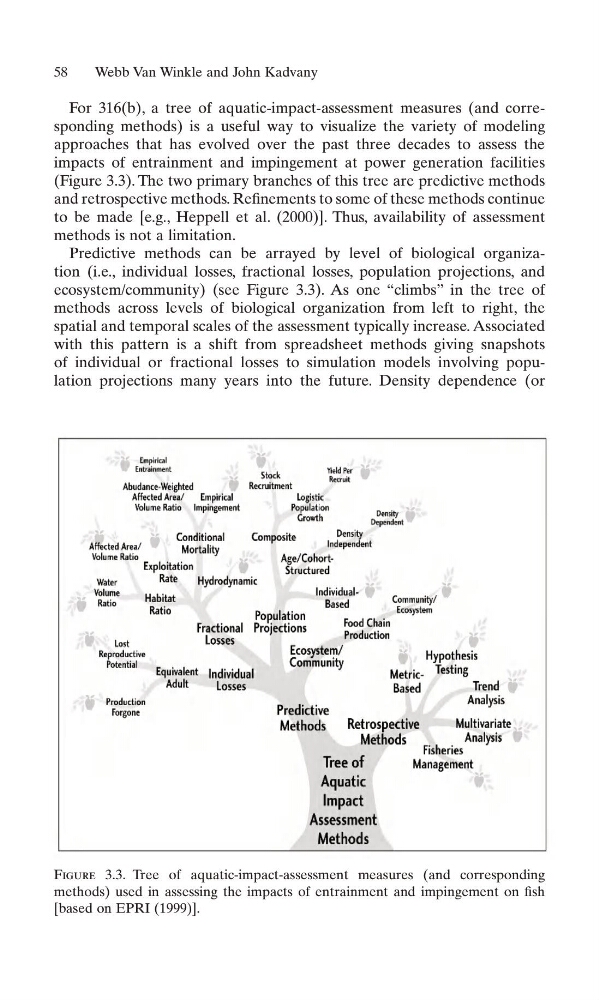
For 316(b), a tree of aquatic-impact-assessment measures (and corresponding methods) is a useful way to visualize the variety of modeling
approaches that has evolved over the past three decades to assess the
impacts of entrainment and impingement at power generation facilities
(Figure 3.3). The two primary branches of this tree are predictive methods
and retrospective methods. Refinements to some of these methods continue
to be made [e.g., Heppell et al. (2000)]. Thus, availability of assessment
methods is not a limitation.
Predictive methods can be arrayed by level of biological organization (i.e., individual losses, fractional losses, population projections, and
ecosystem/community) (see Figure 3.3). As one “climbs” in the tree of
methods across levels of biological organization from left to right, the
spatial and temporal scales of the assessment typically increase. Associated
with this pattern is a shift from spreadsheet methods giving snapshots
of individual or fractional losses to simulation models involving population projections many years into the future. Density dependence (or
58
Webb Van Winkle and John Kadvany
Figure 3.3. Tree of aquatic-impact-assessment measures (and corresponding
methods) used in assessing the impacts of entrainment and impingement on fish
[based on EPRI (1999)].
approaches that has evolved over the past three decades to assess the
impacts of entrainment and impingement at power generation facilities
(Figure 3.3). The two primary branches of this tree are predictive methods
and retrospective methods. Refinements to some of these methods continue
to be made [e.g., Heppell et al. (2000)]. Thus, availability of assessment
methods is not a limitation.
Predictive methods can be arrayed by level of biological organization (i.e., individual losses, fractional losses, population projections, and
ecosystem/community) (see Figure 3.3). As one “climbs” in the tree of
methods across levels of biological organization from left to right, the
spatial and temporal scales of the assessment typically increase. Associated
with this pattern is a shift from spreadsheet methods giving snapshots
of individual or fractional losses to simulation models involving population projections many years into the future. Density dependence (or
58
Webb Van Winkle and John Kadvany
Figure 3.3. Tree of aquatic-impact-assessment measures (and corresponding
methods) used in assessing the impacts of entrainment and impingement on fish
[based on EPRI (1999)].