

40
Jean Fitts Cochrane et al.
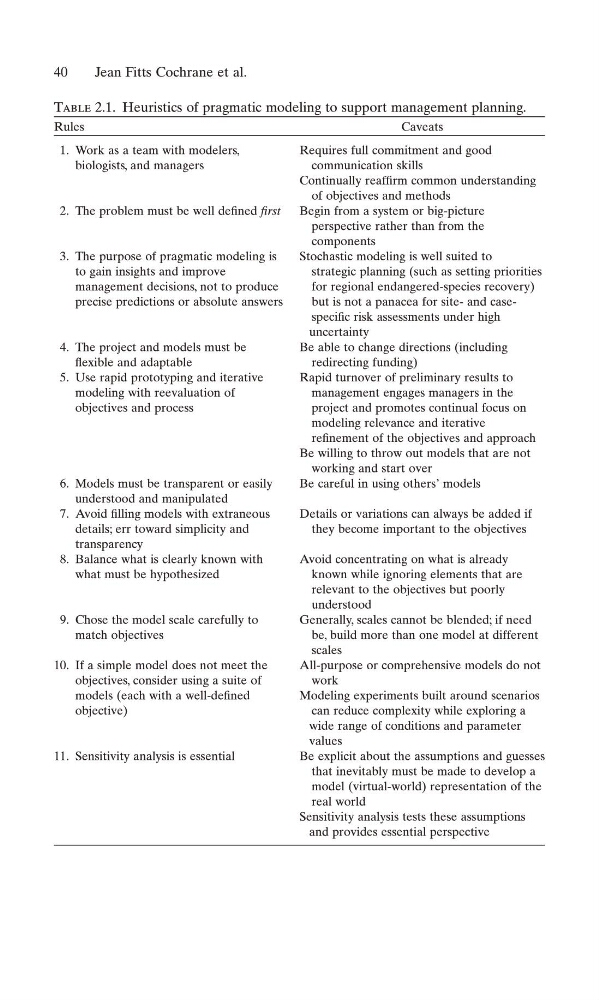
Table 2.1. Heuristics of pragmatic modeling to support management planning.
Rules
Caveats
1. Work as a team with modelers,
Requires full commitment and good
biologists, and managers
communication skills
Continually reaffirm common understanding
of objectives and methods
2. The problem must be well defined first
Begin from a system or big-picture
perspective rather than from the
components
3. The purpose of pragmatic modeling is
Stochastic modeling is well suited to
to gain insights and improve
strategic planning (such as setting priorities
management decisions, not to produce
for regional endangered-species recovery)
precise predictions or absolute answers
but is not a panacea for site- and casespecific risk assessments under high
uncertainty
4. The project and models must be
Be able to change directions (including
flexible and adaptable
redirecting funding)
5. Use rapid prototyping and iterative
Rapid turnover of preliminary results to
modeling with reevaluation of
management engages managers in the
objectives and process
project and promotes continual focus on
modeling relevance and iterative
refinement of the objectives and approach
Be willing to throw out models that are not
working and start over
6. Models must be transparent or easily
Be careful in using others’ models
understood and manipulated
7. Avoid filling models with extraneous
Details or variations can always be added if
details; err toward simplicity and
they become important to the objectives
transparency
8. Balance what is clearly known with
Avoid concentrating on what is already
what must be hypothesized
known while ignoring elements that are
relevant to the objectives but poorly
understood
9. Chose the model scale carefully to
Generally, scales cannot be blended; if need
match objectives
be, build more than one model at different
scales
10. If a simple model does not meet the
All-purpose or comprehensive models do not
objectives, consider using a suite of
work
models (each with a well-defined
Modeling experiments built around scenarios
objective)
can reduce complexity while exploring a
wide range of conditions and parameter
values
11. Sensitivity analysis is essential
Be explicit about the assumptions and guesses
that inevitably must be made to develop a
model (virtual-world) representation of the
real world
Sensitivity analysis tests these assumptions
and provides essential perspective
Jean Fitts Cochrane et al.
Table 2.1. Heuristics of pragmatic modeling to support management planning.
Rules
Caveats
1. Work as a team with modelers,
Requires full commitment and good
biologists, and managers
communication skills
Continually reaffirm common understanding
of objectives and methods
2. The problem must be well defined first
Begin from a system or big-picture
perspective rather than from the
components
3. The purpose of pragmatic modeling is
Stochastic modeling is well suited to
to gain insights and improve
strategic planning (such as setting priorities
management decisions, not to produce
for regional endangered-species recovery)
precise predictions or absolute answers
but is not a panacea for site- and casespecific risk assessments under high
uncertainty
4. The project and models must be
Be able to change directions (including
flexible and adaptable
redirecting funding)
5. Use rapid prototyping and iterative
Rapid turnover of preliminary results to
modeling with reevaluation of
management engages managers in the
objectives and process
project and promotes continual focus on
modeling relevance and iterative
refinement of the objectives and approach
Be willing to throw out models that are not
working and start over
6. Models must be transparent or easily
Be careful in using others’ models
understood and manipulated
7. Avoid filling models with extraneous
Details or variations can always be added if
details; err toward simplicity and
they become important to the objectives
transparency
8. Balance what is clearly known with
Avoid concentrating on what is already
what must be hypothesized
known while ignoring elements that are
relevant to the objectives but poorly
understood
9. Chose the model scale carefully to
Generally, scales cannot be blended; if need
match objectives
be, build more than one model at different
scales
10. If a simple model does not meet the
All-purpose or comprehensive models do not
objectives, consider using a suite of
work
models (each with a well-defined
Modeling experiments built around scenarios
objective)
can reduce complexity while exploring a
wide range of conditions and parameter
values
11. Sensitivity analysis is essential
Be explicit about the assumptions and guesses
that inevitably must be made to develop a
model (virtual-world) representation of the
real world
Sensitivity analysis tests these assumptions
and provides essential perspective