

population control, in which wolves were removed from all territories
overlapping livestock production areas regardless of the depredation
history. We simulated a hypothetical 64-pack wolf population living in
a landscape composed of equal proportions of farm and wild areas. The
simulations were used to predict the relative performance of the three
strategies taken alone and in combination. The model predicted the number
of wolf depredations on livestock and the number of wolves removed out
to a 20-year horizon.
The most significant result was that, compared with no action, each
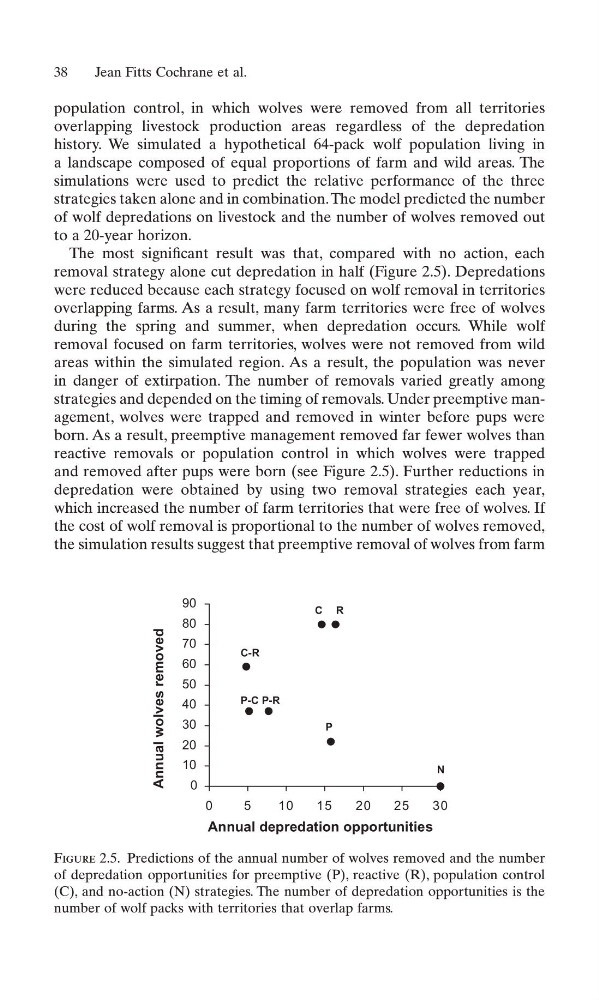
removal strategy alone cut depredation in half (Figure 2.5). Depredations
were reduced because each strategy focused on wolf removal in territories
overlapping farms. As a result, many farm territories were free of wolves
during the spring and summer, when depredation occurs. While wolf
removal focused on farm territories, wolves were not removed from wild
areas within the simulated region. As a result, the population was never
in danger of extirpation. The number of removals varied greatly among
strategies and depended on the timing of removals. Under preemptive management, wolves were trapped and removed in winter before pups were
born. As a result, preemptive management removed far fewer wolves than
reactive removals or population control in which wolves were trapped
and removed after pups were born (see Figure 2.5). Further reductions in
depredation were obtained by using two removal strategies each year,
which increased the number of farm territories that were free of wolves. If
the cost of wolf removal is proportional to the number of wolves removed,
the simulation results suggest that preemptive removal of wolves from farm
38
Jean Fitts Cochrane et al.
0
10
20
30
40
50
60
70
80
90
0
5
10
15
20
25
30
Annual depredation opportunities
Annual wolves removed
P
R
C
C-R
P-R
P-C
N
Figure 2.5. Predictions of the annual number of wolves removed and the number
of depredation opportunities for preemptive (P), reactive (R), population control
(C), and no-action (N) strategies. The number of depredation opportunities is the
number of wolf packs with territories that overlap farms.
overlapping livestock production areas regardless of the depredation
history. We simulated a hypothetical 64-pack wolf population living in
a landscape composed of equal proportions of farm and wild areas. The
simulations were used to predict the relative performance of the three
strategies taken alone and in combination. The model predicted the number
of wolf depredations on livestock and the number of wolves removed out
to a 20-year horizon.
The most significant result was that, compared with no action, each
removal strategy alone cut depredation in half (Figure 2.5). Depredations
were reduced because each strategy focused on wolf removal in territories
overlapping farms. As a result, many farm territories were free of wolves
during the spring and summer, when depredation occurs. While wolf
removal focused on farm territories, wolves were not removed from wild
areas within the simulated region. As a result, the population was never
in danger of extirpation. The number of removals varied greatly among
strategies and depended on the timing of removals. Under preemptive management, wolves were trapped and removed in winter before pups were
born. As a result, preemptive management removed far fewer wolves than
reactive removals or population control in which wolves were trapped
and removed after pups were born (see Figure 2.5). Further reductions in
depredation were obtained by using two removal strategies each year,
which increased the number of farm territories that were free of wolves. If
the cost of wolf removal is proportional to the number of wolves removed,
the simulation results suggest that preemptive removal of wolves from farm
38
Jean Fitts Cochrane et al.
0
10
20
30
40
50
60
70
80
90
0
5
10
15
20
25
30
Annual depredation opportunities
Annual wolves removed
P
R
C
C-R
P-R
P-C
N
Figure 2.5. Predictions of the annual number of wolves removed and the number
of depredation opportunities for preemptive (P), reactive (R), population control
(C), and no-action (N) strategies. The number of depredation opportunities is the
number of wolf packs with territories that overlap farms.