

2.3.4 Disturbance Effects on Gray Wolves inside
Voyageurs National Park
In addition to human-caused mortality of wolves outside Voyageurs
National Park, biologists were concerned about the impact of humans on
the behavior of wolves inside the park. For example, when disturbed by
humans, wolves sometimes move pups to alternative den sites and temporarily ignore prey. While examples of these responses to humans have
been observed in protected areas, their frequency and impact on wolf
demography at this park are not known. Cochrane (2000) used the wolf
population model to investigate how altered behavior of individual wolves
or packs, expressed as temporary changes in the demographic parameters
in the population model, might affect the persistence of wolves in the park.
The purpose was to provide park biologists with guidance on the magnitude
and frequency of disturbance events that could affect wolf population size.
To predict the relative impacts of different types of disturbances,
Cochrane (2000) simulated a wolf population that was assumed to occupy
34
Jean Fitts Cochrane et al.
Prey Biomass
0
10
20
30
40
50
60
70
80
90
100
Cum. % of Sims.
1
5
Level
Immigration
0
10
20
30
40
50
60
70
80
90
100
0 <2 <4 <6 <8 <10 <12 <14 <16 <18 18
Cum. % of Sims.
Lowest Population size
Take
Disease
0 <2 <4 <6 <8 <10 <12 <14 <16 <18 18
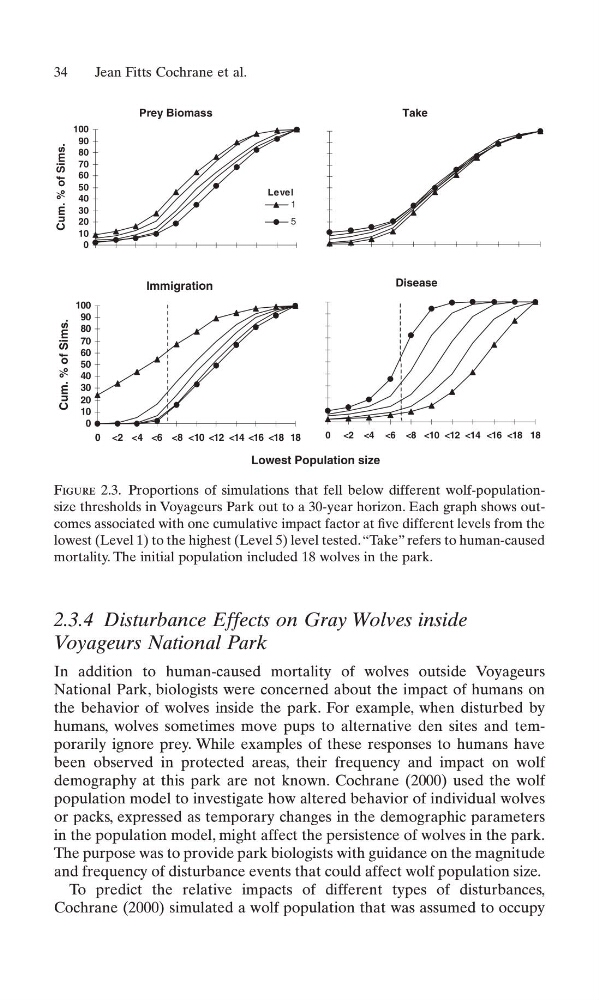
Figure 2.3. Proportions of simulations that fell below different wolf-populationsize thresholds in Voyageurs Park out to a 30-year horizon. Each graph shows outcomes associated with one cumulative impact factor at five different levels from the
lowest (Level 1) to the highest (Level 5) level tested. “Take” refers to human-caused
mortality. The initial population included 18 wolves in the park.
Voyageurs National Park
In addition to human-caused mortality of wolves outside Voyageurs
National Park, biologists were concerned about the impact of humans on
the behavior of wolves inside the park. For example, when disturbed by
humans, wolves sometimes move pups to alternative den sites and temporarily ignore prey. While examples of these responses to humans have
been observed in protected areas, their frequency and impact on wolf
demography at this park are not known. Cochrane (2000) used the wolf
population model to investigate how altered behavior of individual wolves
or packs, expressed as temporary changes in the demographic parameters
in the population model, might affect the persistence of wolves in the park.
The purpose was to provide park biologists with guidance on the magnitude
and frequency of disturbance events that could affect wolf population size.
To predict the relative impacts of different types of disturbances,
Cochrane (2000) simulated a wolf population that was assumed to occupy
34
Jean Fitts Cochrane et al.
Prey Biomass
0
10
20
30
40
50
60
70
80
90
100
Cum. % of Sims.
1
5
Level
Immigration
0
10
20
30
40
50
60
70
80
90
100
0 <2 <4 <6 <8 <10 <12 <14 <16 <18 18
Cum. % of Sims.
Lowest Population size
Take
Disease
0 <2 <4 <6 <8 <10 <12 <14 <16 <18 18
Figure 2.3. Proportions of simulations that fell below different wolf-populationsize thresholds in Voyageurs Park out to a 30-year horizon. Each graph shows outcomes associated with one cumulative impact factor at five different levels from the
lowest (Level 1) to the highest (Level 5) level tested. “Take” refers to human-caused
mortality. The initial population included 18 wolves in the park.