

14. Educational Investments
267
rules for assigning species into categories representing different levels
of threat. The IUCN rules are based on such characteristics as number
and distribution of individuals, fluctuations and decline in abundance
and distribution, and risk of extinction. These characteristics are used
as input data; the output is a classification into one of the categories,
such as critically endangered, endangered, vulnerable, near threatened, or least concern. These threatened-species categories are used
in the Red List of Threatened Species (www.redlist.org) and provide
an easily and widely understood method for highlighting those species
under higher extinction risk to focus attention on conservation measures designed to protect them. The categories are widely recognized
internationally, and they are now used in a whole range of publications and listings produced by the IUCN as well as by numerous
governmental and nongovernmental organizations (NGOs).
The software package RAMAS Red List (Akçakaya et al. 2001)
implements the rules as used by the IUCN and allows the user to
explicitly incorporate uncertainties in the input data. Input data,
such as the number of mature individuals, can be specified either as a
number or as a range of numbers, or as a range of numbers plus a best
estimate (Figure 14.1). The RAMAS Red List propagates the uncertainties by using fuzzy arithmetic [see Akçakaya et al. (2000) for the
details of the method of propagating uncertainty]. Depending on the
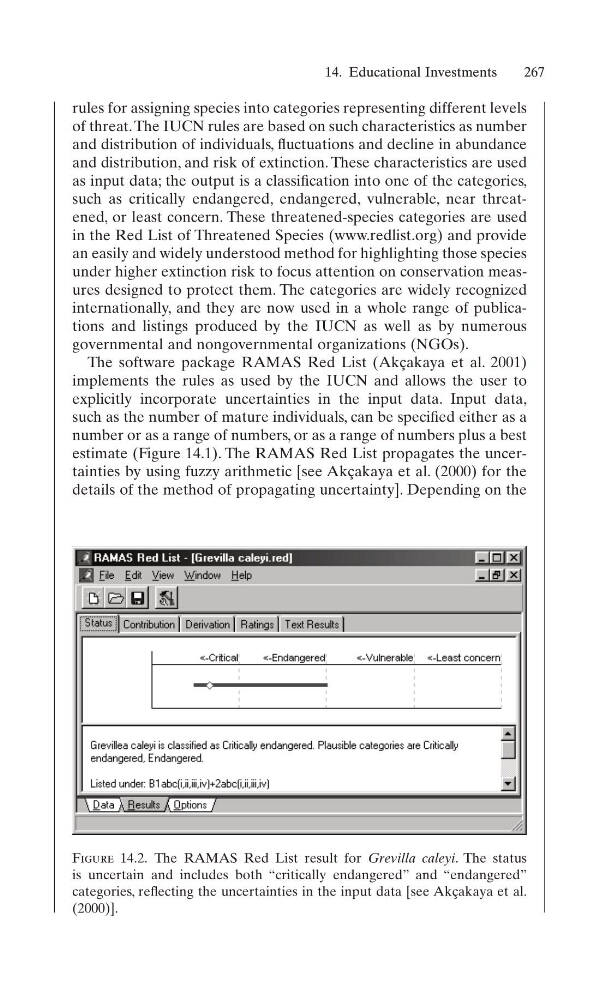
Figure 14.2. The RAMAS Red List result for Grevilla caleyi. The status
is uncertain and includes both “critically endangered” and “endangered”
categories, reflecting the uncertainties in the input data [see Akçakaya et al.
(2000)].
267
rules for assigning species into categories representing different levels
of threat. The IUCN rules are based on such characteristics as number
and distribution of individuals, fluctuations and decline in abundance
and distribution, and risk of extinction. These characteristics are used
as input data; the output is a classification into one of the categories,
such as critically endangered, endangered, vulnerable, near threatened, or least concern. These threatened-species categories are used
in the Red List of Threatened Species (www.redlist.org) and provide
an easily and widely understood method for highlighting those species
under higher extinction risk to focus attention on conservation measures designed to protect them. The categories are widely recognized
internationally, and they are now used in a whole range of publications and listings produced by the IUCN as well as by numerous
governmental and nongovernmental organizations (NGOs).
The software package RAMAS Red List (Akçakaya et al. 2001)
implements the rules as used by the IUCN and allows the user to
explicitly incorporate uncertainties in the input data. Input data,
such as the number of mature individuals, can be specified either as a
number or as a range of numbers, or as a range of numbers plus a best
estimate (Figure 14.1). The RAMAS Red List propagates the uncertainties by using fuzzy arithmetic [see Akçakaya et al. (2000) for the
details of the method of propagating uncertainty]. Depending on the
Figure 14.2. The RAMAS Red List result for Grevilla caleyi. The status
is uncertain and includes both “critically endangered” and “endangered”
categories, reflecting the uncertainties in the input data [see Akçakaya et al.
(2000)].