

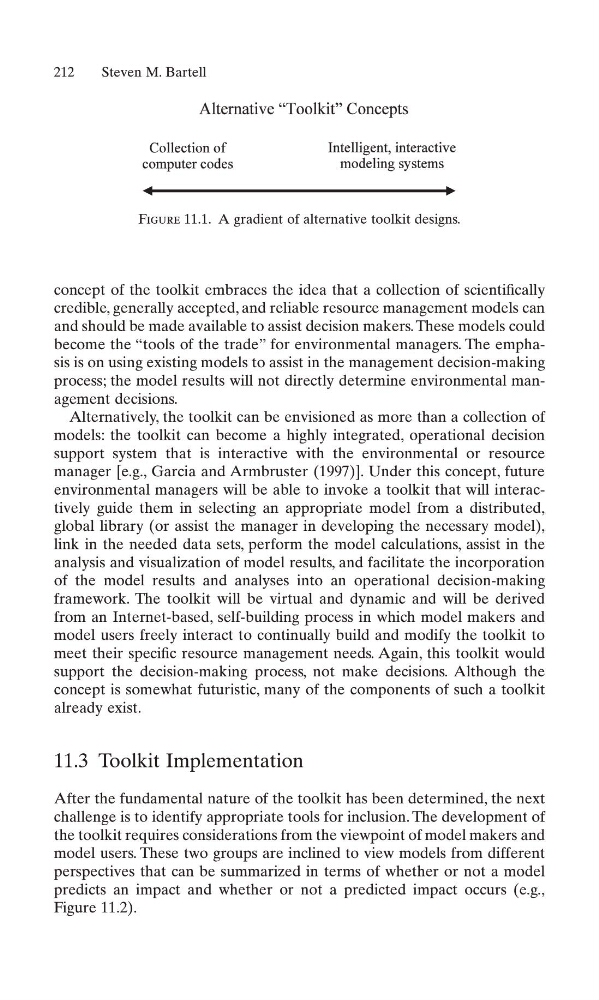
concept of the toolkit embraces the idea that a collection of scientifically
credible, generally accepted, and reliable resource management models can
and should be made available to assist decision makers. These models could
become the “tools of the trade” for environmental managers. The emphasis is on using existing models to assist in the management decision-making
process; the model results will not directly determine environmental management decisions.
Alternatively, the toolkit can be envisioned as more than a collection of
models: the toolkit can become a highly integrated, operational decision
support system that is interactive with the environmental or resource
manager [e.g., Garcia and Armbruster (1997)]. Under this concept, future
environmental managers will be able to invoke a toolkit that will interactively guide them in selecting an appropriate model from a distributed,
global library (or assist the manager in developing the necessary model),
link in the needed data sets, perform the model calculations, assist in the
analysis and visualization of model results, and facilitate the incorporation
of the model results and analyses into an operational decision-making
framework. The toolkit will be virtual and dynamic and will be derived
from an Internet-based, self-building process in which model makers and
model users freely interact to continually build and modify the toolkit to
meet their specific resource management needs. Again, this toolkit would
support the decision-making process, not make decisions. Although the
concept is somewhat futuristic, many of the components of such a toolkit
already exist.
11.3 Toolkit Implementation
After the fundamental nature of the toolkit has been determined, the next
challenge is to identify appropriate tools for inclusion. The development of
the toolkit requires considerations from the viewpoint of model makers and
model users. These two groups are inclined to view models from different
perspectives that can be summarized in terms of whether or not a model
predicts an impact and whether or not a predicted impact occurs (e.g.,
Figure 11.2).
212
Steven M. Bartell
Figure 11.1. A gradient of alternative toolkit designs.
credible, generally accepted, and reliable resource management models can
and should be made available to assist decision makers. These models could
become the “tools of the trade” for environmental managers. The emphasis is on using existing models to assist in the management decision-making
process; the model results will not directly determine environmental management decisions.
Alternatively, the toolkit can be envisioned as more than a collection of
models: the toolkit can become a highly integrated, operational decision
support system that is interactive with the environmental or resource
manager [e.g., Garcia and Armbruster (1997)]. Under this concept, future
environmental managers will be able to invoke a toolkit that will interactively guide them in selecting an appropriate model from a distributed,
global library (or assist the manager in developing the necessary model),
link in the needed data sets, perform the model calculations, assist in the
analysis and visualization of model results, and facilitate the incorporation
of the model results and analyses into an operational decision-making
framework. The toolkit will be virtual and dynamic and will be derived
from an Internet-based, self-building process in which model makers and
model users freely interact to continually build and modify the toolkit to
meet their specific resource management needs. Again, this toolkit would
support the decision-making process, not make decisions. Although the
concept is somewhat futuristic, many of the components of such a toolkit
already exist.
11.3 Toolkit Implementation
After the fundamental nature of the toolkit has been determined, the next
challenge is to identify appropriate tools for inclusion. The development of
the toolkit requires considerations from the viewpoint of model makers and
model users. These two groups are inclined to view models from different
perspectives that can be summarized in terms of whether or not a model
predicts an impact and whether or not a predicted impact occurs (e.g.,
Figure 11.2).
212
Steven M. Bartell
Figure 11.1. A gradient of alternative toolkit designs.