

restoration is possible, the financial resources might not be available, or the
economic or social stability of the area might be threatened by the change.
It is also necessary to recognize that every resource is not available in
any one place. Therefore, some governments have instituted laws to protect
water and air quality or endangered species and their habitats. These
regulations typically apply to land owned by the government or to
federally funded actions. As such, federal agencies are often the leaders in
developing tools for sustainable-management practices. Often, however, the
piecemeal protection of individual resources is not sufficient to retain a
unique and valuable suite of conditions. Thus, areas may be preserved with
the intent of sustaining natural resources, yet critical gaps in protection may
exist. For example, some of the territory required for long-term sustainability of a species (like breeding grounds or winter forage sites) may be in
jeopardy of degradation or change.
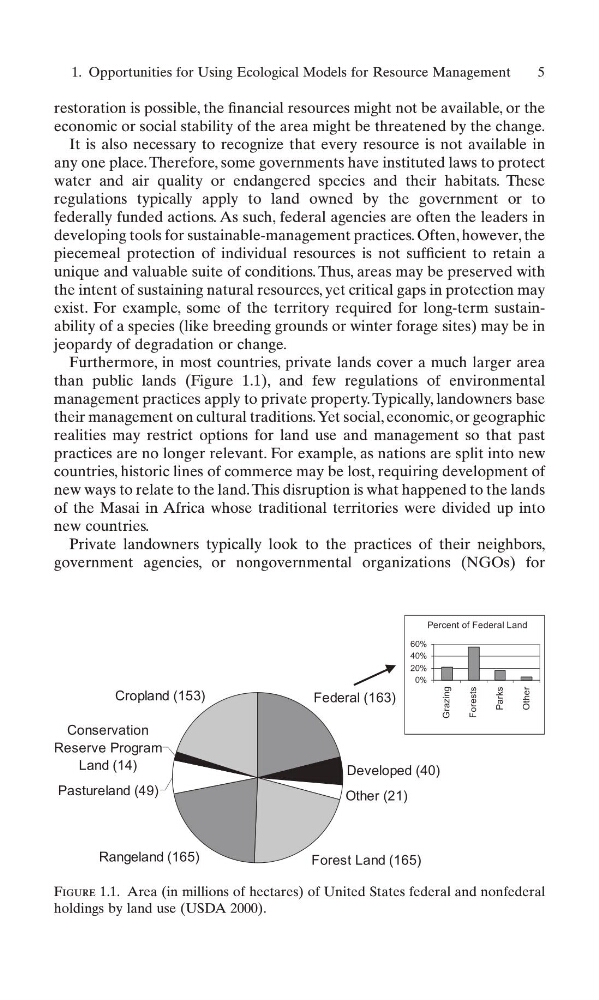
Furthermore, in most countries, private lands cover a much larger area
than public lands (Figure 1.1), and few regulations of environmental
management practices apply to private property. Typically, landowners base
their management on cultural traditions.Yet social, economic, or geographic
realities may restrict options for land use and management so that past
practices are no longer relevant. For example, as nations are split into new
countries, historic lines of commerce may be lost, requiring development of
new ways to relate to the land.This disruption is what happened to the lands
of the Masai in Africa whose traditional territories were divided up into
new countries.
Private landowners typically look to the practices of their neighbors,
government agencies, or nongovernmental organizations (NGOs) for
1. Opportunities for Using Ecological Models for Resource Management
5
Federal (163)
Developed (40)
Other (21)
Forest Land (165)
Rangeland (165)
Pastureland (49)
Conservation
Reserve Program
Land (14)
Cropland (153)
Percent of Federal Land
0%
20%
40%
60%
Grazing
Forests
Parks
Other
Figure 1.1. Area (in millions of hectares) of United States federal and nonfederal
holdings by land use (USDA 2000).
economic or social stability of the area might be threatened by the change.
It is also necessary to recognize that every resource is not available in
any one place. Therefore, some governments have instituted laws to protect
water and air quality or endangered species and their habitats. These
regulations typically apply to land owned by the government or to
federally funded actions. As such, federal agencies are often the leaders in
developing tools for sustainable-management practices. Often, however, the
piecemeal protection of individual resources is not sufficient to retain a
unique and valuable suite of conditions. Thus, areas may be preserved with
the intent of sustaining natural resources, yet critical gaps in protection may
exist. For example, some of the territory required for long-term sustainability of a species (like breeding grounds or winter forage sites) may be in
jeopardy of degradation or change.
Furthermore, in most countries, private lands cover a much larger area
than public lands (Figure 1.1), and few regulations of environmental
management practices apply to private property. Typically, landowners base
their management on cultural traditions.Yet social, economic, or geographic
realities may restrict options for land use and management so that past
practices are no longer relevant. For example, as nations are split into new
countries, historic lines of commerce may be lost, requiring development of
new ways to relate to the land.This disruption is what happened to the lands
of the Masai in Africa whose traditional territories were divided up into
new countries.
Private landowners typically look to the practices of their neighbors,
government agencies, or nongovernmental organizations (NGOs) for
1. Opportunities for Using Ecological Models for Resource Management
5
Federal (163)
Developed (40)
Other (21)
Forest Land (165)
Rangeland (165)
Pastureland (49)
Conservation
Reserve Program
Land (14)
Cropland (153)
Percent of Federal Land
0%
20%
40%
60%
Grazing
Forests
Parks
Other
Figure 1.1. Area (in millions of hectares) of United States federal and nonfederal
holdings by land use (USDA 2000).