

on a priori decisions and the spatial and temporal relevance of the sampling regime. Because field sampling is often expensive, there is usually
some optimization of the regime to be economically efficient. The field data
are then passed on to modelers, who build a representation of the real world
that is used in the decision-making process. Unfortunately, the models that
define and frame this information may or may not be built specifically for
the needs of the decision makers and managers. Unsatisfactory decisions
and outcomes can result from information and models not directly applicable to the problem.
Environmental assessment questions are often developed from existing
data (Berish et al. 1999). Using existing data may lead to poorly developed
questions, and developing environmental management decisions based on
these questions, existing data, and political subjectivity can lead to poor
decisions. Rarely are environmental management decisions made without
political considerations and inputs from the public (Walters 1986). As discussed by Dale (in press), the development of relevant questions, with
appropriate data feeding into the model, is a crucial first step.
Environmental managers often have a different background or experience than modelers do and are unable to help define explicitly useful
models. Modelers often do not have the political insight or desire to include
the decision-making process in an ecological process model. Sometimes the
difference in technical expertise that separates the environmental decision
makers from modelers is not the problem but a failure to communicate for
168
John R. Richardson and Cory W. Berish
Knowledge and Ability
DATA
DECISIONS
INFORMATION
REAL WORLD
F
F
F
Information
Data
Model 3
Model 2
Model 1
Work domain
Manager
Modeler
Field Technician
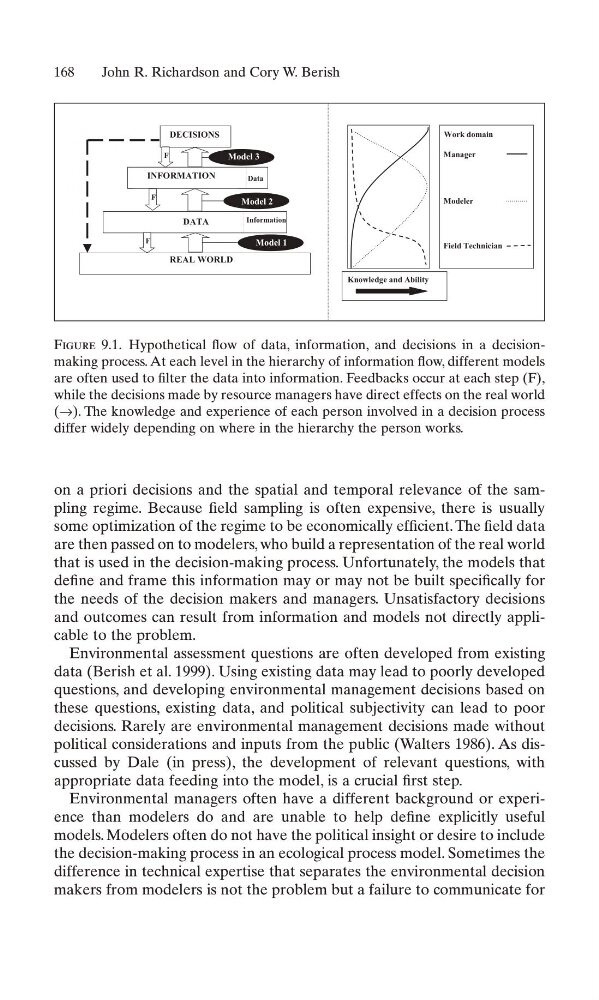
Figure 9.1. Hypothetical flow of data, information, and decisions in a decisionmaking process. At each level in the hierarchy of information flow, different models
are often used to filter the data into information. Feedbacks occur at each step (F),
while the decisions made by resource managers have direct effects on the real world
(Æ). The knowledge and experience of each person involved in a decision process
differ widely depending on where in the hierarchy the person works.
some optimization of the regime to be economically efficient. The field data
are then passed on to modelers, who build a representation of the real world
that is used in the decision-making process. Unfortunately, the models that
define and frame this information may or may not be built specifically for
the needs of the decision makers and managers. Unsatisfactory decisions
and outcomes can result from information and models not directly applicable to the problem.
Environmental assessment questions are often developed from existing
data (Berish et al. 1999). Using existing data may lead to poorly developed
questions, and developing environmental management decisions based on
these questions, existing data, and political subjectivity can lead to poor
decisions. Rarely are environmental management decisions made without
political considerations and inputs from the public (Walters 1986). As discussed by Dale (in press), the development of relevant questions, with
appropriate data feeding into the model, is a crucial first step.
Environmental managers often have a different background or experience than modelers do and are unable to help define explicitly useful
models. Modelers often do not have the political insight or desire to include
the decision-making process in an ecological process model. Sometimes the
difference in technical expertise that separates the environmental decision
makers from modelers is not the problem but a failure to communicate for
168
John R. Richardson and Cory W. Berish
Knowledge and Ability
DATA
DECISIONS
INFORMATION
REAL WORLD
F
F
F
Information
Data
Model 3
Model 2
Model 1
Work domain
Manager
Modeler
Field Technician
Figure 9.1. Hypothetical flow of data, information, and decisions in a decisionmaking process. At each level in the hierarchy of information flow, different models
are often used to filter the data into information. Feedbacks occur at each step (F),
while the decisions made by resource managers have direct effects on the real world
(Æ). The knowledge and experience of each person involved in a decision process
differ widely depending on where in the hierarchy the person works.