

the site-specific specializations can be delegated to a separate modelconfiguration phase. Examples of declarative-modeling formalisms include
the Simulation Module Markup Language (SMML) (Maxwell 1999;
Maxwell and Costanza 1997b), the Integrated Modeling Architecture being
developed at the University of Maryland, and the Modelica modeling language being developed by EUROSIM (Federation of European Simulation
Societies; http://ws3.atv.tuwien.ac.at/eurosim/).
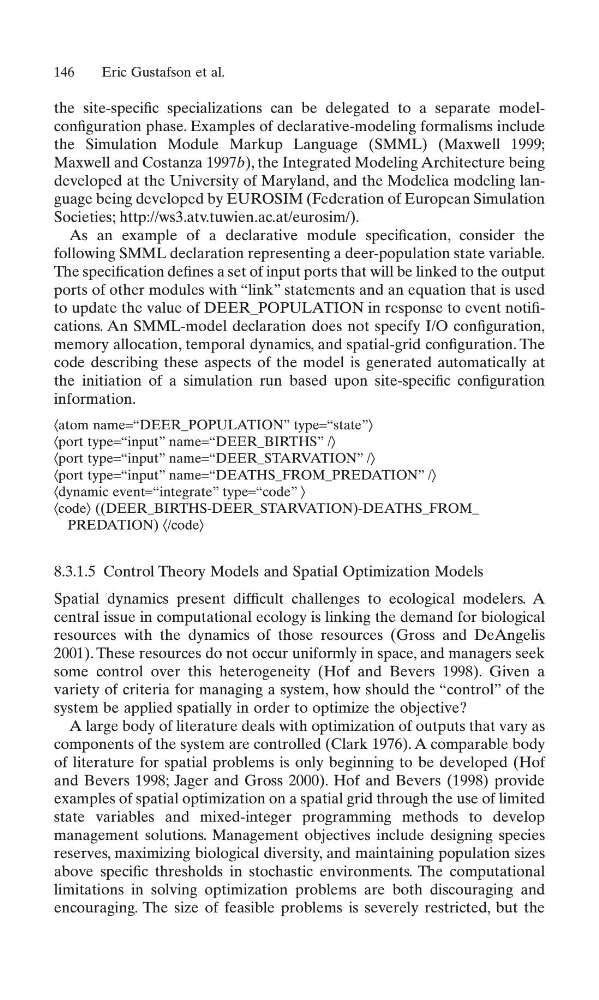
As an example of a declarative module specification, consider the
following SMML declaration representing a deer-population state variable.
The specification defines a set of input ports that will be linked to the output
ports of other modules with “link” statements and an equation that is used
to update the value of DEER_POPULATION in response to event notifications. An SMML-model declaration does not specify I/O configuration,
memory allocation, temporal dynamics, and spatial-grid configuration. The
code describing these aspects of the model is generated automatically at
the initiation of a simulation run based upon site-specific configuration
information.
·atom name=“DEER_POPULATION” type=“state”Ò
·port type=“input” name=“DEER_BIRTHS” /Ò
·port type=“input” name=“DEER_STARVATION” /Ò
·port type=“input” name=“DEATHS_FROM_PREDATION” /Ò
·dynamic event=“integrate” type=“code” Ò
·codeÒ ((DEER_BIRTHS-DEER_STARVATION)-DEATHS_FROM_
PREDATION) ·/codeÒ
8.3.1.5 Control Theory Models and Spatial Optimization Models
Spatial dynamics present difficult challenges to ecological modelers. A
central issue in computational ecology is linking the demand for biological
resources with the dynamics of those resources (Gross and DeAngelis
2001). These resources do not occur uniformly in space, and managers seek
some control over this heterogeneity (Hof and Bevers 1998). Given a
variety of criteria for managing a system, how should the “control” of the
system be applied spatially in order to optimize the objective?
A large body of literature deals with optimization of outputs that vary as
components of the system are controlled (Clark 1976). A comparable body
of literature for spatial problems is only beginning to be developed (Hof
and Bevers 1998; Jager and Gross 2000). Hof and Bevers (1998) provide
examples of spatial optimization on a spatial grid through the use of limited
state variables and mixed-integer programming methods to develop
management solutions. Management objectives include designing species
reserves, maximizing biological diversity, and maintaining population sizes
above specific thresholds in stochastic environments. The computational
limitations in solving optimization problems are both discouraging and
encouraging. The size of feasible problems is severely restricted, but the
146
Eric Gustafson et al.
the Simulation Module Markup Language (SMML) (Maxwell 1999;
Maxwell and Costanza 1997b), the Integrated Modeling Architecture being
developed at the University of Maryland, and the Modelica modeling language being developed by EUROSIM (Federation of European Simulation
Societies; http://ws3.atv.tuwien.ac.at/eurosim/).
As an example of a declarative module specification, consider the
following SMML declaration representing a deer-population state variable.
The specification defines a set of input ports that will be linked to the output
ports of other modules with “link” statements and an equation that is used
to update the value of DEER_POPULATION in response to event notifications. An SMML-model declaration does not specify I/O configuration,
memory allocation, temporal dynamics, and spatial-grid configuration. The
code describing these aspects of the model is generated automatically at
the initiation of a simulation run based upon site-specific configuration
information.
·atom name=“DEER_POPULATION” type=“state”Ò
·port type=“input” name=“DEER_BIRTHS” /Ò
·port type=“input” name=“DEER_STARVATION” /Ò
·port type=“input” name=“DEATHS_FROM_PREDATION” /Ò
·dynamic event=“integrate” type=“code” Ò
·codeÒ ((DEER_BIRTHS-DEER_STARVATION)-DEATHS_FROM_
PREDATION) ·/codeÒ
8.3.1.5 Control Theory Models and Spatial Optimization Models
Spatial dynamics present difficult challenges to ecological modelers. A
central issue in computational ecology is linking the demand for biological
resources with the dynamics of those resources (Gross and DeAngelis
2001). These resources do not occur uniformly in space, and managers seek
some control over this heterogeneity (Hof and Bevers 1998). Given a
variety of criteria for managing a system, how should the “control” of the
system be applied spatially in order to optimize the objective?
A large body of literature deals with optimization of outputs that vary as
components of the system are controlled (Clark 1976). A comparable body
of literature for spatial problems is only beginning to be developed (Hof
and Bevers 1998; Jager and Gross 2000). Hof and Bevers (1998) provide
examples of spatial optimization on a spatial grid through the use of limited
state variables and mixed-integer programming methods to develop
management solutions. Management objectives include designing species
reserves, maximizing biological diversity, and maintaining population sizes
above specific thresholds in stochastic environments. The computational
limitations in solving optimization problems are both discouraging and
encouraging. The size of feasible problems is severely restricted, but the
146
Eric Gustafson et al.