

uses different habitats for spawning, rearing, feeding, and refuge, and
no single model type is presently adequate to simulate its movement
behavior. The Eulerian module is a 2-D (laterally averaged) water-quality
model that is used to describe hydraulic and water-quality time histories in
a grid framework. The Lagrangian module is a fish-movement model that
emulates swim-path-selection behavior by the blueback herring in continuous space. The NFS is the coupling module that interpolates and translates
information between the Eulerian and Lagrangian modules so that the
strengths of each modeling reference framework can be effectively
employed. Coupled models offer the potential to increase the accuracy of
model predictions because an optimum reference framework can be used
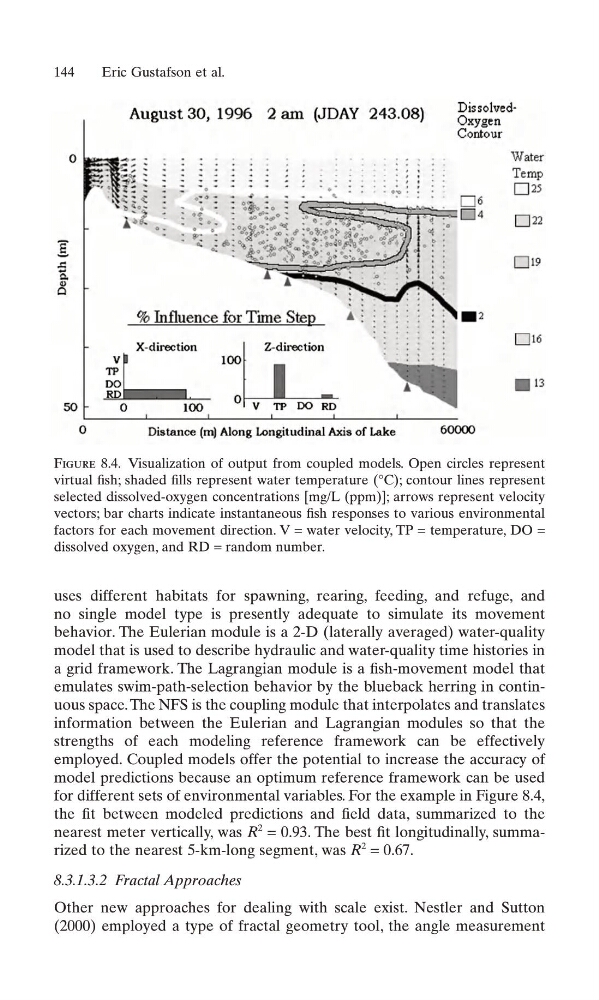
for different sets of environmental variables. For the example in Figure 8.4,
the fit between modeled predictions and field data, summarized to the
nearest meter vertically, was R
2
= 0.93. The best fit longitudinally, summarized to the nearest 5-km-long segment, was R
2
= 0.67.
8.3.1.3.2 Fractal Approaches
Other new approaches for dealing with scale exist. Nestler and Sutton
(2000) employed a type of fractal geometry tool, the angle measurement
144
Eric Gustafson et al.
Figure 8.4. Visualization of output from coupled models. Open circles represent
virtual fish; shaded fills represent water temperature (°C); contour lines represent
selected dissolved-oxygen concentrations [mg/L (ppm)]; arrows represent velocity
vectors; bar charts indicate instantaneous fish responses to various environmental
factors for each movement direction. V = water velocity, TP = temperature, DO =
dissolved oxygen, and RD = random number.
no single model type is presently adequate to simulate its movement
behavior. The Eulerian module is a 2-D (laterally averaged) water-quality
model that is used to describe hydraulic and water-quality time histories in
a grid framework. The Lagrangian module is a fish-movement model that
emulates swim-path-selection behavior by the blueback herring in continuous space. The NFS is the coupling module that interpolates and translates
information between the Eulerian and Lagrangian modules so that the
strengths of each modeling reference framework can be effectively
employed. Coupled models offer the potential to increase the accuracy of
model predictions because an optimum reference framework can be used
for different sets of environmental variables. For the example in Figure 8.4,
the fit between modeled predictions and field data, summarized to the
nearest meter vertically, was R
2
= 0.93. The best fit longitudinally, summarized to the nearest 5-km-long segment, was R
2
= 0.67.
8.3.1.3.2 Fractal Approaches
Other new approaches for dealing with scale exist. Nestler and Sutton
(2000) employed a type of fractal geometry tool, the angle measurement
144
Eric Gustafson et al.
Figure 8.4. Visualization of output from coupled models. Open circles represent
virtual fish; shaded fills represent water temperature (°C); contour lines represent
selected dissolved-oxygen concentrations [mg/L (ppm)]; arrows represent velocity
vectors; bar charts indicate instantaneous fish responses to various environmental
factors for each movement direction. V = water velocity, TP = temperature, DO =
dissolved oxygen, and RD = random number.