

8.3.1.3.1 Coupled Eulerian–Lagrangian Hybrid Models
Ecological-simulation approaches can be broadly separated into those
using an Eulerian-reference framework and those using a Lagrangianreference framework. In an Eulerian-reference framework, a modeler
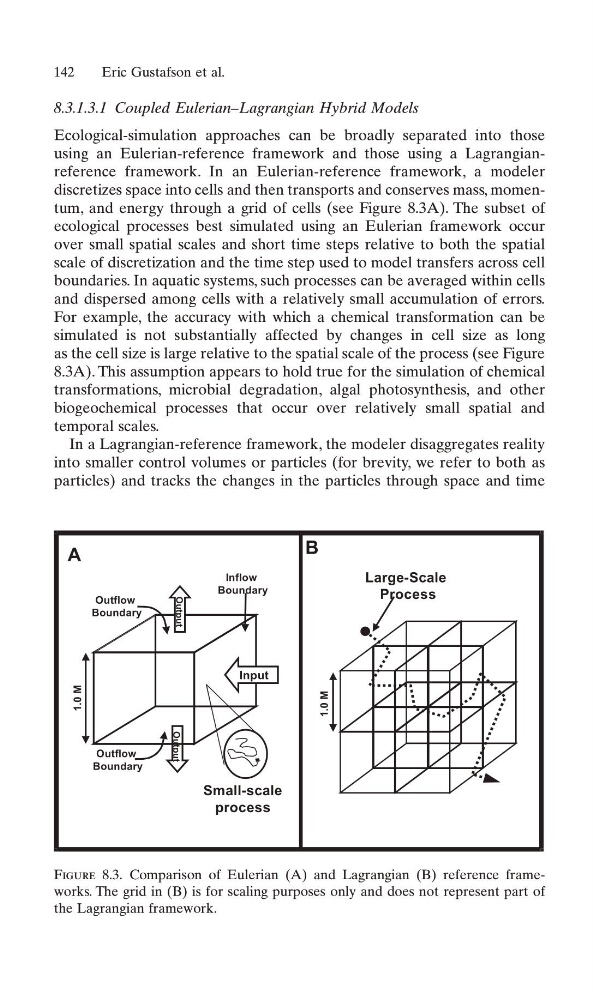
discretizes space into cells and then transports and conserves mass, momentum, and energy through a grid of cells (see Figure 8.3A). The subset of
ecological processes best simulated using an Eulerian framework occur
over small spatial scales and short time steps relative to both the spatial
scale of discretization and the time step used to model transfers across cell
boundaries. In aquatic systems, such processes can be averaged within cells
and dispersed among cells with a relatively small accumulation of errors.
For example, the accuracy with which a chemical transformation can be
simulated is not substantially affected by changes in cell size as long
as the cell size is large relative to the spatial scale of the process (see Figure
8.3A). This assumption appears to hold true for the simulation of chemical
transformations, microbial degradation, algal photosynthesis, and other
biogeochemical processes that occur over relatively small spatial and
temporal scales.
In a Lagrangian-reference framework, the modeler disaggregates reality
into smaller control volumes or particles (for brevity, we refer to both as
particles) and tracks the changes in the particles through space and time
142
Eric Gustafson et al.
Input
Inflow
Boundary
Outflow
Boundary
Outflow
Boundary
Output Output
Small-scale
process
Large-Scale
Process
1.0 M
1.0 M
A
B
Figure 8.3. Comparison of Eulerian (A) and Lagrangian (B) reference frameworks. The grid in (B) is for scaling purposes only and does not represent part of
the Lagrangian framework.
Ecological-simulation approaches can be broadly separated into those
using an Eulerian-reference framework and those using a Lagrangianreference framework. In an Eulerian-reference framework, a modeler
discretizes space into cells and then transports and conserves mass, momentum, and energy through a grid of cells (see Figure 8.3A). The subset of
ecological processes best simulated using an Eulerian framework occur
over small spatial scales and short time steps relative to both the spatial
scale of discretization and the time step used to model transfers across cell
boundaries. In aquatic systems, such processes can be averaged within cells
and dispersed among cells with a relatively small accumulation of errors.
For example, the accuracy with which a chemical transformation can be
simulated is not substantially affected by changes in cell size as long
as the cell size is large relative to the spatial scale of the process (see Figure
8.3A). This assumption appears to hold true for the simulation of chemical
transformations, microbial degradation, algal photosynthesis, and other
biogeochemical processes that occur over relatively small spatial and
temporal scales.
In a Lagrangian-reference framework, the modeler disaggregates reality
into smaller control volumes or particles (for brevity, we refer to both as
particles) and tracks the changes in the particles through space and time
142
Eric Gustafson et al.
Input
Inflow
Boundary
Outflow
Boundary
Outflow
Boundary
Output Output
Small-scale
process
Large-Scale
Process
1.0 M
1.0 M
A
B
Figure 8.3. Comparison of Eulerian (A) and Lagrangian (B) reference frameworks. The grid in (B) is for scaling purposes only and does not represent part of
the Lagrangian framework.