

5.3 Summary
Several key criteria can be proposed for successfully using models in
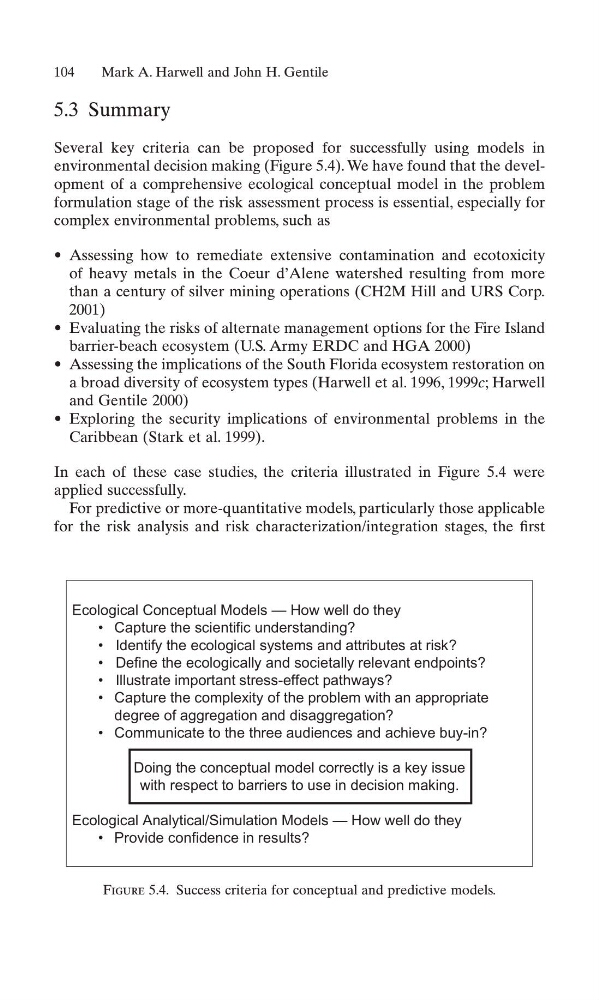
environmental decision making (Figure 5.4). We have found that the development of a comprehensive ecological conceptual model in the problem
formulation stage of the risk assessment process is essential, especially for
complex environmental problems, such as
• Assessing how to remediate extensive contamination and ecotoxicity
of heavy metals in the Coeur d’Alene watershed resulting from more
than a century of silver mining operations (CH2M Hill and URS Corp.
2001)
• Evaluating the risks of alternate management options for the Fire Island
barrier-beach ecosystem (U.S. Army ERDC and HGA 2000)
• Assessing the implications of the South Florida ecosystem restoration on
a broad diversity of ecosystem types (Harwell et al. 1996, 1999c; Harwell
and Gentile 2000)
• Exploring the security implications of environmental problems in the
Caribbean (Stark et al. 1999).
In each of these case studies, the criteria illustrated in Figure 5.4 were
applied successfully.
For predictive or more-quantitative models, particularly those applicable
for the risk analysis and risk characterization/integration stages, the first
104
Mark A. Harwell and John H. Gentile
Ecological Conceptual Models — How well do they
• Capture the scientific understanding?
• Identify the ecological systems and attributes at risk?
• Define the ecologically and societally relevant endpoints?
• Illustrate important stress-effect pathways?
• Capture the complexity of the problem with an appropriate
degree of aggregation and disaggregation?
• Communicate to the three audiences and achieve buy-in?
Doing the conceptual model correctly is a key issue
with respect to barriers to use in decision making.
Ecological Analytical/Simulation Models — How well do they
• Provide confidence in results?
Figure 5.4. Success criteria for conceptual and predictive models.
Several key criteria can be proposed for successfully using models in
environmental decision making (Figure 5.4). We have found that the development of a comprehensive ecological conceptual model in the problem
formulation stage of the risk assessment process is essential, especially for
complex environmental problems, such as
• Assessing how to remediate extensive contamination and ecotoxicity
of heavy metals in the Coeur d’Alene watershed resulting from more
than a century of silver mining operations (CH2M Hill and URS Corp.
2001)
• Evaluating the risks of alternate management options for the Fire Island
barrier-beach ecosystem (U.S. Army ERDC and HGA 2000)
• Assessing the implications of the South Florida ecosystem restoration on
a broad diversity of ecosystem types (Harwell et al. 1996, 1999c; Harwell
and Gentile 2000)
• Exploring the security implications of environmental problems in the
Caribbean (Stark et al. 1999).
In each of these case studies, the criteria illustrated in Figure 5.4 were
applied successfully.
For predictive or more-quantitative models, particularly those applicable
for the risk analysis and risk characterization/integration stages, the first
104
Mark A. Harwell and John H. Gentile
Ecological Conceptual Models — How well do they
• Capture the scientific understanding?
• Identify the ecological systems and attributes at risk?
• Define the ecologically and societally relevant endpoints?
• Illustrate important stress-effect pathways?
• Capture the complexity of the problem with an appropriate
degree of aggregation and disaggregation?
• Communicate to the three audiences and achieve buy-in?
Doing the conceptual model correctly is a key issue
with respect to barriers to use in decision making.
Ecological Analytical/Simulation Models — How well do they
• Provide confidence in results?
Figure 5.4. Success criteria for conceptual and predictive models.