

Podani: N ¼
a þ b À c
j
j
a þ b þ c
if a > 0 and N ¼ 0 if a ¼ 0
Baselga: Nes BJ ¼
b À c
j
j
a þ b þ c
Â
a
a þ 2min b; c
ð Þ
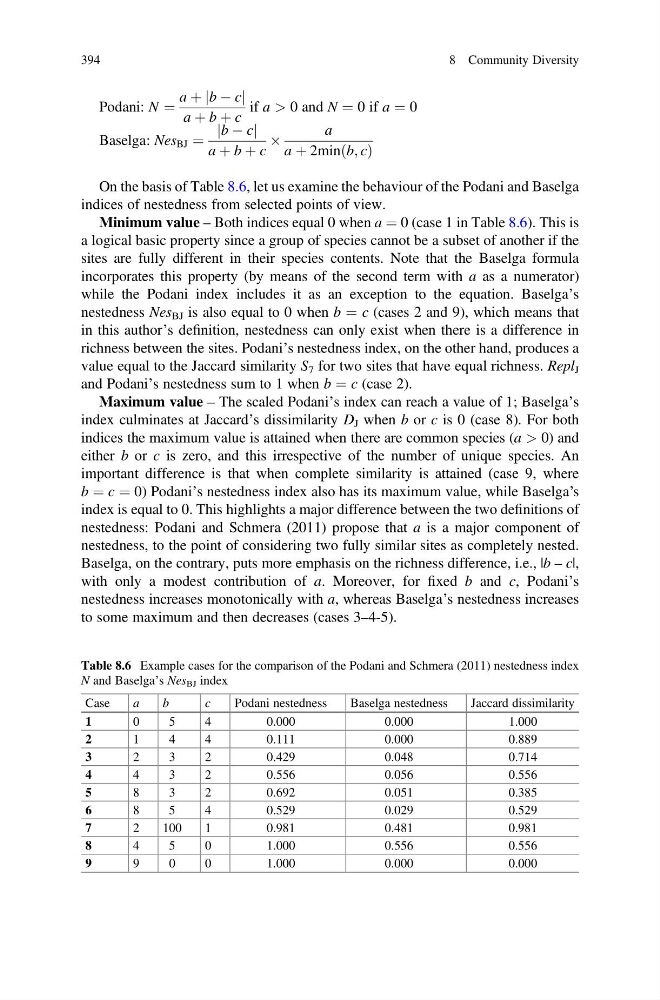
On the basis of Table 8.6, let us examine the behaviour of the Podani and Baselga
indices of nestedness from selected points of view.
Minimum value – Both indices equal 0 when a ¼ 0 (case 1 in Table 8.6). This is
a logical basic property since a group of species cannot be a subset of another if the
sites are fully different in their species contents. Note that the Baselga formula
incorporates this property (by means of the second term with a as a numerator)
while the Podani index includes it as an exception to the equation. Baselga’s
nestedness Nes BJ is also equal to 0 when b ¼ c (cases 2 and 9), which means that
in this author’s definition, nestedness can only exist when there is a difference in
richness between the sites. Podani’s nestedness index, on the other hand, produces a
value equal to the Jaccard similarity S 7 for two sites that have equal richness. Repl J
and Podani’s nestedness sum to 1 when b ¼ c (case 2).
Maximum value – The scaled Podani’s index can reach a value of 1; Baselga’s
index culminates at Jaccard’s dissimilarity D J when b or c is 0 (case 8). For both
indices the maximum value is attained when there are common species (a > 0) and
either b or c is zero, and this irrespective of the number of unique species. An
important difference is that when complete similarity is attained (case 9, where
b ¼ c ¼ 0) Podani’s nestedness index also has its maximum value, while Baselga’s
index is equal to 0. This highlights a major difference between the two definitions of
nestedness: Podani and Schmera (2011) propose that a is a major component of
nestedness, to the point of considering two fully similar sites as completely nested.
Baselga, on the contrary, puts more emphasis on the richness difference, i.e., |b – c|,
with only a modest contribution of a. Moreover, for fixed b and c, Podani’s
nestedness increases monotonically with a, whereas Baselga’s nestedness increases
to some maximum and then decreases (cases 3–4-5).
Table 8.6 Example cases for the comparison of the Podani and Schmera (2011) nestedness index
N and Baselga’s Nes BJ index
Case
a
b
c
Podani nestedness
Baselga nestedness
Jaccard dissimilarity
1
0
5
4
0.000
0.000
1.000
2
1
4
4
0.111
0.000
0.889
3
2
3
2
0.429
0.048
0.714
4
4
3
2
0.556
0.056
0.556
5
8
3
2
0.692
0.051
0.385
6
8
5
4
0.529
0.029
0.529
7
2
100
1
0.981
0.481
0.981
8
4
5
0
1.000
0.556
0.556
9
9
0
0
1.000
0.000
0.000
394
8 Community Diversity
a þ b À c
j
j
a þ b þ c
if a > 0 and N ¼ 0 if a ¼ 0
Baselga: Nes BJ ¼
b À c
j
j
a þ b þ c
Â
a
a þ 2min b; c
ð Þ
On the basis of Table 8.6, let us examine the behaviour of the Podani and Baselga
indices of nestedness from selected points of view.
Minimum value – Both indices equal 0 when a ¼ 0 (case 1 in Table 8.6). This is
a logical basic property since a group of species cannot be a subset of another if the
sites are fully different in their species contents. Note that the Baselga formula
incorporates this property (by means of the second term with a as a numerator)
while the Podani index includes it as an exception to the equation. Baselga’s
nestedness Nes BJ is also equal to 0 when b ¼ c (cases 2 and 9), which means that
in this author’s definition, nestedness can only exist when there is a difference in
richness between the sites. Podani’s nestedness index, on the other hand, produces a
value equal to the Jaccard similarity S 7 for two sites that have equal richness. Repl J
and Podani’s nestedness sum to 1 when b ¼ c (case 2).
Maximum value – The scaled Podani’s index can reach a value of 1; Baselga’s
index culminates at Jaccard’s dissimilarity D J when b or c is 0 (case 8). For both
indices the maximum value is attained when there are common species (a > 0) and
either b or c is zero, and this irrespective of the number of unique species. An
important difference is that when complete similarity is attained (case 9, where
b ¼ c ¼ 0) Podani’s nestedness index also has its maximum value, while Baselga’s
index is equal to 0. This highlights a major difference between the two definitions of
nestedness: Podani and Schmera (2011) propose that a is a major component of
nestedness, to the point of considering two fully similar sites as completely nested.
Baselga, on the contrary, puts more emphasis on the richness difference, i.e., |b – c|,
with only a modest contribution of a. Moreover, for fixed b and c, Podani’s
nestedness increases monotonically with a, whereas Baselga’s nestedness increases
to some maximum and then decreases (cases 3–4-5).
Table 8.6 Example cases for the comparison of the Podani and Schmera (2011) nestedness index
N and Baselga’s Nes BJ index
Case
a
b
c
Podani nestedness
Baselga nestedness
Jaccard dissimilarity
1
0
5
4
0.000
0.000
1.000
2
1
4
4
0.111
0.000
0.889
3
2
3
2
0.429
0.048
0.714
4
4
3
2
0.556
0.056
0.556
5
8
3
2
0.692
0.051
0.385
6
8
5
4
0.529
0.029
0.529
7
2
100
1
0.981
0.481
0.981
8
4
5
0
1.000
0.556
0.556
9
9
0
0
1.000
0.000
0.000
394
8 Community Diversity