

clockwise:
D ¼ BA'C or D ¼ Q'L'R
(6.1)
counter-clockwise:
D ¼ C'AB' or D ¼ R'LQ
(6.2)
Numerical examples, as well as explanations about the χ
2 , G, F or Pearson
r statistics used in the tests, can be found in Legendre and Legendre (2012 Sect.
10.6). The permutation models are the following, considering matrix L (or A) with
observations in the rows and species as columns:
• Model 1: environmental control over individual species. Permute the data within
each column of matrix L (or A) independently. This destroys the links between
L and Q (or A and B) as well as between L and R (or A and C). The null
hypothesis H 0 states that individuals of a species are randomly distributed with
respect to the site conditions.
• Model 2: environmental control over species assemblages. Permute entire rows
of matrix L (A). H 0 states that the species compositions of the sites are unrelated
to the environmental conditions. This model considers that species assemblages
must be taken as whole entities, which are preserved through the permutations,
and react as such to environmental constraints.
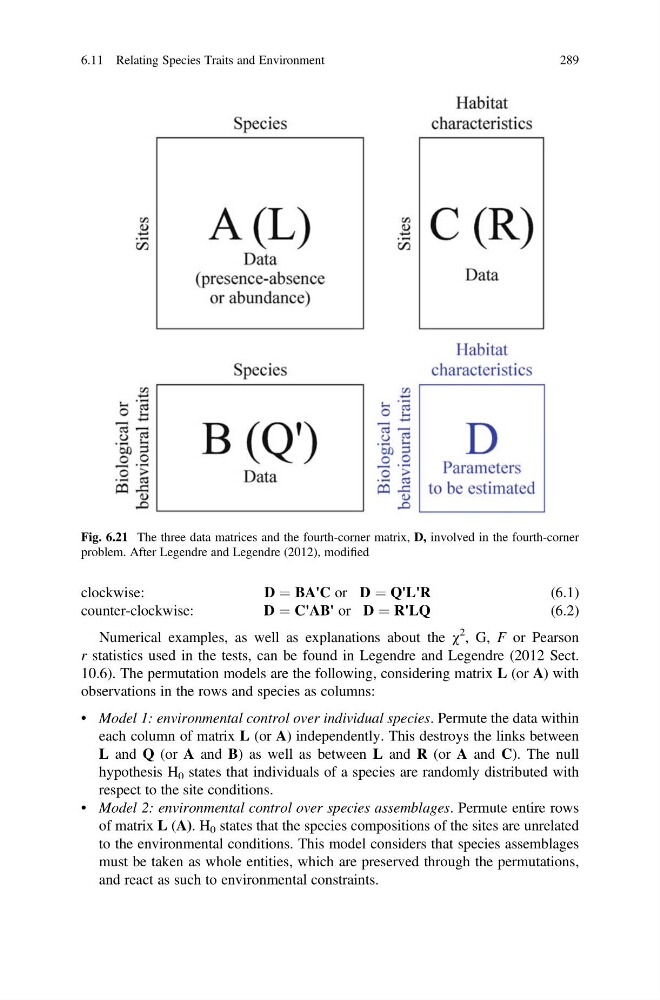
Fig. 6.21 The three data matrices and the fourth-corner matrix, D, involved in the fourth-corner
problem. After Legendre and Legendre (2012), modified
6.11 Relating Species Traits and Environment
289
D ¼ BA'C or D ¼ Q'L'R
(6.1)
counter-clockwise:
D ¼ C'AB' or D ¼ R'LQ
(6.2)
Numerical examples, as well as explanations about the χ
2 , G, F or Pearson
r statistics used in the tests, can be found in Legendre and Legendre (2012 Sect.
10.6). The permutation models are the following, considering matrix L (or A) with
observations in the rows and species as columns:
• Model 1: environmental control over individual species. Permute the data within
each column of matrix L (or A) independently. This destroys the links between
L and Q (or A and B) as well as between L and R (or A and C). The null
hypothesis H 0 states that individuals of a species are randomly distributed with
respect to the site conditions.
• Model 2: environmental control over species assemblages. Permute entire rows
of matrix L (A). H 0 states that the species compositions of the sites are unrelated
to the environmental conditions. This model considers that species assemblages
must be taken as whole entities, which are preserved through the permutations,
and react as such to environmental constraints.
Fig. 6.21 The three data matrices and the fourth-corner matrix, D, involved in the fourth-corner
problem. After Legendre and Legendre (2012), modified
6.11 Relating Species Traits and Environment
289