

know if all groups of species (called “judges” in the original paper) are globally
significantly associated. If it is the case, we shall run post hoc tests (kendall.
post()) on the species of each group to verify if all species within a group are
concordant
3 .
# Transformation of species data and transposition
spe.hel <- decostand(spe, "hellinger")
spe.std <- decostand(spe.hel, "standardize")
spe.t <- t(spe.std)
We can run a first test of Kendall concordance involving all species:
(spe.kendall.global1 <- kendall.global(spe.hel))
5
1 0
1 5
2 0
2 5
K-means partitions comparison
Objects
Number of groups in each partition
2
3
4
5
6
7
8
9
11
13
15
calinski
criterion
Values
2
3
4
5
6
7
8
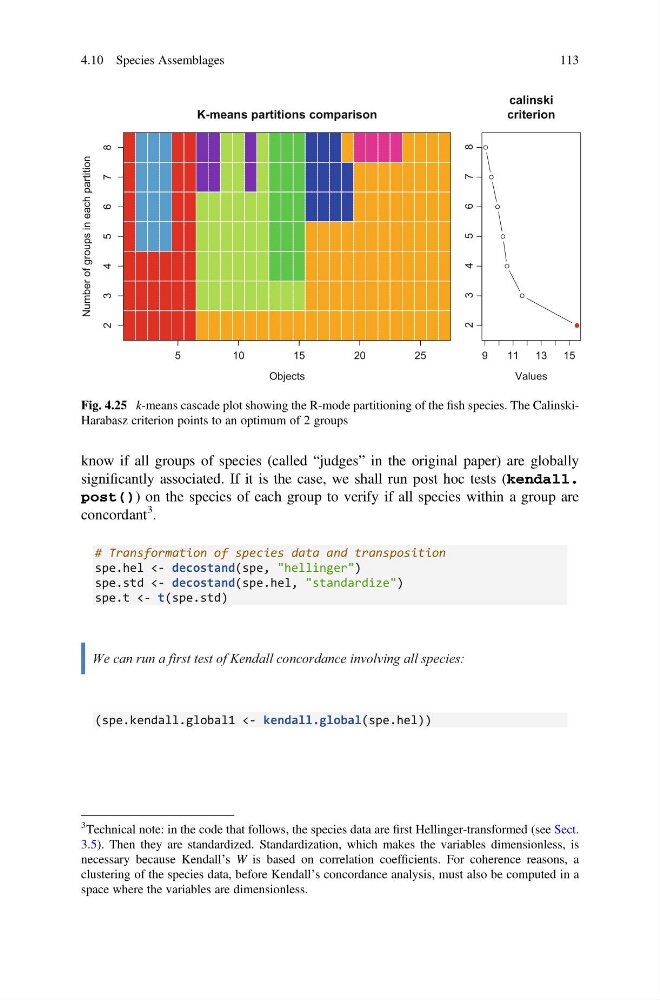
Fig. 4.25 k-means cascade plot showing the R-mode partitioning of the fish species. The CalinskiHarabasz criterion points to an optimum of 2 groups
3 Technical note: in the code that follows, the species data are first Hellinger-transformed (see Sect.
3.5). Then they are standardized. Standardization, which makes the variables dimensionless, is
necessary because Kendall’s W is based on correlation coefficients. For coherence reasons, a
clustering of the species data, before Kendall’s concordance analysis, must also be computed in a
space where the variables are dimensionless.
4.10 Species Assemblages
113
significantly associated. If it is the case, we shall run post hoc tests (kendall.
post()) on the species of each group to verify if all species within a group are
concordant
3 .
# Transformation of species data and transposition
spe.hel <- decostand(spe, "hellinger")
spe.std <- decostand(spe.hel, "standardize")
spe.t <- t(spe.std)
We can run a first test of Kendall concordance involving all species:
(spe.kendall.global1 <- kendall.global(spe.hel))
5
1 0
1 5
2 0
2 5
K-means partitions comparison
Objects
Number of groups in each partition
2
3
4
5
6
7
8
9
11
13
15
calinski
criterion
Values
2
3
4
5
6
7
8
Fig. 4.25 k-means cascade plot showing the R-mode partitioning of the fish species. The CalinskiHarabasz criterion points to an optimum of 2 groups
3 Technical note: in the code that follows, the species data are first Hellinger-transformed (see Sect.
3.5). Then they are standardized. Standardization, which makes the variables dimensionless, is
necessary because Kendall’s W is based on correlation coefficients. For coherence reasons, a
clustering of the species data, before Kendall’s concordance analysis, must also be computed in a
space where the variables are dimensionless.
4.10 Species Assemblages
113